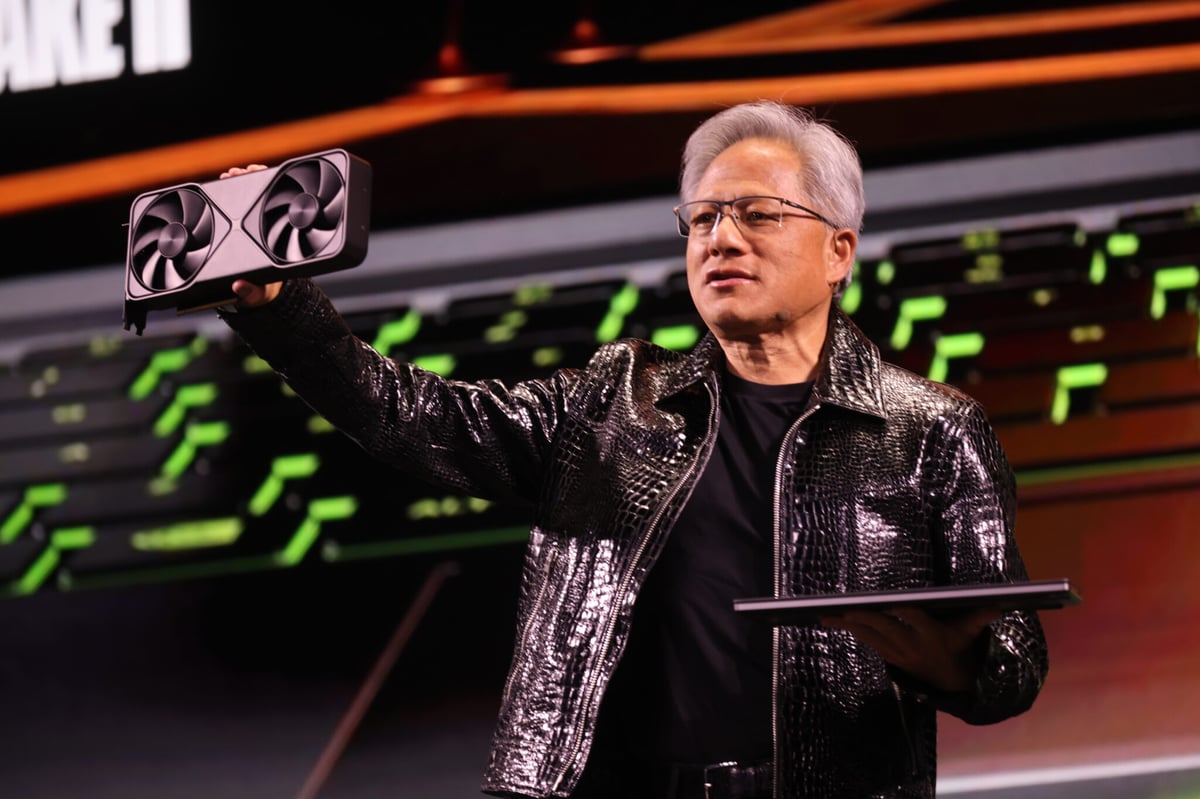
Nvidia CEO Jensen Huang forecasts his company will generate $1 trillion(約160兆円) in AI chip sales through 2027, double a prior projection, and has urged investors to buy semiconductor stocks during market downturns as the AI revolution is just beginning. The forecast is backed by Nvidia's strong Q1 2027 earnings (revenue and net income up 85% and 211% year over year) and signals of sustained hyperscaler spending, though whether the broader investment community believes in the durability of the AI boom remains uncertain.
Summaries like this, in your inbox every morning.
Sign up free →What happened
Nvidia CEO Jensen Huang told investors in Seoul in early June to buy chip stocks aggressively during market weakness, citing an AI revolution that is just beginning. At Nvidia's March GTC conference, Huang forecast the company will collect $1 trillion(約160兆円) in sales from its chips through 2027, double the previous $500 billion(約80兆円) forecast through 2026.
Why it matters
Nvidia has lost its position as the world's most valuable company to Apple (as of July 28), but Huang's credibility is backed by the company's Q1 2027 results showing revenue and net income up 85% and 211% year over year. CFO Colette Kress projects spending on AI infrastructure will total $3 trillion(約480兆円) to $4 trillion(約640兆円) annually by the end of the decade, signaling sustained demand that supports Nvidia's core position supplying graphics processing units to data centers.
What to watch
Whether other hyperscalers (large cloud providers) will raise capital expenditure forecasts when they report financial results later this week, following Alphabet's recent increase to $200 billion(約32兆円) for 2026. The durability of the AI investment cycle itself remains the critical unknown for investors.
Nvidia has dropped from its position as the world's most valuable company, a title now held by Apple, whose shares have gained 25% in 2026 as of July 28, significantly outpacing Nvidia's 6% gain for the year. However, Nvidia's market capitalization stood above $5 trillion(約800兆円) not long ago and could reach that level again soon.
During a trip to Seoul, South Korea, in early June, CEO Jensen Huang delivered a bullish message to investors, advising them to act aggressively and buy chip stocks when there is market weakness. Huang's conviction rests on his belief that the AI revolution is only beginning. At Nvidia's GTC conference in March, he announced a substantially upgraded forecast: the company will collect $1 trillion(約160兆円) in sales from its chips through 2027, double the previously stated $500 billion(約80兆円) forecast through 2026. CFO Colette Kress reinforced this outlook by projecting that spending on AI infrastructure will total $3 trillion(約480兆円) to $4 trillion(約640兆円) by the end of the decade—a figure representing annual spending, not cumulative, underscoring the scale of ongoing investment expected.
Huang's credibility is grounded in Nvidia's recent financial performance. In Q1 2027, which ended April 26, the company posted revenue and net income increases of 85% and 211% respectively year over year, demonstrating that the AI infrastructure boom is translating into tangible business results. Nvidia has deepened its involvement across the AI ecosystem in multiple ways: it invested $30 billion(約4.8兆円) in OpenAI in March, has taken equity stakes in numerous other companies, and is reportedly working to guarantee $250 billion(約40兆円) in financing for OpenAI to lease a new data center in Ohio. Additionally, Nvidia repurchased $19 billion(約3兆円) of its own stock last quarter.
Signals of sustained demand are emerging from the hyperscaler segment. Alphabet recently raised its 2026 capital expenditure forecast to $200 billion(約32兆円) at the midpoint, indicating that the spending surge is not slowing but accelerating. Analysts expect other major hyperscalers to announce similar capex increases when they report financial results later in the week. The critical question for the investment community remains whether the AI revolution will prove durable enough to justify the multitrillion-dollar spending cycle now underway—a question that Jensen Huang will continue working to answer affirmatively for investors.
Nvidia's position in the AI infrastructure market remains central to the company's case for sustained growth, even as it has recently ceded the title of world's most valuable company to Apple. Jensen Huang's confidence in a $1 trillion(約160兆円) cumulative sales target through 2027—a doubling of the prior forecast—reflects not just optimism but also demonstrated execution, with Q1 2027 showing revenue and net income growth of 85% and 211% respectively. The CFO's projection of $3 trillion(約480兆円) to $4 trillion(約640兆円) in annual AI infrastructure spending by decade's end (not a cumulative total) underscores management's conviction that the build-out is accelerating, not plateauing.
The real validation of Huang's bullish stance may come from hyperscaler behavior. Alphabet's recent decision to raise its 2026 capital expenditure forecast to $200 billion(約32兆円) signals that major cloud providers continue to pour resources into AI infrastructure—the very services for which Nvidia supplies essential chips. The article notes that other hyperscalers are expected to announce capex increases in earnings reports due later in the week, which would reinforce the durability of demand. Huang's March comments that investors should aggressively buy during market weakness also carry weight given Nvidia's $30 billion(約4.8兆円) investment in OpenAI, its equity stakes across the AI industry, and a reported $250 billion(約40兆円) financing guarantee for OpenAI's Ohio data center expansion. These moves position Nvidia not only as a vendor but as a principal stakeholder in the AI ecosystem's success.
AI-summarized, only the topics you pick — one digest a day via Email, Slack, or Discord.
Free · takes 30 seconds · unsubscribe anytime
No comments yet. Be the first to share your thoughts!
Log in to join the discussion

Get curated AI news from 200+ sources delivered daily to your inbox. Free to use.
Get Started FreeFree · takes 30 seconds · unsubscribe anytime
