Video Generation
Aug 20, 2026
The Gist
Video generation AI is rapidly advancing toward full-length feature production, with one startup completing a 110-minute film for just $2 million in four weeks, while major players like ByteDance are securing copyright agreements with organizations like the MPA to enable wider commercial deployment. However, the technology's explosive growth has created friction, from OpenAI's senior departures signaling internal tensions over AI development direction to developers creating tools to remove watermarks from AI-generated content. The consolidation of video generation into comprehensive creative suites like Getimg.ai shows the technology is becoming mainstream for marketers in 2026, though questions about copyright compliance and ethical use remain unresolved.
Today's Stories
- 1
AI startup makes 110-minute feature film for $2M in four weeks
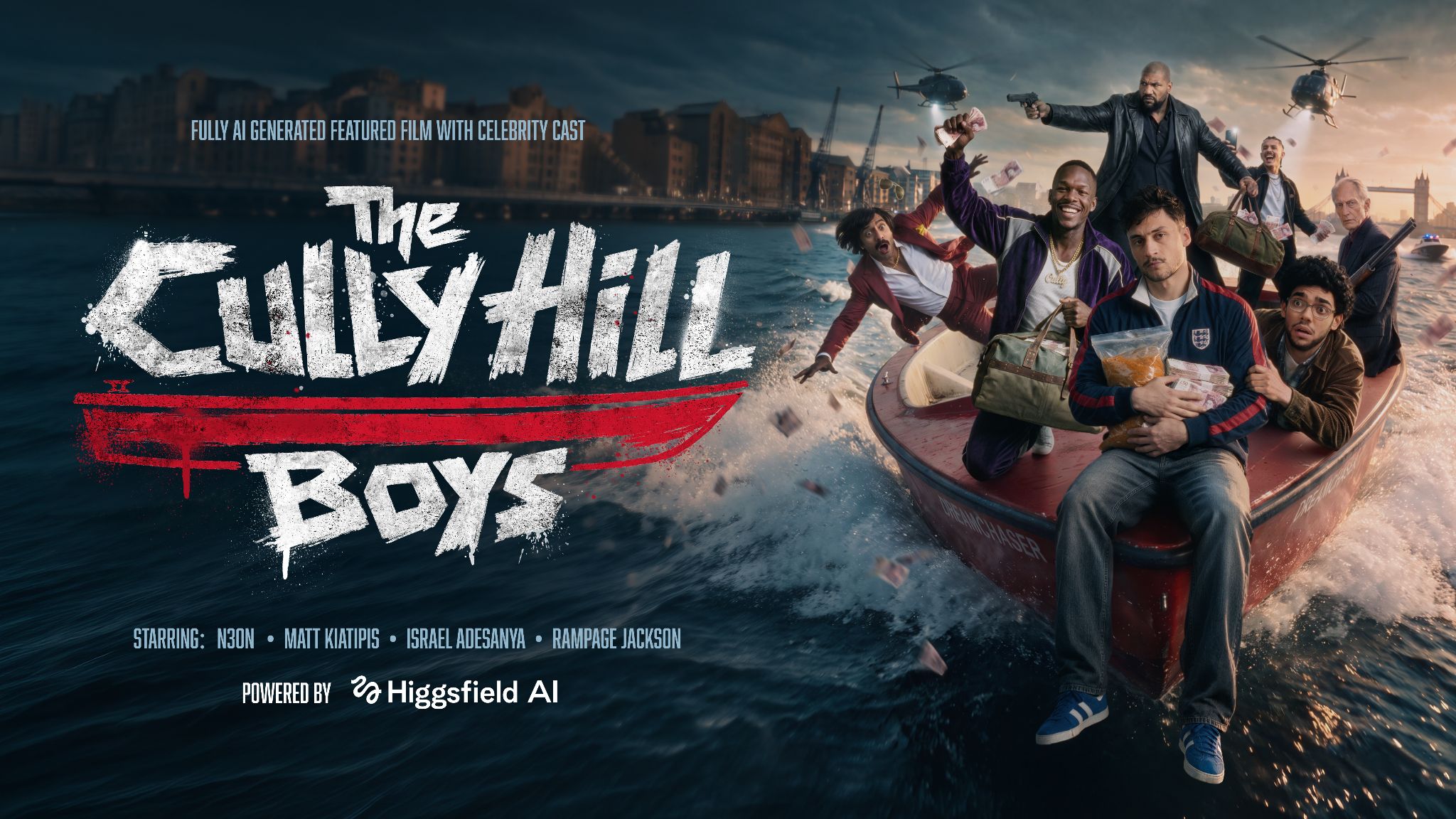
Higgsfield AI, a startup, produced The Cully Hill Boys, a 110-minute action-comedy featuring licensed celebrity likenesses, in just four weeks with a budget of $2 million—half spent on AI tokens. The film follows East London rappers who steal a boat for a music video and get caught between crime cartels. The film demonstrates AI video production can now scale to feature length, a shift from short clips. While the technology still shows visible flaws—unrealistic polish, occasionally obvious AI generation, and inconsistent character reactions—the human screenwriter's dialogue and story structure indicate AI tools may be moving toward democratized, cost-effective long-form production for creators.
Higgsfield AI says it plans to provide scalable AI workflows for creators, signaling the company sees a market opportunity in bringing down the cost and time required for video production. The film's mixed execution—strong writing, visible generation artifacts—shows where the technology still needs refinement.
- 2
Developer builds pagedMark to strip AI watermarks from self-generated images
A developer created pagedMark, a tool designed to remove AI provenance markers—both visible labels and invisible pixel-embedded watermarks—from images and videos generated by AI tools. The tool regenerates images to eliminate invisible marks while attempting to preserve visual similarity, and currently supports watermarks from ChatGPT, gpt-image API, Z-Image Turbo, and Nano Banana for images, plus visible marks and metadata from Sora, Veo, Seedance, Hailuo, and Kling for video. AI-generated content increasingly carries metadata and embedded signals (like SynthID watermarks) that identify its origin. For creators working with their own AI-generated material, these marks can complicate workflow—simple removal methods like screenshots don't eliminate pixel-level markers. pagedMark addresses this by regenerating affected content, though users should know the output may differ from the original (faces, text, and small details can shift).
The tool has been tested on Apple Silicon Macs with 8 GB and 16 GB of memory, with memory-aware processing built in to handle resource constraints on lower-spec machines.
- 3
Can an LLM create a full-length film alone?
A post on LessWrong poses the question of whether a large language model (LLM)—an AI system that understands and generates text—could independently produce a feature-length movie without human intervention. The question explores the boundaries of current AI capabilities in creative production, touching on whether text-based AI systems can handle complex, sustained creative tasks that require narrative coherence, structure, and sustained output across a feature film's runtime.
The question itself remains open; the post frames it as an inquiry rather than a resolved finding, inviting discussion about the technical and creative limitations of LLMs in film production.
- 4
OpenAI's Senior Exodus Sparks Survival Questions
OpenAI closed an $852 billion self-funded tender offer on August 10, 2026, then lost chief operating officer Brad Lightcap (August 11) and chief revenue officer Denise Dresser (August 13) within days. CNBC reported at least a dozen senior leaders have departed in 2026, including heads of ethics and safety. Ed Zitron's newsletter argues OpenAI's annualized run rate of $40 billion (roughly double 2025) masks decelerating growth, while planned compute spending of $750 billion through 2030 balloons obligations to above $800 billion—a gap he says requires raising $100 billion to $200 billion annually, which he calls "close to impossible." OpenAI president Greg Brockman countered that departures are unremarkable for a company in spotlight and that monthly run rate climbed 20% in July with 32% business-customer growth.
Whether OpenAI files IPO paperwork at or near its $1 trillion target valuation (CEO Sam Altman has called anything lower a "non-starter"), whether Microsoft renegotiates commercial terms, and whether enterprise revenue continues outpacing consumer revenue—OpenAI's enterprise business topped consumer for the first time in the latest quarter.
- 5
Getimg.ai tops consolidated AI creative suite for marketers in 2026
A new guide evaluates AI image and video generators for marketing teams, recommending consolidated platforms like Getimg.ai over separate tools for most use cases. Getimg.ai offers image, video, music, speech, and sound effect generation in one workspace, plus editing features like upscaling and background removal, with access to models including FLUX 3, Kling, Google Veo 3.1, Sora, and Eleven Music 2. Marketers waste time moving assets between tools; a single workspace eliminates that friction and the complexity of managing separate subscriptions and credit budgets. Getimg.ai's pricing transparency—showing that 3,000 credits equals roughly 200 FLUX.2 images or 10 Kling videos on the Entry tier—lets teams plan actual monthly costs by output volume rather than subscription price alone, a detail most competitors omit.
Getimg.ai's recent additions include FLUX 3 with synchronized audio and keyframe control, and MiniMax H3 running at 2K resolution with reference image control—the latter critical for keeping product appearance consistent across campaigns. Yearly billing saves 20% across all four paid tiers, all of which carry commercial rights.
- 6
ByteDance, MPA strike copyright pact for AI video tools
ByteDance and the Motion Picture Association (MPA) have reached an agreement to strengthen copyright safeguards for ByteDance's AI video and image-generation models. The deal marks a shift from confrontation toward cooperation between a major AI developer and Hollywood's trade body over generative AI, signaling a pathway for resolving tensions between content creators and AI companies over IP protection.
The agreement's specific safeguards and enforcement mechanisms are not detailed in available reporting; further disclosures about implementation and scope may clarify whether this model can be replicated with other studios or rights holders.
What to Watch
Watch for whether Higgsfield AI can deliver on its promise to make video creation faster and cheaper for creators, as the early results show both impressive potential and technical rough edges that will need smoothing. Meanwhile, keep an eye on OpenAI's next moves—particularly any IPO filing and how the company balances its surging enterprise business against consumer growth—alongside advancements from competitors like Getimg.ai that are racing to give creators more precise control over video generation and consistency.
Sources
- AI startup produces fully AI-generated feature-length film
- I built pagedMark to remove AI provenance from images and video you generated yourself
- Can an LLM make a feature-length movie on its own?
- “What Happens If OpenAI Dies?” Here’s Why Ed Zitron Thinks OpenAI Is Running Out Of Time
- Best AI Image and Video Generators for Marketers in 2026
- ByteDance and Hollywood reach copyright pact for AI video and image tools
- Higgsfield raises $400M at $5.4 billion valuation to scale video and image generation platform
- AI video market has bounced back from Sora's false start
- Disney's Fandom Move: Open AI's Sora Out, TikTok In 08/07/2026
- I curated a database of 37+ powerful AI tools that require NO Sign-ups, NO registration, and NO hidden paywalls. Completely free
- Runway Resources | AI-generated commercials: what they are and how to make one
- 10 Best AI Video Tools That Automate Your Creative Workflow in 2026
- Disney Going 'Vertical,' Unveils AI 'Ad Agent' 01/08/2026
- This Week In E-Commerce - Vmake Labs Transforms Social Video Creation for Businesses
- LTX launches new free-to-use open world model for video and physical AI
- Watching Roku's AI channel is like eating from a trough
Share this with a friend
Send today's roundup to anyone who wants to keep up.
Get daily AI news free with AIToday
Today's AI, for Today's work. Email / LINE / Slack.
Sign up free