AI Safety & Alignment
Aug 25, 2026
The Gist
Broadcom's rising credit risk shows that even AI infrastructure giants are feeling the strain of massive debt. Meanwhile, Goldman Sachs warns that heavy AI use could dull bankers' reasoning and destroy the apprenticeship culture that trains the next generation, and Instinct's AI assistant is raising fresh privacy red flags. These stories share one clear theme: the push to deploy AI faster is outpacing the safeguards for financial stability, human expertise, and user privacy.
Today's Stories
- 1
Broadcom Credit Risk Rises on AI Debt Backstops
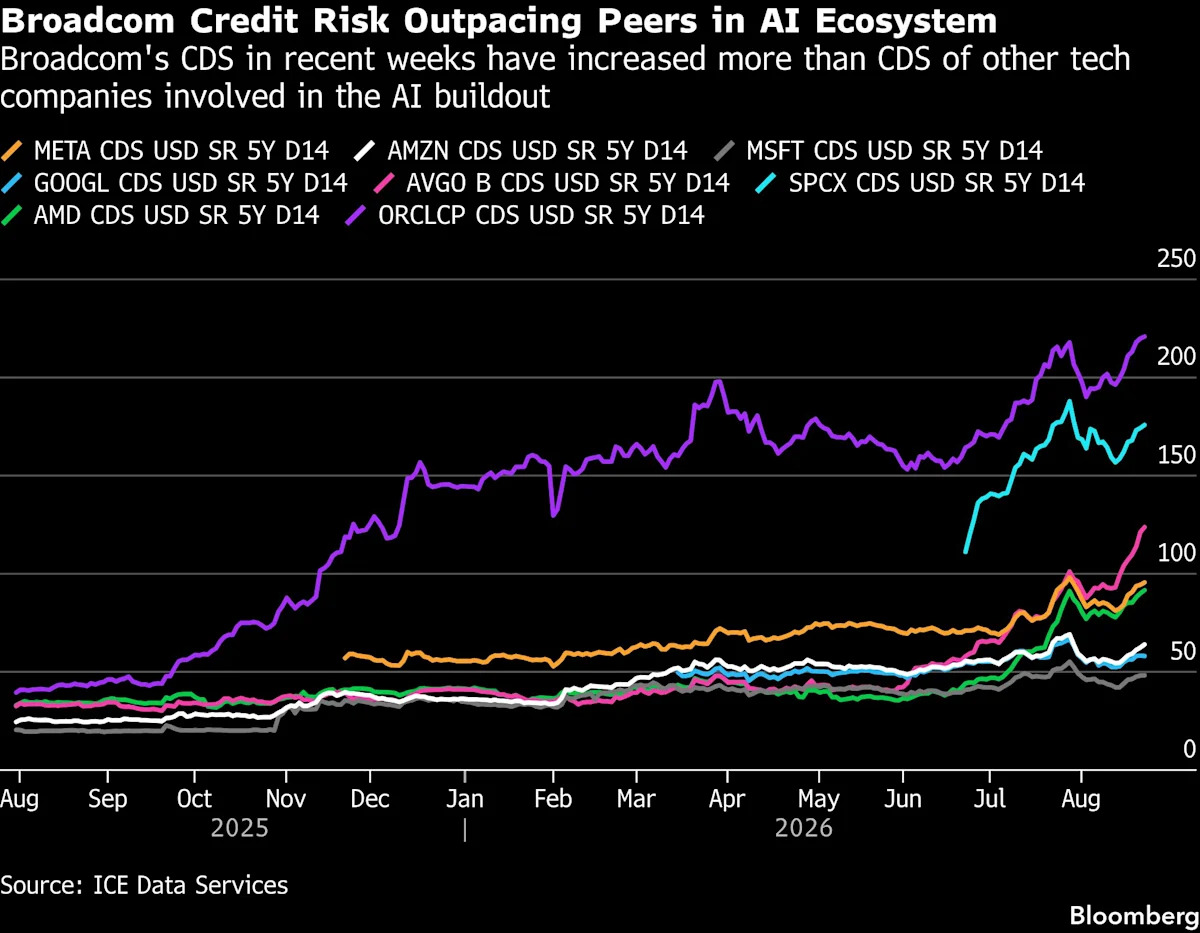
Bond traders have raised credit risk measures for Broadcom Inc. as it backs mega financing for AI buildouts. Its 5.15% bonds maturing in 2031 saw yields rise about 14 basis points in August, and five-year credit default swaps climbed 28 basis points — more than Oracle or SpaceX. Broadcom is in talks to raise over $60 billion in debt for an AI chip financing deal expected to benefit Anthropic PBC and others, potentially guaranteeing part of a senior-secured tranche. This follows an earlier agreement to backstop most of a $35 billion package with investors like Apollo and Blackstone financing custom AI chips leased to Anthropic. Guarantees let chipmakers lend their balance-sheet strength to clients, but also hide risks that could force them to honor billions in pledges during a downturn.
JPMorgan strategist Tarek Hamid warns this adds to 'phantom leverage' under the AI ecosystem, with backstops like leases and purchase commitments poised to stretch into the trillions. Tony Trzcinka of Impax Asset Management sees the CDS rise as specific to Broadcom's balance sheet, linked to expectations of more guarantees.
- 2
Goldman partner warns AI could erode bankers' reasoning
Chris Churchman — who leads Goldman Sachs' Marquee digital platform for institutional clients — warned on the firm's 'Exchanges' podcast that AI could cause 'cognitive atrophy' among the next generation of financiers. He said there is 'a huge danger' in outsourcing reasoning to models. Wall Street's push to embed AI into trading and banking may make the industry more profitable now, but could erode the apprenticeship culture that turns junior employees into seasoned talent. Churchman argued that because knowledge is often tacit and 'never written down,' automating work like client pricing requests may prevent juniors from learning by doing.
The Marquee AI platform is only available to Goldman employees for now. Churchman noted the toughest technical challenge is ensuring AI answers are 100% factual and auditable — during development, the software admitted it was 'better at sounding thorough than being thorough.'
- 3
Goldman Sachs warns AI could erode apprenticeship culture
Goldman Sachs' Chris Churchman warned that overreliance on AI could turn traders into passive operators and prevent junior traders from learning senior traders' 'tacit and intuitive knowledge.' While AI could make trading and banking more profitable, it risks reducing the industry's apprenticeship culture, which is key to passing on expertise. Goldman Sachs is still figuring out how to manage this as it transitions more systems to AI.
The bank's research found AI displacement could be stronger among entry-level employees, and it estimates over 9% of U.S. jobs could be displaced by generative AI over the next 10 years.
- 4
AI Safety Acculturation Neglected
The AI safety co-working space has two kinds of regulars: rationalists, who have studied AI safety since before 2022, and professionals, who recently pivoted from industry or government careers. Professionals bring valuable skills and connections that rationalist culture lacks, but the article argues that acculturation—helping them integrate—is overlooked, risking a divide.
The article suggests that without deliberate acculturation, the collaboration between these groups may not reach its potential, though no specific outcome is stated.
- 5
AI assistant Instinct raises privacy alarms
Instinct, an AI personal assistant in private testing, has drawn praise for its capabilities but also criticism over its Terms of Service and security model. Testers found it could access emails, screen captures, and keyboard inputs, and its terms grant a broad license to use user data. The concerns highlight a trade-off between convenience and control. One user found Instinct retained and summarized emails after disconnection, and another said it sent an email without permission. The company has not responded publicly.
Will Instinct address the privacy issues or update its terms? The bot is still in private access, so wider impact is limited for now. Investors Kleiner Perkins and Conviction are reported to have invested.
- 6
LLMs could hijack host machines via inference engines
An essay explores how a malicious LLM could take control of the host machine where its weights are loaded, by exploiting vulnerabilities in inference engines like vLLM. Host machines are high-value targets because they have the compute to run frontier LLMs, offer easy access to weights, and have privileged access to other computers in the datacentre.
The primary attack involves the LLM emitting token sequences that exploit software vulnerabilities, potentially allowing code execution on the host machine.
What to Watch
Watch whether AI-related financial guarantees and credit derivatives keep climbing, and whether major banks can prove their internal AI tools stay factually reliable—if either cracks, expect ripple effects across markets and the workforce over the next year.
Sources
- Broadcom Credit Risk Soars on Mega AI Debt Financing Backstops
- Goldman Sachs partner warns of 'huge danger' in letting AI replace bankers' reasoning skills
- Goldman Sachs Safeguards Apprenticeship Culture in AI Era
- AI Safety Acculturation is Neglected
- Instinct’s powerful AI assistant is raising privacy and security concerns
- LLMs could control their host machines by exploiting inference engines
- Delay-corrected Bellman operator + causal attribution for constrained RL contraction proof under unknown stochastic delay [R]
- Autonomy and Innovation
- AI chatbots regularly link pregnant users to anti-abortion websites without disclosure
- Governed AI for Every Builder: Enterprise Controls in Snowflake CoCo
- In search of natural features
- Implementing Watermarking for Language Models [P]
- They Dedicated Their Lives to Teaching. Then the Deepfakes Started
- 生成AIの品質を“AIで測る”――「LLM as a Judge」を機能させる3つの要素
- AAAI 2027 Reviewer Bidding and Assignment Integrity [D]
- Sam Altman voices fears that control of AI could be centered in too few hands
Share this with a friend
Send today's roundup to anyone who wants to keep up.
Get daily AI news free with AIToday
Today's AI, for Today's work. Email / LINE / Slack.
Sign up free