Robotics
Jul 24, 2026
The Gist
Intuitive Surgical demonstrated advanced telesurgery capabilities using a new AI framework, while Meta AI rolled out updated planning and task-execution features, signaling major progress in surgical and general-purpose robotics. Investment momentum remains strong with Physical AI startup Atoms leading a $1.7 billion funding week, and new tools like Cotter's open-source framework and egocentric video processing platforms are emerging to improve robot safety and performance. These developments reflect growing confidence in AI-robotics integration across healthcare, manufacturing, and supply chains.
Today's Stories
- 1
Intuitive Surgical unveils five-layer AI framework, demos live telesurgery
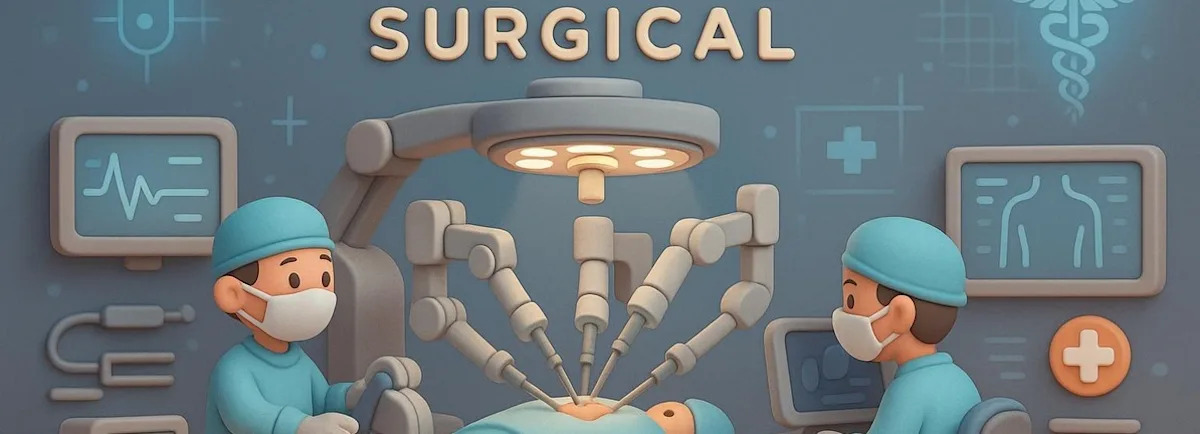
Intuitive Surgical revealed a five-layer AI framework for its surgical platforms and demonstrated a live real-time telesurgical collaboration across distant facilities, showing how it plans to integrate AI into clinical workflows rather than as a standalone feature. The roadmap may influence how hospitals and surgeons adopt AI in surgery, shape partnerships, and affect investor views of Intuitive Surgical's long-term positioning in computer-assisted surgery—particularly as the stock has fallen 40.9% year to date and faces pressure.
Hospital responses in terms of system placements, procedure volumes, and any disclosed AI-related service revenue in coming quarters; execution risks include regulatory comfort, data security, and surgeon adoption for AI-assisted and remote procedures.
- 2
Meta AI Now Plans and Acts on Tasks via Muse Spark 1.1
Meta announced Muse Spark 1.1, an updated AI model powering Meta AI and meta.ai that can plan, execute, and follow through on multi-step tasks without needing repeated prompts. Features include kitchen renovation planning, half-marathon training schedules, birthday dinner coordination, daily briefings, and research synthesis—all rolling out today in select markets, with expansion to WhatsApp and other surfaces in the coming weeks. The model shifts Meta AI from answering questions to acting on behalf of users—handling repetitive tasks, tracking calendar conflicts, and delivering ongoing updates automatically. This represents Meta's step toward what it calls "personal superintelligence," an AI that understands context and handles things users would otherwise manage manually, potentially reshaping how people delegate everyday planning and research.
Meta is deploying these features starting today in select markets via the Meta AI app and meta.ai, with rollout to additional countries and WhatsApp "in the coming weeks." Users can steer tasks in real time (adjusting focus, tone, or content), and all generated content—schedules, slide decks, mood boards—lives in one place for later access and sharing.
- 3
AI and robotics partnerships spur related supply-chain stock buying
Investors are actively buying stocks across the supply chain linked to AI and robotics, driven by expanding partnerships in those sectors. The partnerships signal growing commercial momentum in AI and robotics, which suggests sustained demand for the component makers, software providers, and infrastructure companies that support these technologies.
Market activity will likely track further partnership announcements between AI and robotics companies, as these tend to trigger fresh buying in the broader ecosystem.
- 4
Physical AI Startup Atoms Leads $1.7B Funding Week
Atoms, Travis Kalanick's physical AI startup, raised $1.7 billion(約2700億円) in a funding round led by Andreessen Horowitz, marking the largest deal of the week. Nine other major rounds followed, including $400 million(約640億円) for 3D AI developer Meshy AI and $300 million(約480億円) for battery company Sila. The funding sweep across physical AI, biotech, cybersecurity, and AI infrastructure signals investor appetite for capital-intensive sectors beyond pure software. Kalanick's framing of Atoms as enabling "the coming industrial revolution where large industrial economic sectors get completely digitized" suggests backers see transformative potential in automating physical manufacturing and operations.
Atoms is Los Angeles-based and led by Andreessen Horowitz. Etched (inference technology, Series C at $10 billion(約1.6兆円) pre-money valuation) and Cathedral (defense tech, $160 million(約260億円)) also secured Sequoia or Andreessen backing, suggesting those firms are placing significant bets on AI infrastructure and national security applications.
- 5
Cotter: Open-source framework stress-tests robot policies for safety compliance
Cotter, an open-source CLI tool, was released to run statistical safety, regression, and adversarial compliance tests on trained robot control policies within MuJoCo simulation, generating audit-ready reports with structured pass/fail results. As regulations like the EU Machinery Regulation and ISO 10218 increasingly require evidence that learned robot controllers behave safely, Cotter addresses this emerging compliance need by offering a standardized, CPU-based testing framework that any developer can install via pip.
The tool is available now as open source on GitHub (github.com/yih0nk/cotter) and can be installed with pip install cotterbot; the project website is at cotter-website.vercel.app.
- 6
Processing platform for egocentric video launches, seeks lab partners
A startup has built a platform that automates the data preparation (ETL) pipeline for egocentric and spatial video, converting raw footage into model-ready outputs for robotics and vision-language-action (VLA) model development. The team is openly recruiting research labs and companies to test the service for free. Teams building physical AI and teleoperation systems currently spend significant GPU time and engineering effort on video data preprocessing—a bottleneck the platform is designed to eliminate. By handling the data plumbing upstream, it frees computational resources and engineering cycles for core model work.
The offer is limited to labs willing to provide feedback; interested teams are invited to comment or message directly to discuss participation. No pricing, availability date, or formal launch timeline is stated.
What to Watch
As hospitals begin deploying AI-assisted surgical systems, watch for quarterly disclosures on procedure volumes and revenue—alongside signals on surgeon adoption rates and regulatory progress—to gauge whether this technology is moving from pilot to mainstream adoption. Meanwhile, the broader robotics ecosystem will likely follow partnership announcements between AI and robotics companies, particularly around infrastructure and autonomous systems, as these deals have historically driven investor interest across the sector.
Sources
- Intuitive Surgical (ISRG) Unveils Five Layer AI Plan And Live Telesurgery Demo
- Meta AI Doesn’t Just Think, It Acts
- AI・ロボの提携拡大で関連バリューチェーン物色【今日の市場はどう動いた?】
- The Week’s 10 Biggest Funding Rounds: Physical AI Startup Atoms Leads In Varied Week For Large Deals
- built cotter, an open source framework to stress test your robot policies
- [Showcase] Built a processing engine for egocentric video and looking for labs to test it out for free
- Claude Code skills for ROS 2 Jazzy that route to official docs instead of guessing APIs (measured before/after included)
- HYPE VS PRODUCTION
- Embodied AI is getting scary cheap. We just got our sub-$1,000 open-source robot (AlohaMini2) to do autonomous mobile manipulation trained on a consumer 8GB GPU
- [Project] Reproducing NVIDIA’s Isaac Lab-to-VLA pipeline with 50 remotely collected VR demonstrations
Share this with a friend
Send today's roundup to anyone who wants to keep up.
Get daily AI news free with AIToday
200+ AI sources, summarized in 1 minute. Email / LINE / Slack.
Sign up free