Robotics
Jun 22, 2026
The Gist
Alphabet's Intrinsic is democratizing robot programming with drag-and-drop software, while Bear Robotics and companies like NVIDIA are building more capable systems—Bear through acquiring manipulation skills, and NVIDIA by launching a safety platform tailored to factory environments. Meanwhile, industry experts warn that robotics success hinges as much on hardware reliability and tactile sensing innovations as on AI breakthroughs, and the growing sophistication of these systems is introducing new infrastructure risks that companies must address.
Today's Stories
- 1
Alphabet's Intrinsic replaces manual robot coding with drag-and-drop software, aiming to make industrial automation accessible beyond specialist programmers.
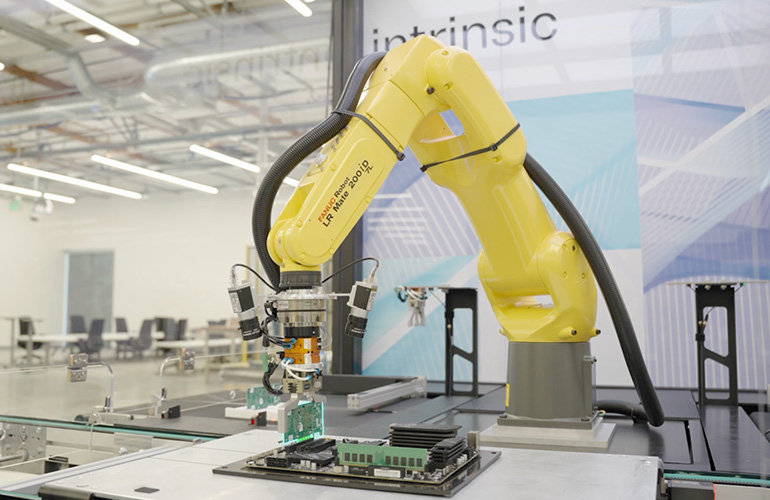
Intrinsic debuted the Intrinsic Intelligence Cell, a modular robotic workcell powered by IntrinsicOS software that eliminates the need to manually program robots. Instead, operators use drag-and-drop automation to configure tasks like assembly, tool changes, and parts handling. The system is being demonstrated at Automate 2026 and will undergo a major manufacturing pilot with Foxconn later this year. Factory floors and machine shops typically require specialist coders to reprogram robots for each new task. By replacing coding with AI-driven skills—such as instant process reconfiguration and automated motion planning—Intrinsic aims to put robotic capability directly in the hands of machine operators and system integrators (like Trinity Automation and MartinSystems), removing a major barrier to adoption of industrial robots.
Intrinsic is also running the AI for Industry Challenge with a $180,000 prize pool to solve cable and connector manipulation in electronics assembly. The challenge drew over 5,000 registrations across more than 1,600 teams spanning over 115 countries, with eight teams achieving near-perfect scores so far—a signal that software engineers outside robotics see opportunity in the field.
- 2
Bear Robotics acquires Kinisi Robotics to add manipulation capabilities to its deployed commercial robot fleet, completing an end-to-end physical AI platform.
Bear Robotics signed a definitive agreement to acquire Kinisi Robotics, integrating Kinisi's KR1 humanoid robot, Bristol-based engineering team, and physical AI capabilities into Bear's platform. The companies expect to close the transaction in the coming days. Brennand Pierce, a co-founder of Bear who founded Kinisi, will join Bear's leadership team as Chief Robotics Officer upon closing. Bear has already shipped more than 16,000 service robots into commercial service worldwide and operates them as a coordinated team through cloud orchestration. Kinisi brings the missing manipulation layer—AI models and grippers that let robots pick, sort, and handle objects—rather than just navigate and deliver. By combining Bear's fleet data and deployment scale with Kinisi's hands-on data-capture tools, the companies can train AI models faster than either could alone, and existing Bear customers gain expanded capabilities on the same platform they already use.
Kinisi's proprietary technology includes a vision-language-action model, robot foundation model, in-house gripper design, and a low-cost glove for capturing manipulation demonstrations. The Bristol office will continue as a strategic engineering hub for Bear under Pierce's leadership, extending Bear's footprint into the United Kingdom alongside its existing Bay Area operations.
- 3
NVIDIA launches Halos, a full-stack safety system for robotics that draws on over 18,600 engineering years of autonomous vehicle development to help companies deploy robots safely alongside workers in factories and warehouses.
NVIDIA released NVIDIA Halos for Robotics, a comprehensive safety architecture that unifies AI compute, system software, sensor data, safety applications, and inspection tools. Agility Robotics is the first company integrating the system into its Digit humanoid robot for industrial work. NVIDIA Halos Core is available in early access for registered developers, and the open source NVIDIA Halos Outside-In Safety Blueprint is now available on GitHub. Autonomous robots operating in dynamic environments alongside humans require safety engineered across every layer of hardware and software. By offering a standardized, unified safety architecture and an ANSI National Accreditation Board-accredited inspection lab, NVIDIA appears to be addressing a key barrier to large-scale robot deployment in industrial settings. The system supports third-party certification by bodies including TÜV Rheinland, UL Solutions, and TÜV SÜD.
More than 40 companies—including software providers (Acontis, Amazon FreeRTOS, QNX), embedded systems makers (Advantech, NexCobot), sensor and semiconductor suppliers (Infineon, NXP, SICK, STMicroelectronics, Texas Instruments), and industrial application developers (FORT Robotics, Inventec, KION Group, Neurealm)—are joining the ecosystem. Agility will participate in the NVIDIA Halos AI Systems Inspection Lab to ensure Digit meets standards including IEC 61508, ISO 13849, and ISO/IEC TR 5469 before final third-party certification.
- 4
Digid, a German nanosensor maker, is positioning its tiny force and temperature sensors as a solution to robotics' tactile sensing challenge, having produced over one million units and attracted interest from major companies.
Digid, founded in 2019, has industrialized nanoscale sensor technology and produced more than one million sensors for applications spanning robotics, medical devices, wearables, and AI infrastructure. The company has around 30 employees, is generating revenue, and recently showcased its technology at CES. Robots today rely heavily on vision but lack rich tactile feedback when handling objects. Digid's sensors are small enough to integrate directly into products without major design changes, enabling dense sensor arrays on robotic skin and fingertips that provide much richer information about force, slip, and environmental conditions than existing technologies allow.
As sensor counts on robots rise, Digid and its customers recognize that data processing must happen locally on the device rather than sent to the cloud—a shift in how robotic systems will be designed. The company sees continued demand from robotics, healthcare, industrial automation, wearables, and AI data centers, where thermal management is becoming increasingly important.
- 5
Robotics leaders face new infrastructure risks as AI-powered systems become more sophisticated across warehouses, manufacturing, and defense.
The robotics industry is entering a new phase of growth, with autonomous mobile robots navigating warehouses with increasing sophistication, industrial robots becoming smarter and more adaptive, and AI-powered vision systems transforming manufacturing, logistics, and defense applications. Each of these advances depends on underlying AI infrastructure, creating new risks that robotics leaders must manage as their systems grow more complex and capable.
The infrastructure supporting these AI-powered robotics systems will become increasingly critical to operational success across warehouses, manufacturing facilities, logistics networks, and defense operations.
- 6
TDK Ventures investment director argues robotics breakthroughs depend far more on hardware and real-world reliability than on AI advances alone, challenging the assumption that generative AI success will automatically translate to capable machines.
Ankur Saxena, investment director at TDK Ventures (the corporate venture capital arm of TDK Corporation), laid out a framework called the '4Ps of Physical AI'—perception, planning, performance, and platform—arguing that success in robotics requires solving physical constraints (sensors, power, mechanics) alongside software intelligence, not just bolting generative AI onto existing hardware as a marketing layer. Many investors assume that AI scale will automatically improve physical systems the way it has improved language and image generation, but Saxena emphasizes that robotics demands determinism, sub-millisecond response times, and fault tolerance in unstructured environments—constraints that statistics-based foundation models alone cannot solve. Perception (reliably interpreting sensor data in real-world conditions) remains the weakest link and a major barrier to scaling autonomous systems.
Saxena identifies near-term opportunities in constrained, high-value environments—autonomous mobile robots in logistics and warehousing, inspection robots in energy infrastructure and mining (where startups like ANYbotics already operate), and aerial autonomy for cargo logistics—while cautioning that humanoid robot investment broadly is pricing in a commercialization timeline that is optimistic by at least a decade. He notes that enabling technologies like sensors, power electronics, and motion control remain undervalued by investors despite being essential to real-world deployment.
What to Watch
Watch for momentum from grassroots engineering talent entering robotics through competitions like Intrinsic's AI for Industry Challenge, while companies increasingly prioritize the unsexy but essential infrastructure—from edge computing and thermal management to safety-certified systems and specialized sensors—that will determine which robots actually work reliably in real-world warehouses, factories, and energy sites rather than in labs. As the robotics ecosystem matures, success will likely belong to those who master the fundamentals of hardware integration and local data processing, not just those betting on humanoid breakthroughs that remain years away from practical deployment.
Sources
- How Intrinsic eliminates manual robot coding
- Bear Robotics acquires Kinisi Robotics to boost its physical AI capabilities
- NVIDIA releases Halos, a full-stack safety system for robotics
- Interview with Digid’s Nils Könne and Christian Kreil: Nanoscale sensors could help solve robotics’ tactile sensing challenge
- The AI infrastructure risk robotics leaders can’t afford to ignore
- From audio tapes to AI: Interview with TDK investment director Ankur Saxena
- Interview with Paul Dawalibi: Can Ras Al Khaimah become the Silicon Valley of the Middle East?
- Why Retail Traders Couldn’t Take Their Eyes Off These Stocks Last Week: INTC, RUM, NBIS, ASTS, ONDS
- Why Boeing's MQ-28 Ghost Bat Just Gatecrashed The US Air Force's Next Big Drone Decision
- Are You Ready to Automate?
Share this with a friend
Send today's roundup to anyone who wants to keep up.
Get daily AI news free with AIToday
200+ AI sources, summarized in 1 minute. Email / LINE / Slack.
Sign up free