Open-Source AI
Jul 28, 2026
The Gist
Open-source AI tools are expanding across everyday applications, with new solutions enabling users to run advanced AI locally on their devices—like a macOS app performing clipboard actions and Writekin allowing personalized language model fine-tuning without cloud dependency. Meanwhile, the ecosystem is addressing both practical challenges and new operational costs, as frontier AI labs grapple with preventing model distillation while companies like Interactive Brokers and Orb bring self-hosted AI capabilities to professional and personal use cases.
Today's Stories
- 1
Interactive Brokers opens AI tool integration via new protocol
Interactive Brokers has expanded its AI tool integration by adopting an open protocol, allowing third-party AI applications to connect more easily to its trading platform. The move lowers barriers for AI developers and fintech companies to build tools that interact with Interactive Brokers' services, potentially expanding the range of AI-powered trading and investing features available to the brokerage's users.
The adoption of an open standard may attract more AI vendors to the Interactive Brokers ecosystem, though the specific technical details, timeline, and which AI tools are already integrated are not detailed in this announcement.
- 2
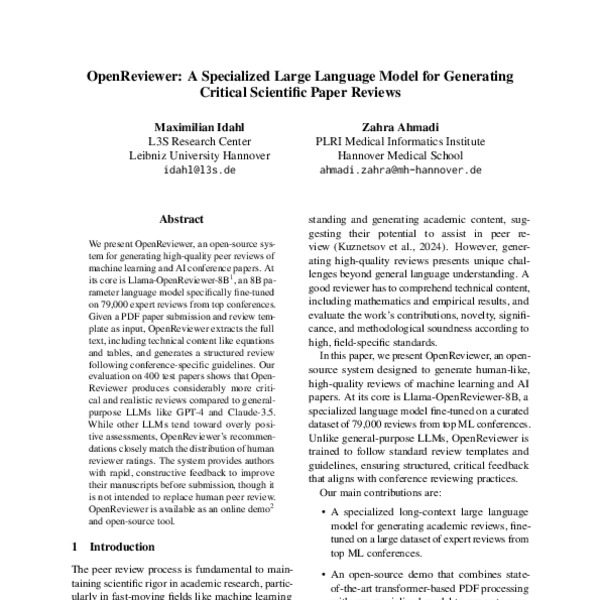
OpenReviewer: AI-powered academic peer review tool
Researchers released OpenReviewer, an open-source system that generates peer reviews for machine learning and AI conference papers. At its core is Llama-OpenReviewer-8B, an 8B parameter language model fine-tuned on 79,000 expert reviews from top conferences, which takes a PDF paper and review template as input and produces a structured review. Testing on 400 papers showed that OpenReviewer produces considerably more critical and realistic reviews compared to general-purpose LLMs like GPT-4 and Claude-3.5, whose reviews tend to be overly positive. OpenReviewer's recommendations closely match the distribution of human reviewer ratings, meaning it can give authors rapid, constructive feedback before formal submission—though the creators stress it is not intended to replace human peer review.
OpenReviewer is available as an online demo and open-source tool, giving researchers and authors a new way to stress-test manuscripts before formal conference submission.
- 3
macOS app brings on-device AI clipboard actions, no cloud needed
apfel-clip, a free macOS menu bar app, lets users copy text, code, or errors and transform them with AI by pressing ⌘⇧V — all processing happens on-device using Apple Intelligence, with no cloud uploads or API keys required. The app removes friction from common text tasks (grammar fixes, code explanations, JSON parsing, error diagnosis) by detecting content type automatically and showing only relevant actions; everything stays private on your Mac, making it safe for sensitive code or data.
Requires macOS 26 (Tahoe), Apple Silicon (M1 or later), and Apple Intelligence enabled; the app is free, MIT-licensed open source, and available via direct download, Homebrew, or GitHub source build.
- 4
Frontier AI labs face major new cost: stopping model distillation
Anthropic's latest model has been distilled into open-weight alternatives that perform nearly as well at a fraction of the cost, exposing a previously unaccounted expense for frontier AI labs—developing countermeasures against distillation. Frontier labs' business model assumes they capture value by being markedly better than alternatives; if open-weight distilled versions match their performance cheaply, the labs' valuations rest on an assumption that no longer holds. Protecting against distillation is now as critical to profitability as the R&D that built the model.
The cost of effective countermeasures remains unknown—frontier labs may need to invest heavily in obfuscation, deception, and other defensive measures, with costs potentially ranging from incidental to uneconomical depending on which protection strategy works. Labs are already turning to lobbying, signaling the challenge's scale.
- 5
Writekin: Fine-tune local LLM on your Mac with your own writing
Writekin, a macOS app, lets users ingest their own writing from Mail, Messages, and documents, then fine-tune a local language model (QLoRA on Apple Silicon via MLX) to generate and rewrite text in the user's voice—all on-device with no data leaving the machine. For writers and professionals who want personalized AI writing assistance without uploading personal data to cloud services, Writekin offers an alternative that keeps all ingestion, training, and generation local; the source code is publicly available so users can verify the privacy claims.
The app requires an Apple Silicon Mac with 16 GB unified memory minimum (32 GB+ recommended for training larger models) and macOS 14 or newer; it is source-available and free for personal noncommercial use, with commercial use requiring a separate license.
- 6
Orb backend: self-hosted AI that proactively messages your phone
Orb released an open-source backend server (Python, Windows, MIT license) that runs on your own hardware and powers an iOS app. The system watches your projects, maintains a model of your life, and initiates contact with your phone only when it has something genuinely worth saying—rather than waiting to be asked. The architecture prioritizes local data retention (nothing leaves your machine), user-supplied credentials (no API keys shipped or stored), and structural safety (destructive actions require explicit approval and are logged). For businesses or individuals handling sensitive workflows, this means AI assistance without cloud dependencies or third-party data exposure.
The backend currently runs on Windows (macOS planned); it requires Python 3.11+, your own Claude Code CLI login, and your own Apple Developer APNs key for push notifications. Setup is self-hosted via git clone and a guided configuration. The iOS app is free on the App Store; the backend repo is at github.com/getorb/Orb-Backend.
What to Watch
Keep an eye on whether Interactive Brokers and other financial platforms begin adopting this open standard to integrate additional AI tools into their ecosystems, as this could reshape how traders access AI capabilities. Meanwhile, watch for OpenReviewer and similar open-source peer-review tools to gain traction in the research community as alternatives to formal conference submission, potentially changing how academic work is validated before publication.
Sources
- Interactive Brokers expands AI tool integration via open protocol
- OpenReviewer: A Specialized LLM for Generating Critical Scientific Paper Reviews
- Show HN: Local AI Clipboard Actions
- Distilling Frontier AI Models
- Show HN: Writekin – fine-tune a local LLM on your own writing, on your Mac
- Show HN: Orb – Self-hosted AI assistant that messages you first
- Labwire, an open protocol for AI agents to control lab instruments
- Anybody.dev – The Open Source AI App Builder
- The OlmoEarth Platform: Geospatial inference at planetary scale
- Chinese open-weight models reignite AI safety debate
Share this with a friend
Send today's roundup to anyone who wants to keep up.
Get daily AI news free with AIToday
200+ AI sources, summarized in 1 minute. Email / LINE / Slack.
Sign up free