AI Coding Assistants
Jul 19, 2026
The Gist
AI coding assistants are gaining practical advantages through supporting tools like Bun rather than raw model improvements, while major tech companies including Google and Intel are deepening partnerships to advance AI-powered chip design. Meanwhile, concerns are rising about AI benchmarks potentially rewarding technically impressive but practically meaningless work, and entertainment companies like Netflix are rapidly integrating AI into production workflows as a standard industry practice.
Today's Stories
- 1
Claude Code's Real Edge: The Harness, Not the Model
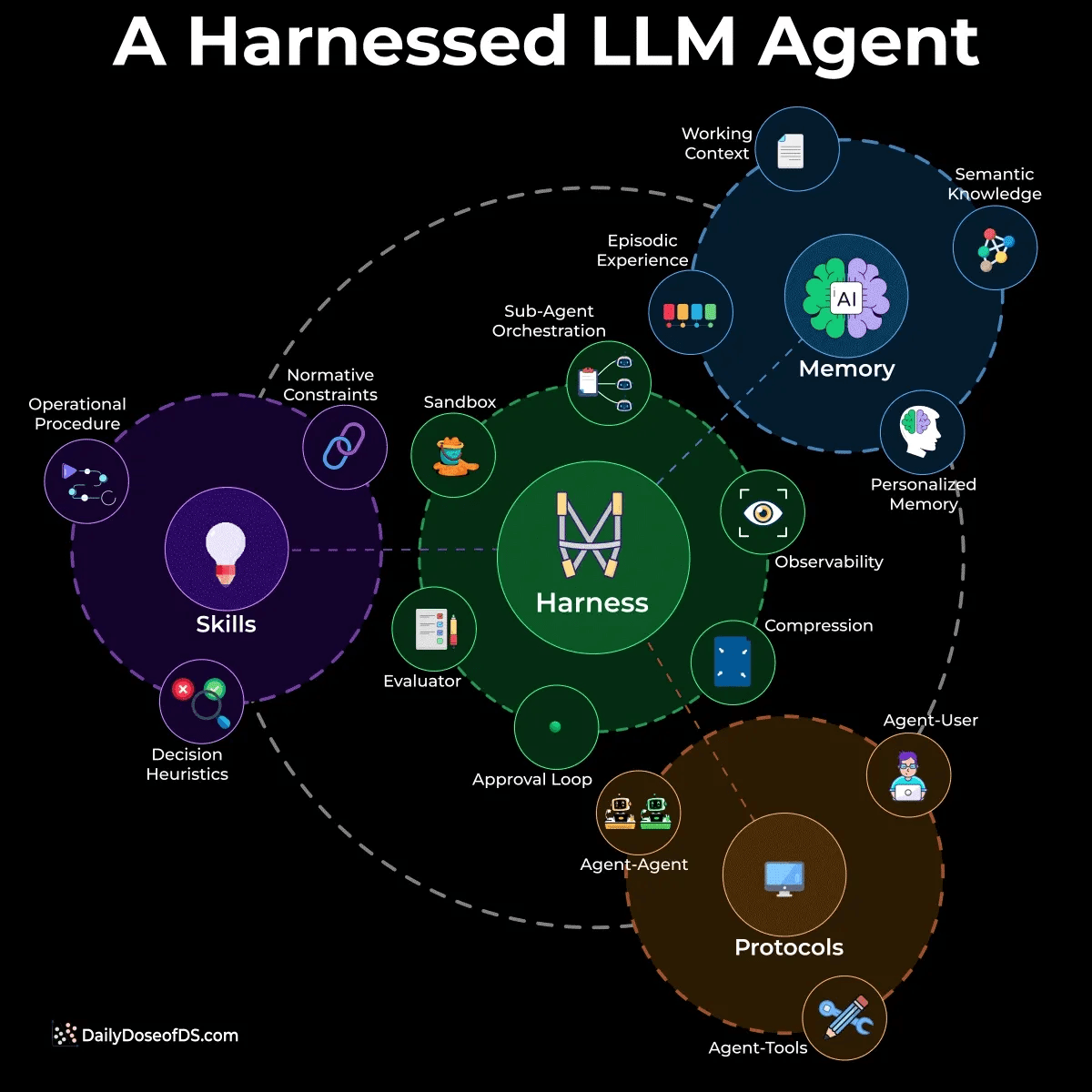
A developer rebuilt Claude Code's agent architecture in CrewAI, an open-source framework, and found that the gap between a basic agent loop and Claude Code's capability comes from the surrounding machinery—planning, memory, sandboxing, subagent delegation, and approval systems—not the underlying language model itself. Most teams underestimate how much engineering sits outside the model. A bare agent loop fails on real codebases (reads wrong files, loses context, fills memory with stale output), while Claude Code stays on track. Understanding this split—model as "brain" deciding actions, harness as "hands" executing them—shows what you actually need to build reliable coding agents in production.
The rebuild tested against a small BankAccount class with two real bugs and five tests. The harness took the project from 3 failing and 2 passing to all 5 passing, demonstrating that planning, subagents, and sandboxing together enable the agent to fix code correctly without shortcuts like editing tests.
- 2
DeepMind Kaggle Prize Criticized for Rewarding 'Nonsensical' Benchmark Work
A Google DeepMind-sponsored Kaggle competition titled 'Measuring Progress Toward AGI - Cognitive Abilities' announced results this week, awarding a $25K grand prize to a submission that a critic claims is poorly reasoned and unfounded. The winning entry purported to test whether large language models change their assessment when presented with alternative viewpoints on claims, but the critic argues the actual work consists of unclear methodology, unfounded claims, and exceeded submission format constraints — raising questions about the quality of benchmarks being used to measure AI progress toward artificial general intelligence.
The criticism centers on whether DeepMind and Kaggle's review process adequately vetted a submission the critic describes as 'a vibed pile of spaghetti 10 times the size of the requested submission format,' suggesting potential gaps in how competitive AI benchmarking is evaluated.
- 3
Claude Code now runs Bun written in Rust
Claude Code v2.1.181 (released June 17th) and later versions now use a Rust port of Bun, the JavaScript runtime. The shift was confirmed by examining the Claude binary, which contains Bun v1.4.0—a preview version not yet publicly released on GitHub (the latest public release is v1.3.14 from May 12th). The Rust rewrite delivered a 10% startup speed improvement on Linux. More broadly, Bun written in Rust is now running in production across millions of devices through Claude Code, validating the port's stability and performance in real-world use at scale.
The Rust implementation of Bun contains 563 source files (confirmed by examining the Claude binary), suggesting a substantial codebase transition. Adoption has been quiet—most users have not noticed the change—which the author frames as a sign of successful, stable infrastructure work.
- 4
Article Lists 25+ AI Tools for Small Business Management
A guide curated a selection of AI software organized by business function—CRM, sales, marketing, and customer service—targeting entrepreneurs and small teams seeking to automate repetitive tasks, analyze data, and reduce administrative workload. According to a Small and Medium Business Trends Report cited in the article, 76% of SMBs adopting technology are growing, with AI-backed CRM at the center of that momentum. The article notes that 91% of SMBs using AI say it boosts revenue, and 90% say it makes operations more efficient, suggesting these tools can directly impact business performance for resource-constrained teams.
The article emphasizes starting with a CRM as the business operating system, then layering in point solutions for sales, marketing, and service. Many tools listed offer free or low-cost starter plans—including Apollo.io, ChatGPT, Canva Magic Studio, Claude, Tidio, and Tawk.to—making entry accessible for solo founders and small teams.
- 5
Intel, Google deepen AI partnership for chip design
Intel and Google Cloud announced an expanded partnership on Thursday, 16th, deploying Gemini Enterprise across Intel's workforce and integrating agentic AI tools into Intel's chip design process. The partnership signals Intel's commitment to embedding AI into its core engineering operations. Agentic AI tools—systems that can autonomously plan and execute tasks—represent a step beyond traditional AI assistance, potentially accelerating the chip design cycle, which is a critical competitive lever for semiconductor makers.
The specifics of how agentic AI will be deployed in chip design workflows, and whether this partnership yields measurable improvements in design speed or quality that Intel can report in coming quarters.
- 6
Netflix uses AI for 300 titles this year; it's just the next production tech shift
Netflix says AI tools are being used in roughly 300 titles this year, including a documentary called American Experiment that featured 17 minutes of AI-enhanced footage produced "twice as fast and at half the cost." The company acquired InterPositive in Q1 2026 and also uses tools called iLine and an "animation lab" for crowd enhancement, battle sequences, and establishing shots. Netflix spends roughly $20 billion(約3.2兆円) annually on content, produces in more than 50 countries, and can mandate tool adoption across productions, giving it structural advantages over fragmented traditional studios. However, AI savings aren't yet showing up materially in Netflix's finances—content amortization is still expected to grow 10% this year, and free cash flow guidance remains unchanged at $12.5 billion(約2兆円)—suggesting the technology is enabling marginal improvements rather than restructuring production economics.
Whether AI cost efficiencies eventually show up in Netflix's financial model. Content amortization growth and free cash flow guidance will signal whether these tools move from marginal gains to material impact. The stakes are labor relations: co-CEO Ted Sarandos has framed AI as augmentation, not replacement, a careful message in the recent memory of 2023 guild strikes.
What to Watch
As AI coding assistants mature from fixing isolated bugs to handling complex projects reliably, watch whether DeepMike and Kaggle's benchmarking rigor keeps pace with increasingly sophisticated submissions, and whether Intel and Netflix's partnerships with agentic AI yield measurable business results—content amortization, chip design speed, and financial impact—that justify the industry's growing investment in these tools. The coming quarters will reveal whether AI augmentation becomes genuinely transformative or remains another incremental gain in an already tool-heavy landscape.
Sources
- [Hands-on] Rebuilding Claude Code's Harness
- Did blatant AI Slop just win a 25K USD Deepmind / Kaggle Grand Prize? [D]
- Claude Code uses Bun written in Rust now
- 25+ AI Tools For Entrepreneurs: Best Business Management Software
- Intel and Google deepen AI ties for chip design
- Netflix's AI Strategy Has a 25-Year-Old Precedent
- Nvidia and Hugging Face expand LeRobot with new open robotics AI tools
- Embarrassingly Simple Self-Distillation Improves Code Generation
- Capital One releases VulnHunter, an open-source AI tool that finds software flaws before hackers do
- Linus Torvalds tells AI critics in the Linux kernel community to fork off
Share this with a friend
Send today's roundup to anyone who wants to keep up.
Get daily AI news free with AIToday
200+ AI sources, summarized in 1 minute. Email / LINE / Slack.
Sign up free