Robotics
Jul 20, 2026
The Gist
BrainCo demonstrated a brain-controlled robot at an AI conference while AGIBOT unveiled four new robot models designed for factory and service work, signaling rapid advancement in robotics capabilities. Meanwhile, geopolitical tensions are emerging as the US and China diverge on humanoid robot development strategies, with the US emphasizing AI intelligence and China focusing on supply chain control, while industry players like Nvidia's CEO are pursuing manufacturing and AI partnerships in key markets like Tokyo.
Today's Stories
- 1
BrainCo showcases brain-controlled robot at AI conference
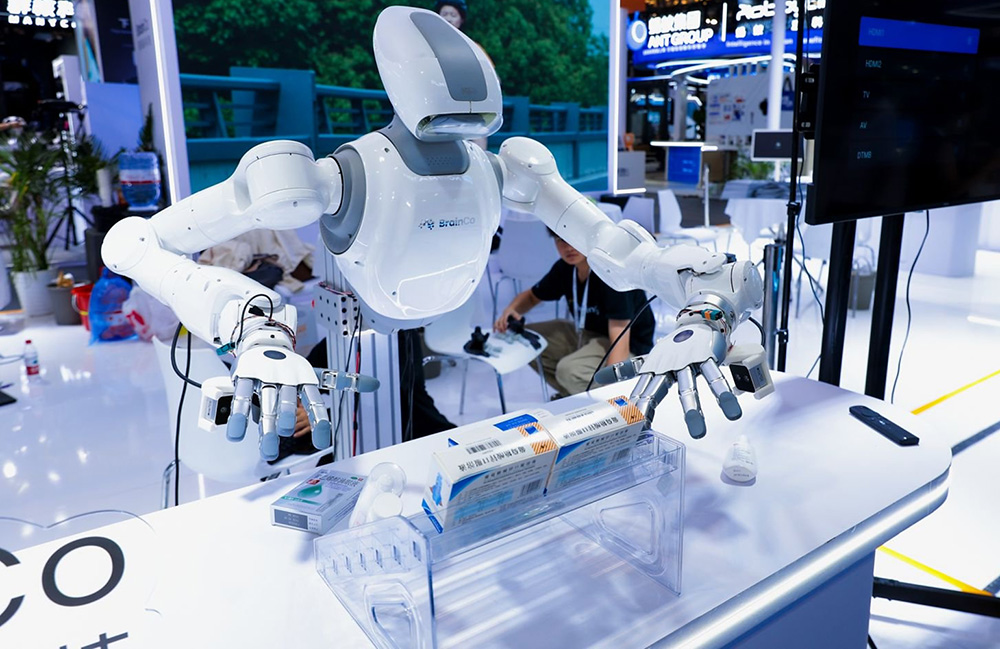
At the 2026 World Artificial Intelligence Conference in Shanghai, BrainCo demonstrated a brain-computer interface (BCI) platform that lets users direct a robot through neural signals. A person wearing an EEG headset thought about grasping a cap, and a robotic arm performed the action in under 200 milliseconds. The company also debuted its Embodied AI Data Collection Solution, which combines EEG data from human operators with robot execution and simulation data to address the shortage of high-quality training data for robots learning complex physical tasks. Teaching robots to perform dexterous tasks like folding laundry or assembling components requires enormous amounts of high-quality training data—a persistent technical challenge in robotics. BrainCo's system captures not just what hands do, but what the brain intends, combining real-world execution quality with the scalability of human demonstration. The BCI platform works with commercially available robots (humanoids, arms, legged robots) without requiring proprietary hardware, potentially making it easier for robotics R&D teams to integrate into existing pipelines.
BrainCo, founded in 2015 and based in Somerville, Massachusetts, already sells three robotic products: the Revo 3 Dexterous Hand (21-degree-of-freedom end effector), the Intelligent Bionic Hand (prosthetic), and the Intelligent Bionic Leg (smart prosthetic knee joint). The company has spent over a decade developing its BCI and medical rehabilitation technology.
- 2
AGIBOT unveils four robot models for real-world factory and service work
AGIBOT yesterday presented four new embodied AI products at the World Artificial Intelligence Conference in Shanghai: the A3 Ultra humanoid (1.74 m tall, 60 kg, 51 degrees of freedom), the G2 Max heavy-payload industrial robot, the OmniHand 3 Ultra-M dexterous hand (20 degrees of freedom, 630 g), and the X2 EDU educational platform. The company, founded in 2023, produced its 15,000th robot last month. AGIBOT co-founder Peng Zhihui stated that the industry should judge embodied AI "by whether it can be manufactured, delivered and integrated reliably into real operating environments" — not by one-time demonstrations. The A3 Ultra supports up to eight hours of continuous operation with autonomous charging; the G2 Max is already deployed in Longcheer's Nanchang factory for tablet quality inspection, completing a closed-loop workflow with less than 4% downtime over 64 hours of cumulative operation. This marks a shift from research prototypes to production systems integrated into existing factory lines.
Integration with Longcheer took 36 hours and the system has inspected about 3,000 units per shift. AGIBOT also presented tourism and transportation applications with partners Sichuan Cultural Tourism and Guangzhou Railway. More than 30 AGIBOT robots provided visitor guidance and demonstrations across WAIC venues.
- 3
AGIBOT unveils four robots at Shanghai AI conference, pushes manufacturing deployments
AGIBOT introduced four new robotics products at the World Artificial Intelligence Conference (WAIC) 2026 in Shanghai — the A3 Ultra humanoid robot (1.74 m tall, 60 kg, 51 degrees of freedom), X2 EDU education platform, G2 Max industrial robot, and OmniHand 3 Ultra-M dexterous hand (20 active degrees of freedom). The company deployed more than 30 robots throughout the exhibition providing visitor guidance and demonstrations. Co-founder Peng Zhihui stated that the industry should judge embodied AI "by whether it can be manufactured, delivered and integrated reliably into real operating environments" — not by one-off demonstrations. AGIBOT's new products address three layers of that challenge: humanoid platforms, industrial task execution, and dexterous manipulation. The company has already integrated G2 robots into Longcheer Technology's tablet quality inspection line, processing around 3,000 units per shift after a 36-hour installation.
AGIBOT's focus is moving embodied AI beyond laboratory demonstrations into repeatable commercial and industrial workflows, with deployments now active at manufacturing partners including Longcheer Technology and PIA Automation. The A3 Ultra supports up to eight hours of operating time with battery swapping, direct charging and autonomous charging options.
- 4
US, China split on humanoid robots: AI smarts vs. supply chain control
The global humanoid robot industry is shifting from technology validation to commercial trials, with the US and China pursuing fundamentally different strategies—the US building AI capability through ecosystem partnerships (NVIDIA's Cosmos and Isaac Lab, Google DeepMind's Gemini Robotics, OpenAI's embodied AI research), while China is integrating its supply chain to localize components like servo motors, reducers, and lithium batteries and lower costs. The competitive divide reflects a structural difference in how each region believes robots will succeed: the US is betting that intelligence—environmental understanding, multi-step task planning, and continuous learning from real-world data—will set winners apart, while China is betting that cost control and scale deployment through a vertically integrated supply chain will dominate the market. For businesses, this split may mean choosing between paying for smarter robots (US-made) or cheaper, scalable ones (China-made).
Tesla's Optimus Gen 3 is undergoing real-world factory validation with a focus on generalization across different work environments, Figure AI is deepening partnerships to collect large volumes of factory training data, and Boston Dynamics is combining motion control with AI for autonomous operation—all signs of how US firms intend to sustain their edge through continuous model refinement.
- 5
Tai-Saw expands into optical, LEO satellites, drones via frequency components
Tai-Saw Technology is leveraging its frequency-control component portfolio to enter optical communications, low Earth orbit (LEO) satellite, and drone markets as demand shifts toward higher frequencies and smaller form factors. The company's existing expertise in frequency components—devices that control signal timing and stability—positions it to serve emerging sectors that depend on precise frequency control at smaller scales. This diversification may help Tai-Saw capture growth in space and autonomous vehicle applications.
The article does not specify launch dates, availability, or financial targets for these new market entries.
- 6
Nvidia CEO visits Tokyo for manufacturing, AI partnerships
Nvidia founder and CEO Jensen Huang spent last week in Tokyo meeting government officials, robotics makers, and supply chain executives as the company deepens its push into Japan's manufacturing and AI ecosystem. The visit signals Nvidia's strategic focus on Japan's manufacturing sector and supply chain — a critical region for the chipmaker's growth in robotics, industrial AI, and semiconductor partnerships.
The article does not specify concrete outcomes, timelines, or announced partnerships from the meetings.
What to Watch
As BrainCo advances its decade-long work in brain-computer interfaces and bionic limbs while AGIBOT scales embodied AI from labs into real factory floors, watch for these companies to prove their systems can handle diverse, unpredictable work environments at scale—a critical step before humanoid robots become mainstream in manufacturing and beyond. Meanwhile, Tesla, Figure AI, and Boston Dynamics are racing to refine their own models through continuous factory deployment, suggesting that the next wave of robotics breakthroughs will depend less on dramatic announcements and more on which companies can quietly, steadily improve their systems in the real world.
Sources
- BrainCo demonstrates brain-controlled robot AI platform
- AGIBOT unveils four embodied AI products for real-world operations at WAIC
- AGIBOT unveils four new robots at WAIC 2026 as it expands industrial embodied AI portfolio
- Humanoid Robots: The US-China Divide and Who Controls the Supply Chain — Latest Analysis on TrendForce's Substack
- Tai-Saw leverages frequency-component portfolio to expand into optical communications, LEO satellites and drones
- Jensen Huang's week in Tokyo: what Nvidia's Japan trip reveals about future partners
- BETA Technologies Makes the Case for Advanced Air Mobility
- Neuromorphic Locomotion on Display
- How to avoid the teleoperation trap in robotics development
- Three-tier humanoid robot architecture shift opens edge AI opportunities
Share this with a friend
Send today's roundup to anyone who wants to keep up.
Get daily AI news free with AIToday
200+ AI sources, summarized in 1 minute. Email / LINE / Slack.
Sign up free