Open-Source AI
Oct 3, 2026
The Gist
ELYZA released the free ELYZA-Thinking-1.0-llm-jp-4-33b models, while Ai2's Olmo-core 3 now processes 52,000 tokens per second, beating Megatron-core. Trillium Labs is opening up risky AI research with plans to raise $40–100 million, and Qwen previewed its Qwen4.x architecture with Qwen3.8-Flash-Next. NetApp and Iterate.ai also launched AIPod Mini for private AI, and testing showed Clef-flash matches Jev on format but fails on its speed claim.
Today's Stories
- 1
ELYZA free-releases ELYZA-Thinking-1.0-llm-jp-4-33b models
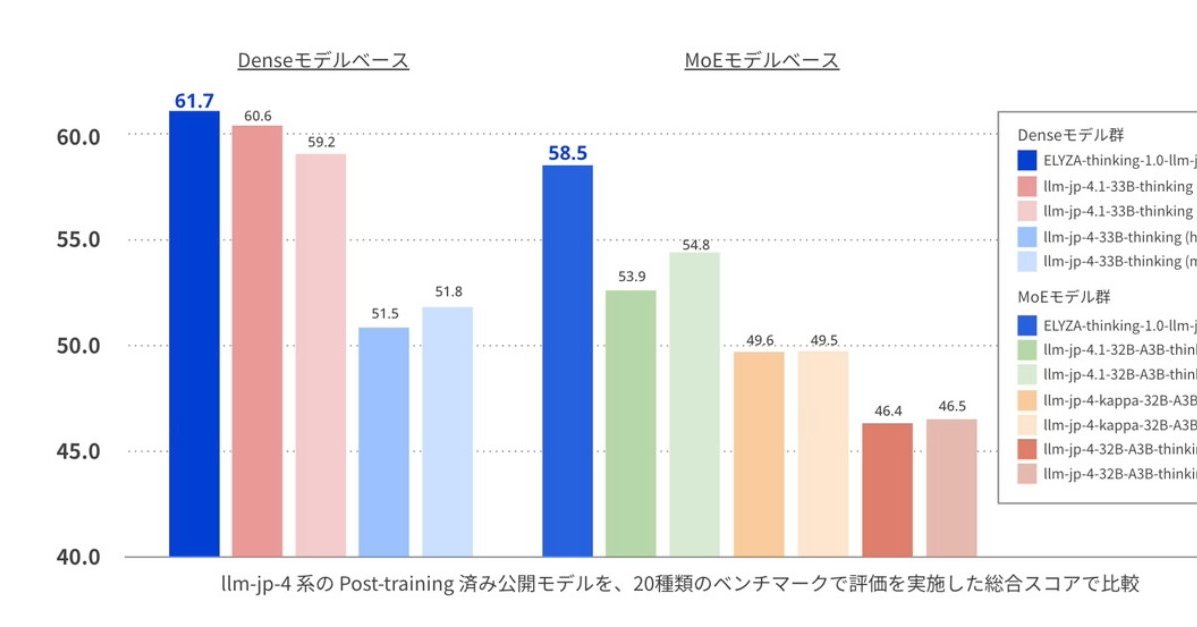
KDDI Group's ELYZA released ELYZA-Thinking-1.0-llm-jp-4-33b and ELYZA-Thinking-1.0-llm-jp-4-32b-a3b for free on October 2 via Hugging Face, built on NII's LLM-jp-4 series. ELYZA said the two models scored above NII's improved LLM-jp-4.1 on some benchmarks, suggesting outside customization can lift a base Japanese model's results.
The models' practical value hinges on which benchmarks and tasks they were measured against, since only 'some benchmarks' are cited. The same release also launched ELYZA RSI Research, whose recursive self-improvement goal is still described as pre-stage.
- 2
Ai2's Olmo-core 3 hits 52,000 tokens per second, topping Megatron-core
The Allen Institute for AI announced Olmo-core 3 on Thursday, a training framework it says scaled mixture-of-experts models to over one trillion parameters while processing 52,000 tokens per second on Nvidia B3000 GPUs, about 2.7 times Nvidia's Megatron-core. The framework is meant to lower the memory and networking costs that keep trillion-parameter models out of reach for researchers without state or enterprise infrastructure, which may widen who can train these systems.
The throughput figure is a first-party benchmark, and the test is whether outside developers reproduce it on other hardware. The project and related systems are already on GitHub.
- 3
Trillium Labs to open up risky AI research, aims for $40 to $100 million
Nathan Lambert and Tom Zick launched Trillium Labs, which will publish experiment details in areas like recursive self-improvement and agents. It raised an undisclosed sum and aims to raise $40 to $100 million. Publishing how models are tuned could let outside scientists scrutinize and replicate work that frontier labs keep closed, which Lambert argues is key to mitigating risks.
The $30 million planned for training over 18 months hinges on whether the remaining $40 to $100 million is raised. Watch whether outside researchers can replicate the published runs.
- 4
NetApp and Iterate.ai push AIPod Mini for private AI
NetApp and Iterate.ai are packaging the AIPod Mini with Iterate's Generate platform and an embedded LLM, so enterprises can run AI queries locally on their own hardware. The companies say open-weight and closed models are getting close to the frontier, which the partners see as making privately run AI a credible option for enterprises that want to keep data under their own control.
Iterate.ai's results — an insurance accident-report analysis cut from about eight hours to eight minutes, and a forensic agent that identified $17.4 million in denied claims — are early examples; the test is whether such outcomes carry over to other customers.
- 5
Qwen3.8-Flash-Next Previews Qwen4.x Architecture
Qwen released Qwen3.8-Flash-Next on August 27, 2026, calling it a preview of the architecture planned for Qwen4.x. The design suggests Qwen's team is applying its own improvements rather than reusing existing structures, which points to independently developed technology rather than reliance on distillation.
The outcome hinges on whether llama.cpp adds full support for the new attention structure before Qwen4.x arrives. Watch the sparse flash attention pull request, #28349.
- 6
Clef-flash vs Jev: format matches, speed claim fails
A developer testing Cloudflare's Clef and Clef-flash, released October 1 under Apache 2.0, found Jev's official Python SDK ran on Clef after only changing the endpoint and model name, with identical answer structure. The two families of decision models look interchangeable on the code level, so teams already using Jev can compare them on their own data rather than rewriting an application to try Clef.
Whether the speed case holds depends on region and network, since the official 38.8 ms figure is a Cloudflare-internal median; the test also found Jev stays the cheapest option per judgment.
What to Watch
Keep an eye on whether outside developers can reproduce the claimed speed, training runs, and benchmark results — especially in new regions, on different hardware, and for other customers. The next big signal will be whether llama.cpp fully supports the new attention structure before Qwen4.x arrives.
Sources
- 国産AI「LLM-jp-4」ベースのAIモデル、KDDI傘下のELYZAが無料公開
- Ai2 releases Olmo-core 3 to make developing large mixture-of-experts LLMs more efficient
- These AI Experts Want to Do High-Stakes Research Out in the Open
- Enterprise storage becomes AI memory as privately run models close in on the frontier
- 次世代アーキテクチャを先取り!Qwen3.8-Flash-Nextで覗くQwen4の設計思想
- Cloudflare の判定モデル Clef は Jev の代わりになるか — 精度・速度・料金・互換性を比べる
- Open-Jevを Databricks AI Runtime と Model Serving で動かしてみた
- Black Forest Labs launches Flux 3 Image with multi-step editing that leaves the rest of your picture alone
- 無料&オープンソースのAIコーディングツール「Pi 1.0」が正式リリース、MCP対応や複数のAIモデルを切り替える機能を追加
- 「完全国産」AI、KDDI傘下のELYZAが無料公開 「LLM-jp-4」ベースに性能強化
- 生成AI活用を加速するDifyアプリ共有プラットフォーム提供開始 1万件超の社内実践知を企業間で共有可能な「RICOH AI App Mall」
- 画像生成AI「FLUX 3 Image」が登場、「最大4K生成」「被写体の位置指定」「一部分のみ編集」など高機能でオープンモデル版も数週間後に登場予定
- 沈黙の物理学者、Anthropic CEO ダリオ・アモディ。
- Build Local AI Apps with C++ and NVIDIA TensorRT RTX Samples | NVIDIA Technical Blog
- Parallel-in-Time Training of Recurrent Neural Networks for Dynamical Systems Reconstruction [R]
- AWS debuts Strands Decider 2B, a first lightweight decision model for accelerate agentic workflows
Share this with a friend
Send today's roundup to anyone who wants to keep up.
Get daily AI news free with AIToday
Today's AI, for Today's work. Email / LINE / Slack.
Sign up free