AI in Healthcare
Jun 26, 2026
The Gist
AI technology is rapidly transforming healthcare and drug development, with major companies like Danaher, Thermo Fisher, and AWS advancing AI-powered tools for everything from opioid monitoring to streamlined drug discovery. Stanford researchers and partnerships like Insilico Medicine's $2.5B collaboration with SK Biopharm are deploying AI "scientist" agents to accelerate pharmaceutical innovation. These breakthroughs signal that AI is becoming essential infrastructure across clinical monitoring, drug discovery, and manufacturing processes in modern medicine.
Today's Stories
- 1
Medical robots & AI take center stage at London festival debate
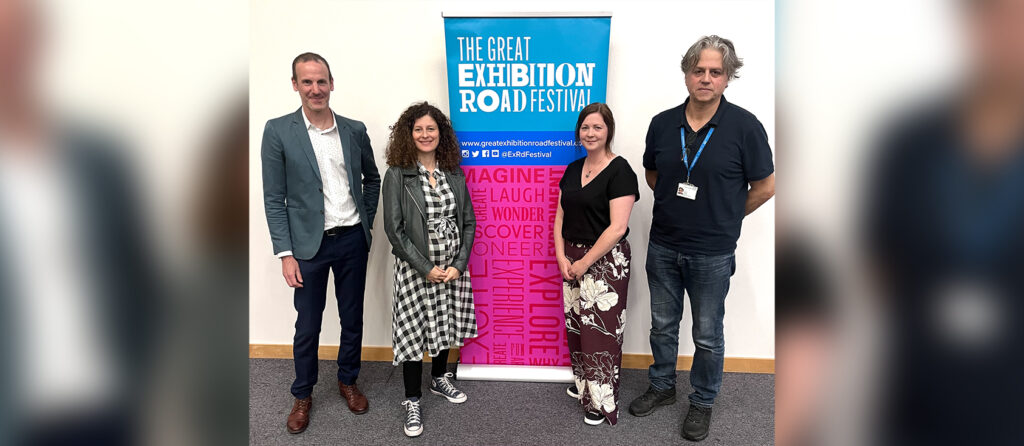
A live podcast recording at the Great Exhibition Road Festival in London brought together three leading UK academic researchers—George Mylonas (Imperial College London), Antonia Tzemanaki (University of Bristol), and Tom Vercauteren (King's College London)—to discuss robotics and AI in medicine and healthcare, more than 40 years after the first robot-assisted surgery. As medical tools become increasingly autonomous, the conversation addresses critical questions about ethics, regulation of technologies that can learn and change over time, and fair access to cutting-edge medical devices. These concerns directly shape how hospitals and healthcare systems can safely adopt and deploy new surgical and diagnostic tools.
The researchers cover a range of surgical applications—from robotic needle steering and tumor detection to rehabilitation and wearable robotics for physical therapy. Tom Vercauteren's spin-out company, Hypervision Surgical, already has its optical imaging technology in use across hundreds of hospitals worldwide, showing one path from research to clinical practice.
- 2
How FDA Clearance of AI Opioid-Respiratory Monitoring Could Shape Danaher's (DHR) Clinical Data Advantage
How FDA Clearance of AI Opioid-Respiratory Monitoring Could Shape Danaher's (DHR) Clinical Data Advantage
- 3
Stanford researchers deploy AI 'scientist' agents to streamline drug discovery
A Stanford team led by James Zou, associate professor of Biomedical Data Science, has deployed thousands of autonomous AI 'scientist' agents in a virtual biotech environment. These agents handle the full lifecycle of drug development, from initial discovery through safety testing and clinical trial design, while maintaining continuity across workflows. Drug discovery today is fragmented across disconnected specialist teams, with 90% to 95% of projects reportedly failing and successful drugs taking over a dozen years and up to $1 billion(約1600億円) from discovery to distribution. The agentic AI approach addresses the knowledge loss that occurs at each handoff between teams, suggesting a potential path to reduce inefficiency in one of the industry's most challenging processes.
The Stanford team will discuss their work at VB Transform 2026. Generative AI is already being applied to drug discovery challenges, but this deployment represents a step forward in using agentic AI (AI that acts independently) to solve the structural problem of disconnected workflows.
- 4
AWS shows how to build multi-tenant AI agents safely
AWS published a blog post demonstrating how to build multi-tenant AI applications using Amazon Bedrock AgentCore, with a healthcare example that implements two service tiers—Basic (using Mistral Ministral 3 8B Instruct for small clinics) and Premium (using OpenAI GPT OSS 120B with web search for hospitals and specialty centers). Multi-tenant AI systems face real operational risks: customer data exposure, inconsistent service quality across pricing tiers, and hidden cost overruns. This post addresses those challenges by showing how to enforce complete tenant isolation through document scoping, memory separation, model access control, and granular cost attribution—all without building custom isolation infrastructure.
The solution uses a pool model where tenants share underlying compute resources (rather than dedicated silos), maximizing efficiency while maintaining logical isolation through scoped identifiers, access policies, and data partitioning. Sample code is available on GitHub at https://github.com/aws-samples/sample-agentcore-and-multitenancy-blog.
- 5
Insilico Medicine, SK Biopharm partner on $2.5B AI drug discovery deal
Insilico Medicine and SK Biopharmaceuticals have struck a $2.5B partnership to discover and develop new drugs for neuroimmune therapies using AI, according to remarks by Insilico's co-CEO Alex Zhavoronkov to Fortune. The deal signals that major pharmaceutical companies are now willing to commit substantial capital to AI-driven drug discovery, a shift from earlier skepticism. For businesses in biotech and pharma, this validates the business model of using AI to accelerate the costly, time-consuming drug development process.
The partnership targets neuroimmune therapies, an area where Insilico sees significant opportunity to apply its AI platform to reduce development timelines and costs.
- 6
Thermo Fisher Launches AI Tools for Drug Development, Manufacturing
Thermo Fisher Scientific unveiled new capabilities in manufacturing, clinical development, and AI-enabled research at BIO International 2026. The company is expanding its portfolio to help customers accelerate drug development and production workflows using artificial intelligence. Biopharma companies face pressure to bring drugs to market faster and more cost-effectively. AI-powered tools for research, manufacturing, and clinical work could help streamline these processes, making it easier for customers to adopt digital solutions across their entire development pipeline.
The announcements were made at BIO International 2026, a major industry conference. Specific pricing, availability timelines, or which products received the deepest updates were not detailed in the announcement.
What to Watch
Watch for breakthroughs in autonomous AI agents tackling healthcare's fragmented systems—from drug discovery workflows to surgical applications—as companies like Hypervision Surgical and partnerships focused on neuroimmune therapies move research innovations into real-world hospitals and clinics at scale. The coming months will reveal how quickly these AI tools can reduce drug development timelines and improve surgical precision, with key details expected from industry conferences and product announcements.
Sources
- Robot Talk Episode 162 – The robot doctor will see you now
- How FDA Clearance of AI Opioid-Respiratory Monitoring Could Shape Danaher’s (DHR) Clinical Data Advantage
- Stanford researchers will discuss their agentic 'scientists' that are on course to reshape drug discovery at VB Transform 2026
- Shared infrastructure, isolated tenants: Pool model multi-tenancy with Amazon Bedrock AgentCore
- Insilico Medicine, SK Biopharmaceuticals strike $2.5B AI drug discovery deal targeting neuroimmune therapies
- Thermo Fisher Scientific Showcases New Capabilities Across Manufacturing, Clinical Development and AI-Enabled Research at BIO International 2026
- Thermo Fisher Scientific Showcases New Capabilities Across Manufacturing, Clinical Development and AI-Enabled Research at BIO International 2026
- Show HN: Jacobi–IDE for Abaqus subroutine with analytical tests and AI diagnosis
- AI Rewrites Drug Discovery: Eli Lilly and Twist Bioscience Chart Two Distinct Industrialization Paths
- The Next Wave of Medical AI Could Mint More Millionaires Than the First -- Here Are the Stocks to Own
Share this with a friend
Send today's roundup to anyone who wants to keep up.
Get daily AI news free with AIToday
200+ AI sources, summarized in 1 minute. Email / LINE / Slack.
Sign up free