AI Regulation & Policy
Jun 29, 2026
The Gist
Governments and companies are advancing AI safety through new governance frameworks, with CORE launching safeguards for AI agents, Rubrik integrating AWS Bedrock for oversight, and OpenAI releasing GPT-5.6 models after regulatory clearance. Meanwhile, advocacy groups like PauseAI are mobilizing to shape AI policy, while some companies like Skyways continue deploying advanced AI systems with limited transparency.
Today's Stories
- 1
CORE: Open-source governance layer blocks AI agents from dangerous code changes
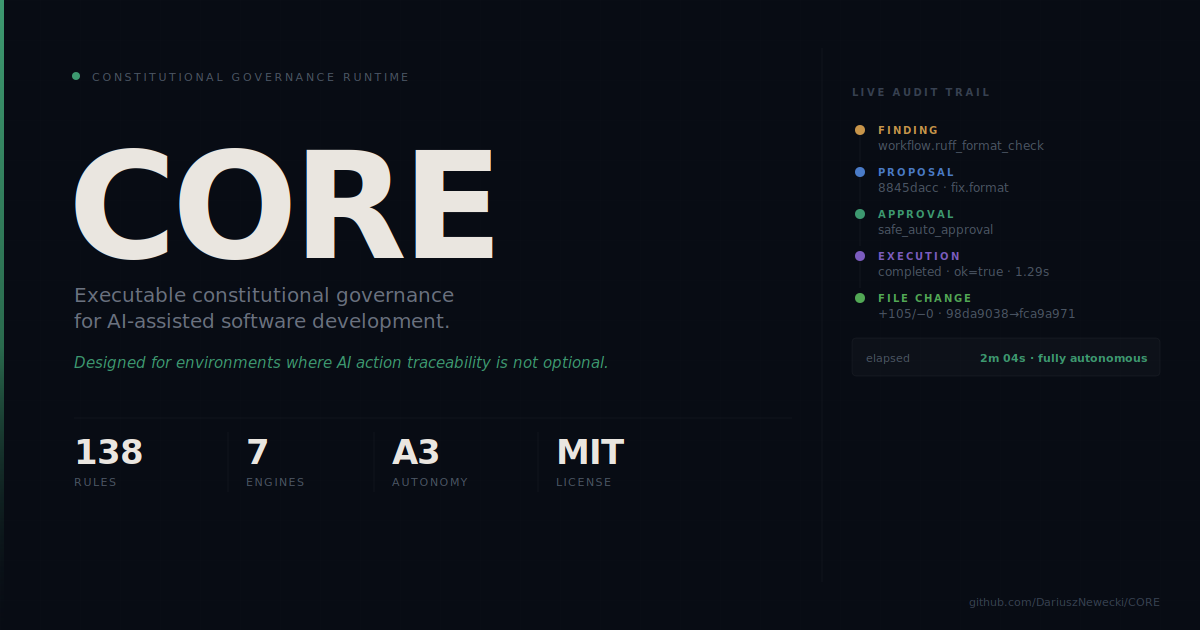
A new tool called CORE enforces constitutional rules on AI coding agents, structurally blocking violations before execution—for example, preventing an agent from deleting a production database. Every action is logged with a complete audit trail showing finding, proposal, approval, execution, and file change. AI coding tools generate code faster than teams can review it, creating invisible technical debt and architectural violations. CORE makes dangerous mutations impossible by moving enforcement from after-the-fact detection to hard barriers before any code runs, giving developers deterministic control over autonomous workflows.
CORE is available now on pip (version 2.x, beta stage) and can be tested immediately with a Docker command that runs a live governance demo. The system separates four repository layers—specs (human intent), mind (law), will (judgment), and body (execution)—enforced as constitutional law, not convention.
- 2
Feedback around "Tech enforcement layer for AI governance"
Feedback around "Tech enforcement layer for AI governance"
- 3
Rubrik expands Cognizant partnership, integrates with AWS Bedrock for AI agent governance
In mid-June 2026, Cognizant expanded its alliance with Rubrik, and Rubrik announced an upcoming integration with Amazon Bedrock AgentCore to provide real-time AI governance, rollback capabilities, and unified policy control for enterprises running autonomous agents on AWS and Cognizant platforms. These moves position Rubrik as a core infrastructure provider for governing AI agents at scale, particularly in heavily regulated sectors where traceability and policy enforcement are critical. For enterprises deploying autonomous agents across cloud and on-premises environments, the integration may reduce the operational risk and compliance burden of managing AI workloads.
The Rubrik Agent Cloud integration with Amazon Bedrock AgentCore is described as upcoming, meaning availability details and timing remain to be confirmed.
- 4
AI safety group PauseAI builds social movement to influence governance
PauseAI and the existential AI safety community are treating the building of a civic and social movement as a core intervention strategy to reduce catastrophic risks from AI. The post, written by Matilda da Rui and Maxime Fournes with contributions from Benjamin Schmidt (PauseAI Germany co-lead), argues this approach has been badly neglected despite its potential value. The body states this social movement approach may significantly enhance the likelihood that governance efforts succeed at keeping humanity safe from AI-related catastrophic risks. For business and policy leaders, it suggests that coordinated civic organizing—not only technical work or regulation alone—is being positioned as necessary to shape how AI development is governed.
The post notes that as far as the authors can tell, only one organization is currently building this kind of movement. (Note: PauseAI and PauseAI US are described as distinct entities with different leadership and approaches.)
- 5
OpenAI rolls out GPT-5.6 trio to 20 orgs after US government review
OpenAI announced a limited preview of three new GPT-5.6 models—Sol, Terra, and Luna—available through the API to approximately 20 organizations after sharing the models with the U.S. government. General release is planned for the coming weeks. The GPT-5.6 series claims superior token efficiency and enhanced reasoning, enabling complex tasks with significantly fewer resources—a shift that could reduce computing costs for software engineering, scientific research, and cybersecurity workloads. The staggered rollout reflects a new process where federal agencies benchmark AI capabilities before wider deployment.
Access is currently limited to a narrow set of roughly 20 organizations; a general release timeline of the coming weeks will determine when broader adoption becomes possible.
- 6
Skyways builds global cargo drone fleet in near-total secrecy
Austin-based Skyways Aviation has quietly assembled the world's largest unmanned aircraft fleet over the past decade, operating heavy-duty autonomous drone deliveries across three continents. The company's V3 aircraft can carry payloads of up to 100 pounds across a range of over 1,000 miles and operates offshore cargo missions for maritime, oil, and logistics clients. Skyways has partnered with Japan's All Nippon Airways (ANA) to fly cargo missions from Okinawa to surrounding islands and military vessels, and is preparing to begin flights with Danish logistics company DSV A/S. Skyways' approach—solving customer problems rather than marketing technology—reflects a deliberate business philosophy established by CEO Charles Atkin nine years ago, when he decided to avoid marketing and promotion entirely. The company's wealth of international regulatory experience positions it to handle upcoming U.S. drone regulations, particularly the FAA's anticipated BVLOS (beyond visual line of sight) rule, Part 108, which will require commercial drones to have detect-and-avoid technology. For businesses with offshore or maritime assets seeking cargo delivery and inspection services, Skyways' track record across multiple regulatory environments offers credibility in a sector known for unfulfilled promises.
Skyways is developing a project to provide cargo delivery and inspection services to major U.S. and international oil companies operating in the Gulf of Mexico, with more details expected in the next several months. The company is also pursuing two significant regulatory goals: the ability to operate multiple aircraft using a single pilot, and authorization to fly offshore beyond the 12-nautical-mile limit—capabilities the company believes will unlock new airspace.
What to Watch
As CORE moves into public beta testing and access expands from its current 20-organization limit in the coming weeks, watch whether this constitutional approach to AI governance gains traction as a practical alternative to traditional policy frameworks. Meanwhile, Skyways' pursuit of offshore autonomy and multi-aircraft single-pilot operations could reshape how autonomous systems are regulated in high-stakes industries like maritime energy, setting precedents that extend far beyond cargo delivery.
Sources
- Core – Deterministic governance rules for AI-generated code (pip installable)
- Feedback around "Tech enforcement layer for AI governance"
- How Rubrik’s Expanded Cognizant Alliance And Bedrock AgentCore Tie-Up At Rubrik (RBRK) Has Changed Its Investment Story
- Existential AI safety needs an effective social movement. PauseAI is building it
- OpenAI unveils GPT-5.6 Sol, Terra and Luna models — but only accessible to limited preview partners for now, per US Gov
- How Skyways Quietly Built a Global Heavy-Lift Drone Business
- Production-grade AI agents for financial compliance: Lessons from Stripe
- OpenAI will delay GPT-5.6 after Trump administration request
- AI Agent Governance vs. Observability: What's the Difference?
- Cloud AI Today - AI Investment Shifts Focus to Growth Amid Scaling Challenges
Share this with a friend
Send today's roundup to anyone who wants to keep up.
Get daily AI news free with AIToday
200+ AI sources, summarized in 1 minute. Email / LINE / Slack.
Sign up free