Image Generation
Sep 2, 2026
The Gist
Google rolled out Pics, an AI image editor built into Workspace, positioning it as a direct competitor to Canva. Meanwhile, a report explains that many consumers find AI-generated images "cringey," highlighting a trust gap with the technology, even as auction demand for hand-drawn Disney concept art soared to $3.43M. AI imaging is clearly pushing into both enterprise tools and tiny embedded devices, but the consumer appetite for purely AI-made visuals remains a key hurdle.
Today's Stories
- 1
Google Pics launches with AI image editing for Workspace
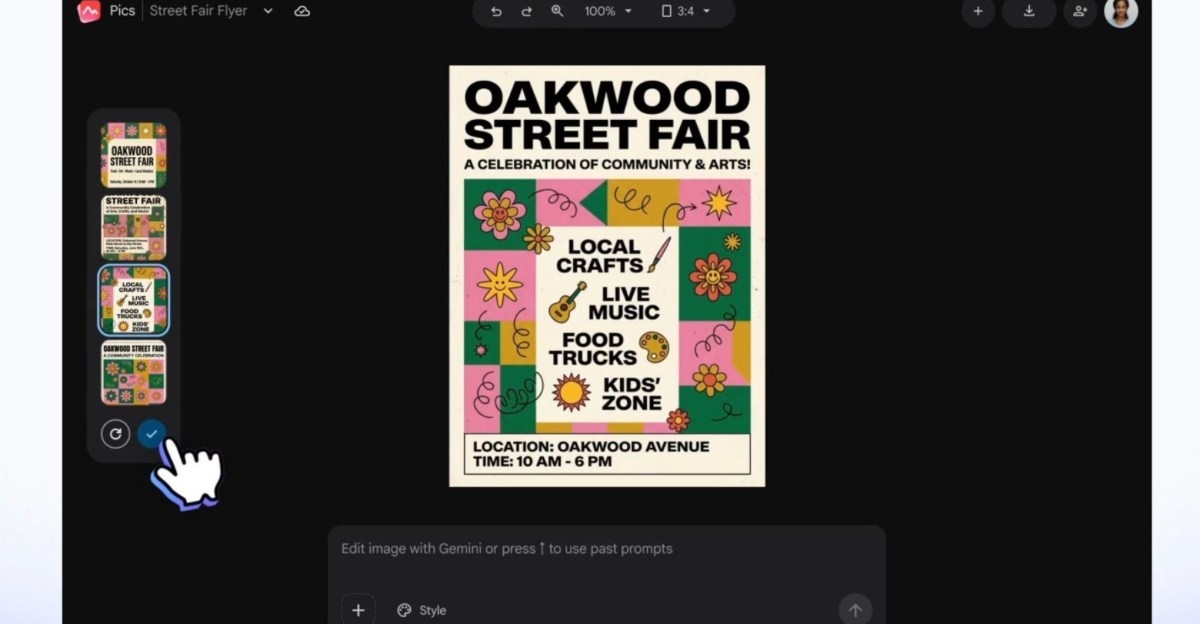
Google has launched Google Pics, a new suite of creative design tools for Workspace users, built around Gemini and the Nano Banana AI model. It is available as a standalone app and integrated into Google Docs and Slides, with Drive rollout planned. Google aims to solve business pain points with AI image generation, such as inconsistent results and cumbersome workflows, by offering more precise control. This could reduce the need for Workspace users to rely on third-party tools like Canva or Adobe Express.
The rollout includes Business Standard, Business Plus, Enterprise Standard, and Enterprise Plus plans, as well as Google AI Pro and Ultra personal plans, and Google AI Pro for Education. The tools include upscaling to 2K or 4K and collaborative design sharing.
- 2
Google Pics: Google's AI answer to Canva
Google is launching Google Pics, an AI-powered image creation and editing tool that will be part of Google Workspace for business customers and premium Google AI subscribers. It starts rolling out today in Docs and Slides, with Drive support coming later. Unlike Canva, which lets artists sell templates in a marketplace for royalties, Google Pics creates visuals purely from AI prompts trained on artists' work. Unlike Adobe Express, it's designed for prompting rather than designing from scratch, making everyday work visuals like posters and social posts faster.
Powered by Google's Nano Banana image-generation model, the tool will reach most Workspace customers and Google AI Pro/Ultra subscribers over the coming weeks. It also includes collaborative editing and multi-generation options to pick the best result.
- 3
Why AI images feel 'cringey' to consumers
Recent controversies include Ajinomoto's official X account posting an AI-edited image and a restaurant menu sample image made with generative AI, both drawing backlash. The gap between what senders think is good and what receivers value causes rejection, according to Asteria executive officer Fumihiro Naganuma, who notes polished AI images may seem careless or lacking human touch.
As AI-generated images become common, appreciation grows for handmade, imperfect creations, like the Agriculture Ministry's simple poster that went viral in June, and the rise of BeReal. as a reaction to overly curated Instagram posts.
- 4
Disney concept art auction fetches $3.43M
Heritage Auctions' sale of Disney art last weekend generated $3.43 million across 1,346 lots. Gustaf Tenggren's concept painting for Snow White and the Seven Dwarfs fetched $85,400. The auction shows concept art holds artistic and monetary value, which contrasts with the use of AI for concept art. It raises the question of whether AI-generated art will be valued similarly in the future.
Whether the growing appreciation for animation art continues, as noted by Heritage's Jim Lentz. The article questions if anyone will appreciate AI-generated Spider-Man art in 50 years.
- 5
ESP32-P4 Reads Water Meter with AI
A hobbyist built a system that reads a water meter using the Makerfabs ESP32-P4 board with autofocus camera. They trained a dedicated model on real water meter images, focusing on the pointer and digit-reading area. After deployment, it correctly recognized the meter reading. This moves from a proof-of-concept 5-digit recognition demo to a practical application. It shows that AI-based image recognition can run directly on an embedded device for real-world tasks like utility metering.
The system's accuracy on more varied meter conditions, such as different lighting or wear, is not yet reported. Further real-world testing would show if it can be deployed widely.
- 6
Small AI image model runs on microcontroller
A developer created a tiny image generation model, a latent flow transformer with 12 layers, that runs fully on a microcontroller. It has only 2.4–4 million parameters, making it extremely small. The model generates 128x128 face images in about 20 seconds on a low-power microcontroller, demonstrating that complex AI tasks can run on minimal hardware. This could enable AI generation in devices where it was previously impossible.
The developer will share the repository, allowing others to reproduce and experiment with the model. The use of CFG and Relu² activation improved image quality and efficiency, hinting at future optimizations for such tiny AI systems.
What to Watch
Watch for Google’s new image tools to roll out widely over the coming weeks, bringing 4K upscaling and collaborative features to most Workspace and AI subscription users, while the same period may see a growing public taste for hand-made or imperfect visuals over polished AI outputs. Also keep an eye on whether the fascination with AI-generated art lasts, and if tiny, efficient models like this one gain traction as their code goes public for anyone to test in real-world conditions.
Sources
- Google Pics is like Canva, but with even more AI
- Google’s answer to Canva is an AI tool where you prompt instead of design
- 生成AI画像はなぜ“キショい”のか 消費者が抱く違和感の正体 広報のプロが解説
- The $3.4m Disney auction is a reminder of what AI concept art takes from us
- From 5-Digit Recognition to Water Meter Reading with ESP32-P4
- I implemented a very tiny image generation model (latent flow transformer) on a RP2350 microcontroller - it can generate 128x128 images of faces [P]
- 33 image models from 8 providers compared
- He Scraped All of Their Art for AI. Now He’s Collaborating on a Tool to Help Them
- Build agentic creative workflows with Amazon Quick and fal
- Adobe is adding more AI to Photoshop
- Luce: Relightable Gaussians for 3D Asset Generation
- AI Slop Is Ruining Cute Animals on the Internet
- Netflix’s Hamnet Accused of Using AI, but the “Error” Has a Historical Explanation
- Stability AI, maker of image generator Stable Diffusion, raises $76 million in fresh funding
- STARFlow2: Bridging Language Models and Normalizing Flows for Unified Multimodal Generation
- アシックス---「AI-App クマ検知」を9月1日より提供開始 執筆 - Investing.com
Share this with a friend
Send today's roundup to anyone who wants to keep up.
Get daily AI news free with AIToday
Today's AI, for Today's work. Email / LINE / Slack.
Sign up free