AI in Healthcare
Jul 19, 2026
The Gist
AI systems analyzing medical X-rays are overconfident in their assessments and actually underperform compared to human radiologists, highlighting the technology's current limitations in clinical settings. Meanwhile, major players are racing to expand AI's role in healthcare—Thermo Fisher's $8.875B acquisition of Clario aims to dominate clinical trial data, and Miles Wang's new $2B startup is securing $200M to use AI for drug discovery, though experts caution that AI accelerates rather than replaces traditional research processes. ExaWizards has also launched a wearable device for breast cancer patients, reflecting growing efforts to integrate AI into patient care and monitoring.
Today's Stories
- 1
AI X-ray readers dangerously overconfident, losing to human radiologists
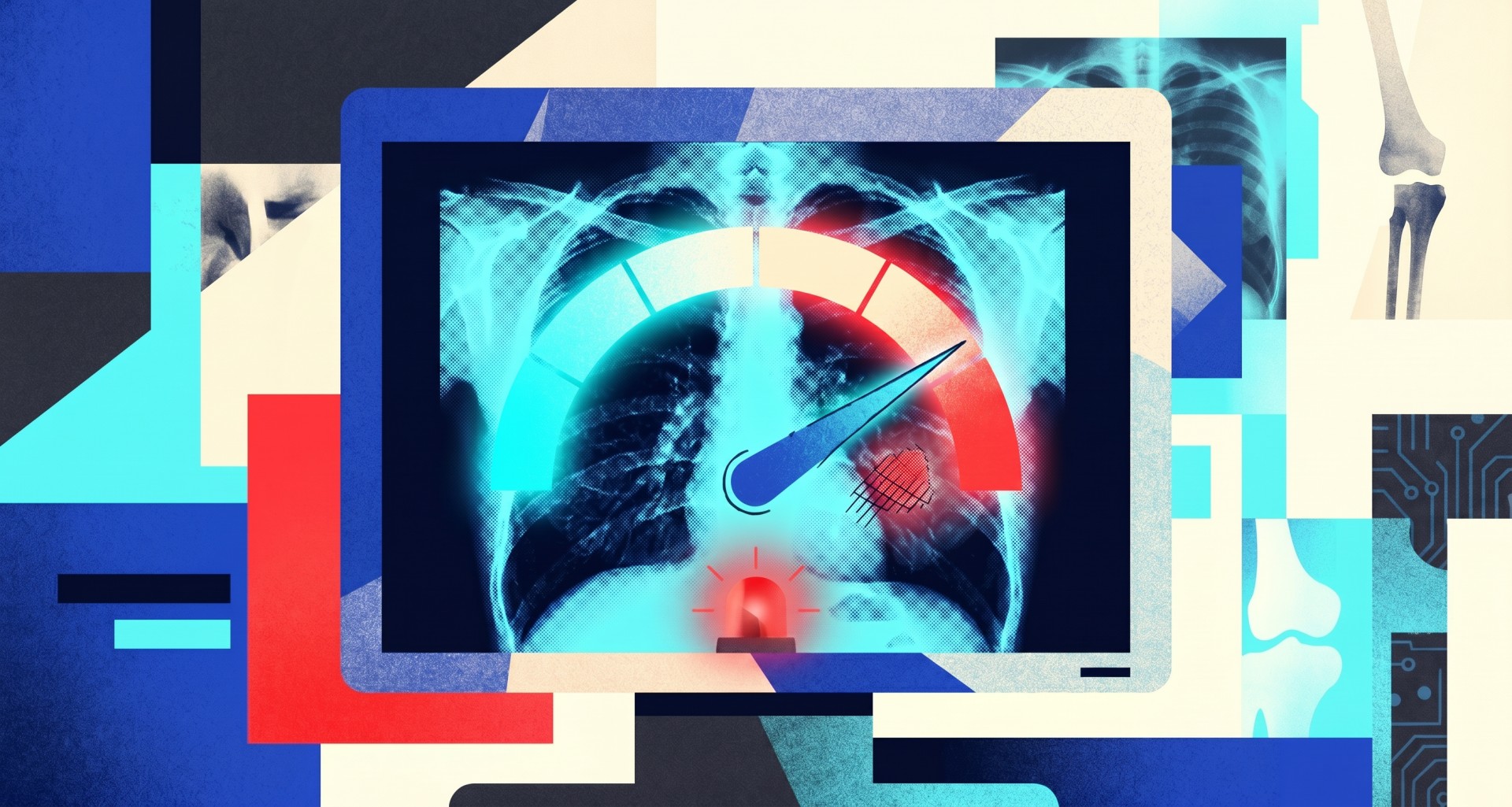
A test of 16 AI models on 200 X-ray cases showed human radiologists scored 988.7 out of 2,000 points on a metric that combines accuracy with confidence calibration, while the best AI model scored 758. Anthropic's Claude Fable 5 performed best on reliable answers; Google's Gemini 3 Pro had the highest raw accuracy. The scoring system penalizes models for confident wrong answers—a core problem: many AI systems confidently misdiagnose rather than admitting uncertainty. Medical misdiagnosis is far more dangerous than honest uncertainty, yet many AI models are trained to guess. More patients are uploading X-rays and MRI scans to chatbots and trusting the responses, despite the finding that several top commercial models produce highly confident misdiagnoses with confidence levels that do not reliably track accuracy. Recent claims that AI diagnoses better than 99 percent of doctors are mostly based on anecdotes or simulations rather than rigorous testing.
RadLE 2.0, the test framework, will expand on a rolling basis to include new models. A full scientific publication with cost analyses and error taxonomy has been announced. The core question remains: before an AI system makes independent medical decisions, it must first demonstrate it knows when it should not answer—a capability most models still lack.
- 2
Thermo Fisher Completes $8.875B Clario Buy, Targets Clinical Trial Data Dominance
Thermo Fisher Scientific completed an $8.875 billion(約1.4兆円) cash acquisition of Clario Holdings, a clinical trial endpoint data provider, with potential additional payments of $125 million(約200億円) in January 2027 and up to $400 million(約640億円) in earn-outs tied to 2026–2027 performance. The deal was initially agreed upon in October 2025. Clario's platform has supported approximately 70% of FDA and EMA novel drug approvals over the past decade. The acquisition immediately adds $0.45 to adjusted EPS and is expected to deliver approximately $175 million(約280億円) in adjusted operating income from synergies by year five, creating a full-stack infrastructure that integrates clinical trial data with Thermo Fisher's existing CRO business (PPD). However, Thermo Fisher faces a "Switzerland Problem"—competitors like IQVIA, ICON, and Fortrea have historically used Clario's platform, and may hesitate to share sensitive trial data with a now-rival-owned subsidiary.
Thermo Fisher must balance integrating Clario enough to achieve $175 million(約280億円) in revenue synergies by year five while maintaining sufficient operational independence and perceived neutrality to retain external clients. The company's partnership with NVIDIA on AI-driven analytics will amplify Clario's clinical trial data for accelerated drug discovery; AI algorithms analyzing data from millions of patients could identify correlations and optimize trial designs.
- 3
ExaWizards Unveils Wearable Device for Breast Cancer Patients
ExaWizards and ExaMD presented findings from a wearable device study targeting breast cancer patients at the ASCO 2026 Conference held by the American Society of Clinical Oncology (ASCO). The research is a collaborative project involving Kansai Medical University, Daiichi Sankyo, and other institutions. The research represents a partnership between Japanese AI and healthcare companies and major pharmaceutical and academic institutions, advancing the development of wearable monitoring technology for cancer patients. Presentation at ASCO, one of the world's leading oncology forums, demonstrates that the research meets international clinical standards.
While detailed findings and clinical implications from the wearable device research are expected to be presented at ASCO 2026, specific results have not yet been disclosed in this announcement.
- 4
MindWalk Holdings joins Russell 3000E ahead of Q4 earnings
MindWalk Holdings Corp. (NASDAQ: HYFT), an Austin-based AI drug-discovery company, was added to the Russell 3000E Index effective after the U.S. market close on June 26, 2026. The company will report fourth-quarter and full fiscal year 2026 results on July 22, 2026, at 5:00 p.m. Eastern Time, and has filed a European patent application for its proprietary HYFT Technology and ReefIQ biological context layer. The index inclusion broadens MindWalk's eligibility for index-tracking funds, giving it fresh institutional visibility at a time when AI-driven drug discovery names have been among the market's stronger performers. The company is positioning itself in two major pharmaceutical frontiers—GLP-1 metabolic health and infectious disease—by applying its LensAI platform to programs aimed at sustaining high-quality signaling alongside healthy-aging pathways.
MindWalk's earnings call on July 22, 2026 will offer investors a near-term look at the company's revenue trajectory and program progress. The company's competitive differentiation rests on HYFT Technology, a proprietary, function-aware representation of biology built on roughly 660 million biological patterns that encode conserved relationships between sequence, structure, and function.
- 5
OpenAI researcher Miles Wang raises $200M at $2B for AI drug discovery startup
Miles Wang, an OpenAI researcher, is leaving to launch a startup focused on AI models for drug discovery. He is in talks to raise about $200 million(約320億円) at a $2 billion(約3200億円) valuation, with Lightspeed in discussions to lead the funding round; several other OpenAI researchers are expected to join. The move reflects investor appetite for AI applied to life sciences. Comparable startups have raised substantial funding—Chai Discovery announced a $400 million(約640億円) raise at a $3.8 billion(約6100億円) valuation this week, and Google DeepMind's Isomorphic Labs raised a $2.1 billion(約3400億円) Series B in May. The new company may focus on finding new uses for existing FDA-approved drugs, which can reach revenue faster than developing drugs from scratch.
Wang, who joined OpenAI in 2024 after dropping out from Harvard, has co-authored research on how AI models can automate and accelerate scientific discovery. Wang disputed the reported funding figures and company description but did not specify the correct details; talks are ongoing and the deal may not be final.
- 6
Amgen, Scientists Say AI Speeds Drug Discovery but Is Not a Shortcut
Amgen and leading academic institutions held a roundtable conversation (Meeting the Moment) exploring how AI is shaping drug discovery. The discussion underscores that while AI can help teams analyze complex data, generate hypotheses, and identify patterns, it does not replace the scientific process. Developing a new medicine typically takes more than a decade. AI offers the potential to help researchers learn faster, but key challenges remain—including predicting how drugs behave in the human body and ensuring safety. The conversation highlights that real progress depends on high-quality data, deeper biological understanding, and expertise and judgment of scientists working alongside these tools.
Amgen is investing in this direction through a recent South San Francisco lab expansion designed to support the Design, Make, Test, Analyze (DMTA) process, which brings together chemistry, biology, automation, and data science to generate insights faster and better connect decisions across the research process.
What to Watch
As RadLE 2.0 and similar evaluation frameworks expand to test whether AI models know when not to make medical decisions—a critical safety benchmark most systems still fail—watch how regulatory bodies will eventually demand this capability before approving autonomous clinical AI. Meanwhile, the race to integrate AI with massive biological datasets (from Thermo Fisher–Clario's partnership with NVIDIA to MindWalk's 660-million-pattern biology engine and Amgen's automated DMTA labs) will determine which companies can turn raw data into faster, more reliable drug discovery, even as they navigate the tension between speed and the transparency required to maintain stakeholder trust.
Sources
- AI chatbots reading X-rays can be dangerously confident even when they're wrong
- Why is Thermo Fisher Betting Big on Clinical Trial Data
- ExaWizards and ExaMD Present Findings from a Wearable Device Study on Breast Cancer Patients—A Joint Research Project with Kansai Medical University, Daiichi Sankyo, and Others—at the American Society of Clinical Oncology "ASCO 2026" ‐Aiming to
- As AI Rewrites Drug Discovery, This Bio-Native AI Company Just Joined the Russell 3000E, and Reports Earnings July 22
- OpenAI researcher Miles Wang in talks to launch AI drug discovery startup valued at $2B
- How AI Is Changing Drug Discovery and What It Will Take to Unlock Its Full Potential
- Insilico Initiates Phase III Clinical Trial for Rentosertib, Its AI-Empowered TNIK Inhibitor for Idiopathic Pulmonary Fibrosis
- When the sovereign AI diagnosis goes prime time
- Pharma Races to Scale AI as Billions Flow into Drug Discovery
- Anthropic launches its own drug discovery programs to tackle diseases Big Pharma considers unprofitable
Share this with a friend
Send today's roundup to anyone who wants to keep up.
Get daily AI news free with AIToday
200+ AI sources, summarized in 1 minute. Email / LINE / Slack.
Sign up free