AI Regulation & Policy
Sep 9, 2026
The Gist
Japan’s SoftBank secured ISO/IEC 42001:2023 certification for its TASUKI Annotation service, while a RIZAP employee leaked 210 IHI health-insurance records to AI and notified OpenAI. Separately, Meta ads were found to have nudified real teens, and a lawsuit claims Anthropic’s Max plan overpromises usage. AI is moving faster than oversight, so expect stricter audits and clearer vendor accountability this year.
Today's Stories
- 1
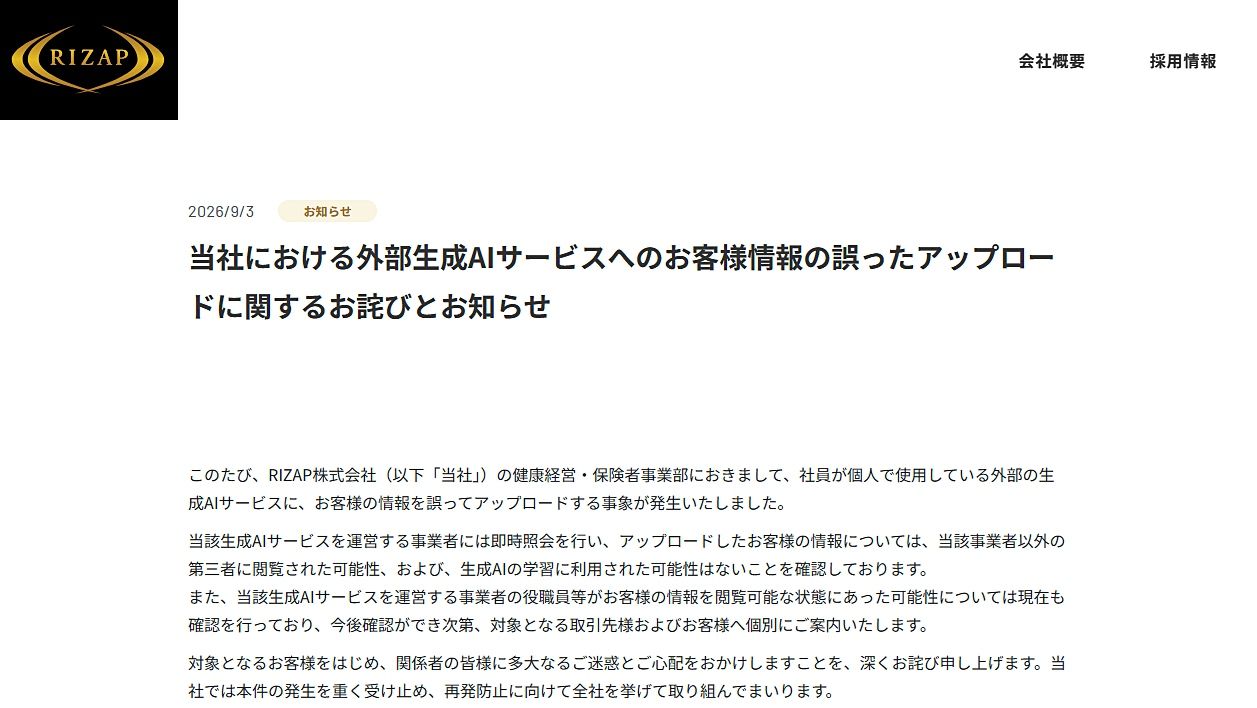
RIZAP employee leaks 210 IHI health-insurance records to AI, OpenAI notified
RIZAP Group said an employee mistakenly uploaded personal data, including names and disease details of 210 people covered by IHI's health insurance, to a generative AI for personal use. This marks a shift from internal data-handling policies to a real incident involving health information, which is highly sensitive. RIZAP publicly disclosed the breach to OpenAI, signaling a new level of accountability.
How RIZAP and IHI respond to affected individuals and regulators. The number of affected people (210) is a concrete figure to monitor for any updates.
- 2
SoftBank earns ISO/IEC 42001:2023 for TASUKI Annotation
SoftBank obtained ISO/IEC 42001:2023 certification on August 25, 2026 (UK time) for the AI management system of its data preparation service 'TASUKI Annotation'. The certifying body was BSI Assurance UK Limited. This certification marks SoftBank's formal recognition for managing AI risks under an international standard. It shifts the company from internal policies to a third-party-verified governance framework, supporting its 'Activate AI for Society' growth strategy.
SoftBank plans to apply insights from this certification to improve AI governance and pursue certification for other products and services. The effective management of AI-related risks, data quality, and transparency will determine the broader impact.
- 3
BSI awards SoftBank ISO/IEC 42001:2023 for TASUKI Annotation
BSI Group Japan certified SoftBank's AI management system for its data-preparation service 'TASUKI Annotation' under the international standard ISO/IEC 42001:2023, effective August 25, 2026. This certification, issued after audits by BSI Japan and review by BSI Assurance UK, marks SoftBank's AI governance as meeting international requirements, a contrast to BSI's survey finding that only 10% of Japanese firms have AI governance programs.
The certification hinges on SoftBank continuously evaluating and improving risks and opportunities in its AI management system; its value for customers and partners will depend on how SoftBank maintains this standard in practice.
- 4
Meta ads nudified real teens; TTP found CSAM
TTP found ads on Meta that nudify real teens, including a CSAM ad from a page claiming to represent the Church of Jesus Christ of Latter-day Saints. Meta disabled the page only after TTP flagged it. Meta's delayed response allowed ads to reach over 29,000 people in the EU and 6,800 in the UK, with about 80% served in the US. Attorneys general in Michigan and Florida are now looking into the issue.
Meta's response to Senator Warner's letter and the Australian eSafety regulator's request for information will determine next steps. Watch whether Meta takes clearer action to stop these ads.
- 5
Lawsuit: Anthropic's Max plan overpromises usage
A group of Claude subscribers filed an expanded class action lawsuit today, alleging Anthropic deceptively advertised the limits of its Max subscription tier. The Max plan promises '5x' or '20x' usage, but the fine print limits these to five-hour sessions with weekly caps, which plaintiffs say adds up to far less than advertised.
The case hinges on whether the court finds clicking hyperlinks to reveal session limits is sufficient disclosure, or if it's a 'buyer beware' approach that misleads consumers.
- 6
SoftBank, Kirin, Lawson cut hiring time with AI agents
SoftBank introduced an AI system for video interview screening in May 2020, cutting screening time by about 70%. Kirin Holdings and Lawson use AI interviewers, with Lawson seeing offer acceptance rise about 10%. These tools replace manual hiring steps, but the article stresses avoiding discrimination and legal issues. AI outputs are used as pass filters, with humans reviewing all failures, a pattern that balances speed and safety.
EU AI Act obligations for high-risk AI start December 2, 2027. The EU AI Act classifies recruitment AI as high-risk, so firms with EU operations must prepare recording systems.
What to Watch
As these cases unfold, watch whether companies like RIZAP, IHI, SoftBank, and Meta turn stated policies into concrete, enforceable action—particularly around transparency and user protection. Longer term, the countdown is on for the EU’s high-risk AI rules taking effect in late 2027, meaning firms with EU operations should already be building their compliance systems.
Sources
- RIZAP、社員が個人利用の生成AIに氏名・疾患情報を誤アップロード IHI健保分は210人、OpenAI社と公表
- AIマネジメントシステムの国際規格 「ISO/IEC 42001:2023」の認証を取得
- BSI(英国規格協会)、ソフトバンク株式会社に AIマネジメントシステムの国際規格 「ISO/IEC 42001:2023」認証を授与
- “This is the AI men actually use”: Meta ads pushed apps nudifying real teens
- AI power users claim Anthropic duped them with subscriptions, and they’re taking it to court
- AIエージェントの採用活用 自動化できる業務とおすすめツール10選
- AI anxiety crosses party lines as data centers become a midterm issue
- Trump and Xi should align on artificial Intelligence
- Morgan Stanley breaks down the midterm races it's watching with implications for AI and the data center boom
- Steve Bannon sides with progressive Democrats in battle over AI data centers
- New York City bans AI tools from public schools through eighth grade
- The Scramble: getting in position to pace the frontier
- Silicon Valley goes physical: how San Jose is building an energy-rich, tariff-mitigated capital for physical AI
- 米中のAI覇権争い、性能は肉薄 資金力の米vsコスパの中国
- Seattle Times and Newsday sue OpenAI and Microsoft for infringement
- ‘Feeding the beast’: Meta faces allegations of using its ‘perv glasses’ to train AI in new lawsuit
Share this with a friend
Send today's roundup to anyone who wants to keep up.
Get daily AI news free with AIToday
Today's AI, for Today's work. Email / LINE / Slack.
Sign up free