AI in Healthcare
Aug 18, 2026
The Gist
Johnson & Johnson's Monarch lung robot received FDA approval for its AI planning capabilities, while pharmaceutical companies are racing to invest billions in AI-driven drug discovery despite limited clinical evidence of success. Meanwhile, U.S. health agencies are rapidly expanding their AI use—with FDA and CDC adoption surging 148% and 87% respectively—even as questions mount about proper oversight of these emerging tools. The sector is consolidating around major players like Pfizer, Abbott, and Google who are pairing AI with medical devices and coaching systems to boost productivity.
Today's Stories
- 1
J&J's Monarch lung robot gains FDA clearance for AI planning tools
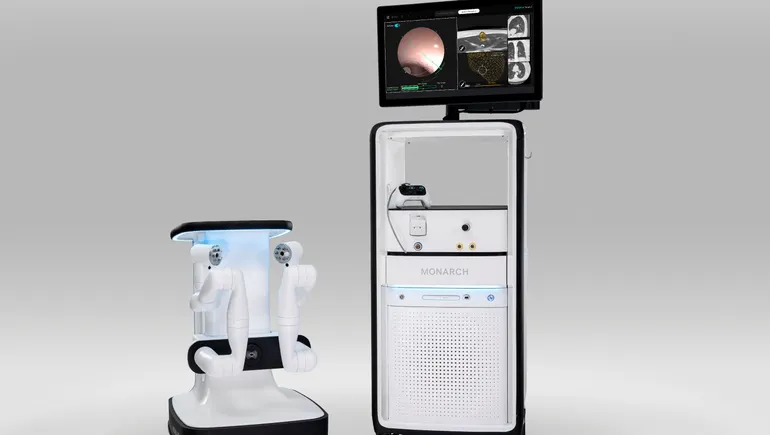
Johnson & Johnson announced Monday that its Monarch bronchoscopy robot received FDA clearance for a software update (Quest 3) that adds AI-powered pre-procedure planning, improved imaging system compatibility, and enhanced navigation and targeting capabilities. This is the platform's fourth major software launch in the past 18 months. Monarch is the first robotic bronchoscopy platform on the market and is used to assist physicians in lung biopsy procedures and early lung cancer diagnosis. The AI features are designed to automatically generate more accurate nodule boundaries during planning and improve visual orientation for physicians, potentially making procedures more precise and efficient.
Monarch competes with Intuitive's Ion system and Noah Medical's Galaxy system in the bronchoscopy market. J&J also received FDA authorization last month for its Ottava soft tissue robotic system, which will compete against Intuitive's da Vinci robot and Medtronic's Hugo system.
- 2
Pharma Bets Billions on AI Drug Discovery Before Clinical Proof
Pharmaceutical companies and investors are pouring billions into AI-driven drug discovery platforms—Isomorphic Labs raised $2.1 billion in May, while partnerships between Genesis Molecular AI and Incyte exceed $1 billion potential value, and Inceptive secured a deal with Alnylam worth up to $2 billion. These investments focus on end-to-end platforms and biological foundation models rather than individual drug assets. The industry is building general design engines (like Isomorphic's IsoDD platform) that can predict hidden protein binding sites and handle multiple drug modalities—expanding the range of diseases that can be tackled computationally. However, few AI-designed drugs have reached the clinic yet, raising questions about whether valuations are decoupled from clinical proof and depend instead on computational promise alone.
Whether AI's generative design capabilities can actually accelerate drug approval timelines and reduce failure rates in clinical trials. One industry observer cautioned that even generatively designed molecules may take another seven years to reach patients, suggesting the most valuable innovation window exists now—before that first FDA approval.
- 3
FDA, CDC AI use surges 148%, 87% — raises questions on healthcare oversight
Between fiscal years 2024 and 2025, the FDA experienced a 148 percent surge in AI use, the CDC an 87 percent increase, the CMS a 78 percent rise, and the NIH a 51 percent jump, according to the HHS AI Use Case Inventory. Federal and state healthcare agencies are rapidly expanding AI adoption, citing efficiency, accuracy, and cost savings. Healthcare AI decisions carry high stakes — errors can harm patients. Recent cases show real risks: UnitedHealth Group's AI preauthorization system had alleged error rates of 90 percent (nine of 10 appealed denials reversed, per a March 2026 federal court order), and defective eligibility software from Deloitte Consulting caused widespread improper Medicaid terminations across multiple states. Current federal frameworks require risk mitigation assessments but do not determine whether AI should be used at all, leaving agencies without guidance on when human judgment is mandatory.
The article proposes a Five Factor Framework requiring agencies to examine who may be harmed, the nature of the decision itself, the technology's capabilities and limitations, the role of human oversight, and applicable legal constraints. Agencies using this framework for high-impact decisions should seek public input through notice and comment, town halls, and engagement with advocacy groups representing affected communities.
- 4
Anthropic CEO: AI must cure cancer to win public trust
Anthropic CEO Dario Amodei posted on X that the AI industry needs to deliver tangible scientific breakthroughs—specifically curing cancer—to shift public opinion. He acknowledged that saying AI will cure cancer has become a cliché, and that AI companies including Anthropic have not yet delivered on their big promises to benefit the world. About half of Americans feel the increased prevalence of AI in their daily lives makes them feel "more concerned than excited," according to a recent Pew Research Center study. Amodei's statement reflects the industry's broader struggle with public skepticism as it builds data centers, scrapes copyrighted data to train models, and disrupts the workforce. Unlike some peers, Amodei rejected the idea that his own safety warnings are driving distrust, arguing instead that public skepticism reflects decades-long American wariness toward corporations overall.
Amodei said Anthropic is ramping up work in biological and medical fields, with hopes for "incredible results in the coming years and some early glimmers in the coming months." He pledged that when Anthropic achieves real accomplishments, "the whole world will hear about it, as loudly as possible."
- 5
Abbott, Google pair glucose sensor with AI coaching
Abbott and Google announced a multiyear partnership to integrate Abbott's Lingo glucose sensor with Google's AI and Health app, beginning with Lingo integrations into Google Health later this year. The companies plan to launch a large metabolic health study combining continuous glucose, wearable, laboratory, and survey data. The partnership makes glucose insights more accessible and actionable for people managing metabolic health. Google's AI-powered health coach—available to Google Health premium subscribers—will use the integrated data to provide personalized recommendations based on how daily habits like diet and exercise affect blood sugar levels. Abbott's Lingo sensor, an over-the-counter device that debuted in the U.S. in 2024, reaches adults not taking insulin who want to understand their metabolic patterns.
Results from the planned metabolic health study, which will integrate data across glucose readings, wearables, labs, and surveys. These findings are expected to inform more personalized guidance and help both companies improve their products. Abbott did not disclose the study enrollment size.
- 6
Pfizer, Tempus AI, Stryker emerge as AI healthcare productivity plays
Three AI healthcare companies—Pfizer (market cap US$152.7b), Tempus AI (US$9.4b), and Stryker (US$130.1b)—have been highlighted as stocks positioned to use data and algorithms to help doctors work faster and more accurately. Pfizer is leaning on AI-powered R&D and cost savings of about US$9.7b through 2029; Tempus AI links genomic diagnostics, clinical data, and software to feed new tests into its models; Stryker is deploying robotics and AI-assisted virtual care platforms in surgical and hospital settings. With global bond yields high and borrowing costs rising, capital is flowing toward companies that can raise productivity rather than just cut expenses. AI healthcare stocks fit that pattern by helping medical professionals work more efficiently—a concern when every dollar needs to work harder. The sector offers both growth potential and valuation appeal in a cost-conscious environment.
Pfizer faces headwinds including patent expiries, heavy debt, and expected revenue decline, though it offers a 6.42% dividend yield and P/E below peers. Tempus AI is unprofitable but analysts expect movement toward profitability within three years, supported by FDA-approved tests and an AI tool pipeline. Stryker's premium valuation and high debt hinge on execution quality following its 2026 cyberattack.
What to Watch
Watch for breakthroughs in how AI-designed drugs actually perform in real clinical trials—the next few years will reveal whether generative design truly accelerates approval timelines or remains mostly a research tool—while competing robotic surgery platforms from J&J, Intuitive, Medtronic, and Noah Medical battle for market dominance across multiple surgical specialties. Additionally, keep an eye on Anthropic's medical applications and the results from metabolic health studies that could reshape how companies personalize health guidance, alongside whether AI-focused healthcare companies like Tempus AI can achieve profitability while navigating a landscape where traditional giants like Pfizer face significant headwinds.
Sources
- J&J’s Monarch robot wins FDA nod for AI features
- Pharma Races to Scale AI as Billions Flow into Drug Discovery
- The Use of AI by Government Healthcare Agencies: Is It in the Public Interest?
- Anthropic CEO says the way for AI to win over the public is to cure cancer
- Abbott, Google to combine glucose data with AI coaching
- Pfizer Stock And 2 AI Healthcare Picks Built Around Productivity Growth
- Will Gilead’s AI-Driven ADC Research with Nucleai Refine Its Oncology Strategy and Valuation Story (GILD)?
- Gen Z is eyeing up ‘secure’ healthcare jobs to AI-proof their careers, but be warned: Chiropractors, doctors and paramedics are the unhappiest workers
- Enlicitide: A stress test for AI in drug discovery
- How robotics is revolutionizing stroke rehabilitation
- The unlikely opera star: How AI helped a nonspeaking performer find his voice
- Gilead Sciences (GILD) Could Be 8% Overvalued As AI Deal And Q2 Results Lift Shares
- Automated NGS and AI to advance precision medicine - SelectScience interview
- Can Veeva Systems Inc. (VEEV)’s AI Platform Keep Pace With Eli Lilly and Company (LLY)’s Explosive Growth
- Can Abbott Laboratories (ABT)’s Lingo Partnership With Alphabet (GOOG) Unlock a New Era of AI-Powered Health?
- Open-source Python library + no-code web dashboard for evaluating oncology AI models at clinical decision thresholds. [P]
Share this with a friend
Send today's roundup to anyone who wants to keep up.
Get daily AI news free with AIToday
Today's AI, for Today's work. Email / LINE / Slack.
Sign up free