Robotics
Aug 24, 2026
The Gist
Scaling robots demands stable workforce, not just better AI. Robot lawn mowers eye 50% US household share in 8 years. Factory floors lag AI progress despite rapid advancement
Today's Stories
- 1
Scaling robots demands stable workforce, not just better AI
As robotics deployments grow from small pilots to dozens of sites across multiple shifts, companies are discovering that the robot itself is no longer the limiting factor—the workforce required to operate, maintain, and adapt it is. Organizations are shifting from loosely coordinated gig-style labor toward hybrid structures with a stable core of trained, hourly W-2 operators and technicians paired with flexible surge capacity. Physical AI systems operating in warehouses, hospitals, factories, and public spaces have raised the stakes for workforce design. Quality now means uptime, safety, hardware integrity, and customer experience in dynamic environments—not just model metrics. Traditional task-based labor models and speed-only incentives actively degrade performance; instead, teams are prioritizing procedure adherence, documentation quality, escalation accuracy, and safe behavior under uncertainty.
New role types are emerging—robot operators, field technicians, teleoperators, QA validators, and data capture specialists—that sit between engineering and operations and are responsible for interpreting edge cases, documenting failures, and translating real-world behavior into engineering feedback loops. Success in scaling robotics will depend on whether companies can build workforce systems as robust and adaptive as the machines themselves.
- 2
Robot lawn mowers eye 50% US household share in 8 years
AI, satellite navigation, and autonomous systems are transforming robotic lawn mowers from a niche product into a mainstream platform. The global lawn mower market generated $35.2 million in 2025 and is projected to reach $63.2 million by 2033. Market analysis suggests the U.S. robotic lawn mower market could approach 50% household penetration over the next eight years as costs fall and AI capabilities improve. Modern robotic mowers now use realtime kinematics (RTK) technology for centimeter-level positioning accuracy and 4G connectivity for cloud communication, enabling real-time obstacle avoidance and route optimization with minimal human intervention. This removes the installation complexity and maintenance burden that limited earlier models, making the technology viable for larger, more complex lawns typical across North America.
The main barrier to adoption is no longer technological but cultural—consumer awareness and perception. The commercial landscaping industry, which faces labor shortages and grows at an average annual rate of 6.5% between 2020 and 2025, represents a significant expansion opportunity; lightweight commercial models are already entering the market, with more robust systems expected in coming years.
- 3
Factory floors lag AI progress despite rapid advancement
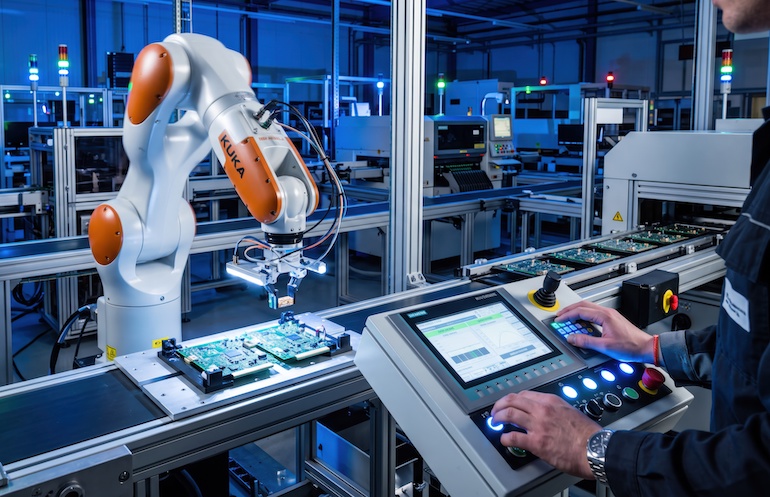
Automation Taipei 2026 is examining why, despite extraordinary progress in artificial intelligence, the physical world remains stubbornly difficult to automate on factory floors. The disconnect between AI advancement and manufacturing automation suggests that real-world deployment faces obstacles that lab progress does not encounter—a critical issue for factories seeking to modernize operations.
How industry participants at the conference identify and address the gap between AI capability and practical factory-floor implementation.
- 4
R2 Labs brings AI vision, robotics to legacy factory equipment
R2 Labs, a Peachtree Corners, Georgia–based smart manufacturing provider, has developed the RAC (R2 Autonomy Controller), a product that retrofits legacy factory equipment with modern industrial technology including AI vision and advanced robotics. Founder and CEO Dr. Roby Lynn, who previously worked at Formlabs and holds a Ph.D. in mechanical engineering from Georgia Tech, discussed the company's approach to software-defined manufacturing—automation that enables more flexible production—in Episode 258 of The Robot Report Podcast. Software-defined manufacturing allows factories to unlock new capabilities from existing equipment without replacing entire production lines, lowering the barrier to technology adoption for manufacturers with aging infrastructure. By adding AI vision and robotics to legacy systems, companies can access modern automation without the capital cost of new equipment.
The podcast episode, which features Lynn's full discussion of how the RAC integrates with real factory operations, is available now; the conversation begins at the 25:50 mark.
- 5
Texas Instruments MCU with edge AI now stocked at Mouser
Mouser Electronics announced on August 20, 2026, that it is now stocking the MSPM0G5187 mixed-signal microcontrollers from Texas Instruments. The MCUs feature an Arm Cortex-M0+ 32-bit core, an edge AI neural processing unit (NPU) accelerator, up to 128KB of embedded flash memory with error correction, and USB 2.0 connectivity. The MSPM0G5187 enables edge AI processing—inference happening directly on the device rather than in the cloud—in resource-constrained applications like home appliances, medical devices, wearables, and building automation. By pairing an NPU accelerator with ultra-low-power architecture, the MCU lets manufacturers add AI-driven sensing and control without sacrificing battery life or adding external processors.
The TI LP-MSPM0G5187 LaunchPad development kit is also available from Mouser, bundling an onboard XDS110 debug probe, buttons, and USB Type-C connectors to support designers building applications on this platform.
- 6
The Job Is Dying, Not Work Itself—AI and Robots Rewrite the Next 10 Years
A technology writer argues that the traditional salaried 9-to-5 job model—invented for 20th-century factories—is being dismantled by AI agents handling cognitive tasks and humanoid robots handling physical ones. The World Economic Forum projects 92 million jobs displaced by 2030, with 41% of employers planning headcount cuts as AI automates repetitive work. Young workers aged 22–25 in AI-exposed fields saw employment fall 3.8% per year as of April 2026, running roughly 19% below peers in low-exposure roles by mid-2026. The transition is structural, not cyclical. Stanford research shows the bottom rungs of career ladders are being sawed off—entry-level tasks like information retrieval, scheduling, and document assembly vanish first. While the long-run economy may create more jobs, the 5–to–10-year window is where individuals and institutions face real risk; companies replacing salaried employees with mission-based contractors will select globally, making geography irrelevant and punishing those who insist on office presence.
The shift from hours-based pay to outcome-based pay will accelerate. Humanoid robots like Agility Robotics' Digit (logged 65,000+ operating hours) and lower-cost platforms (Unitree shipping ~5,500 units in 2025 at ~$16,000 each) are moving past pilot phase toward production. Four-day-week trials are expanding as AI-driven productivity gains translate into time savings, and by the body's prediction, "what are your working hours?" will sound antiquated within a decade.
What to Watch
New role types are emerging—robot operators, field technicians, teleoperators, QA validators, and data capture specialists—that sit between engineering and operations and are responsible for interpreting edge cases, documenting failures, and translating real-world behavior into engineering feedback loops. Success in scaling robotics will depend on whether companies can build workforce systems as robust and adaptive as the machines themselves. The main barrier to adoption is no longer technological but cultural—consumer awareness and perception. The commercial landscaping industry, which faces labor shortages and grows at an average annual rate of 6.5% between 2020 and 2025, represents a significant expansion opportunity; lightweight commercial models are already entering the market, with more robust systems expected in coming years.
Sources
- Robots don’t run themselves: The workforce powering physical AI
- The technology that could bring robot mowers to one in two American lawns
- Automation Taipei 2026: If AI is advancing so fast, why is the factory floor still so hard to automate?
- How software-defined manufacturing fits into real factory operations
- Texas Instruments' MSPM0G5187 Mixed-Signal MCUs, Now Available at Mouser, Enable Edge AI in Any Device
- The Death of the Job: How AI and Robots Will Rewrite Work in the Next 10 Years
- What Is Amazon.com (AMZN) Planning With Prime Air In 500 U.S. Cities?
- Motorola Solutions Completes $1.5 Billion Acquisition of D-Fend Solutions
- CEO of viral backflipping robot company says robots are still years from ‘ChatGPT moment,’ even after investors sent his stock soaring 460%
- Nvidia’s Ruthless Way to Beat the Competition Has 2 Problems
- Vecow eyes robotics growth as North America, EMEA account for 65% of business
- Logic Robotics launches autonomous pallet for rail-to-road transloading
- Honor Robot Phone moves from concept to mass production
- Automation Taipei 2026: German suppliers target aerospace's hidden manufacturing bottlenecks
- Taiwan automation shifts from hardware specs to AI platforms and open robot architectures
- 日本精工、国産ヒト型ロボ新興と基本合意書 開発・実装へ協業
Share this with a friend
Send today's roundup to anyone who wants to keep up.
Get daily AI news free with AIToday
Today's AI, for Today's work. Email / LINE / Slack.
Sign up free