Robotics
Jun 25, 2026
The Gist
Warehouse robots are becoming more reliable in chaotic environments—Robust.AI's Gen 3 Carter now uses Aptiv's advanced sensors to handle real-world messiness—while drones are proving they can safely share delivery airspace without human coordination, as Flytrex and Wing demonstrated with 8,000 conflict-free deliveries in Dallas–Fort Worth. Meanwhile, the robotics industry is grappling with how to manage the human side of automation: Percepto's AI-powered inspection software and ARM Institute's career platform are helping companies and workers adapt, while Ford's decision to rehire experienced engineers highlights the risks of automating too aggressively without preserving institutional knowledge.
Today's Stories
- 1
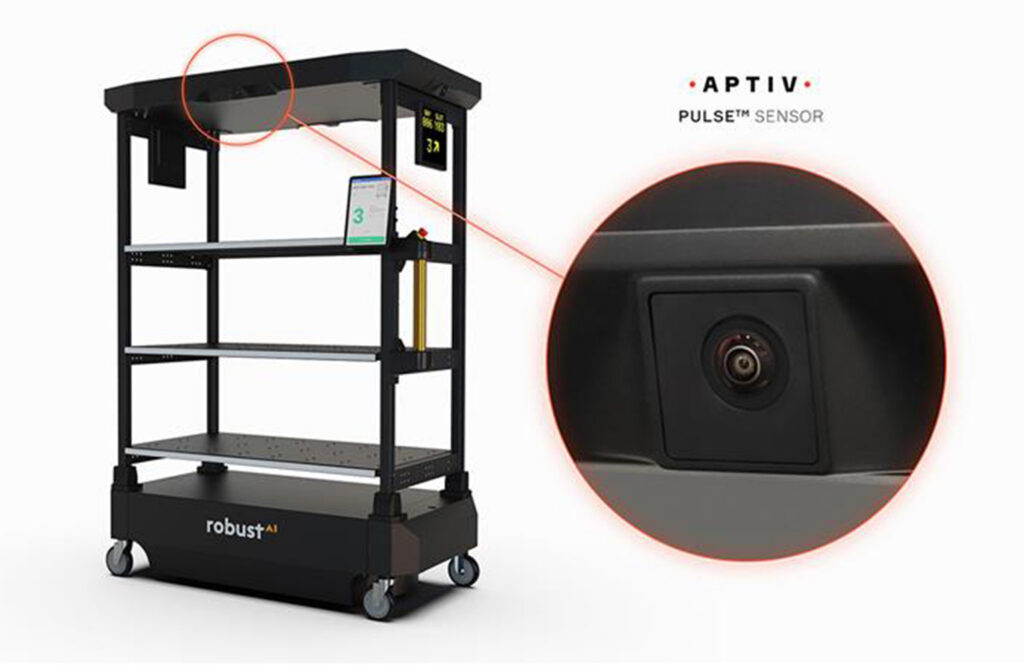
Robust.AI equips its Gen 3 Carter warehouse robot with Aptiv's PULSE sensor to improve reliability in messy, dynamic environments where conventional systems often fail.
Robust.AI selected Aptiv's PULSE sensor—a camera-and-radar perception system powered by machine learning—for its Gen 3 Carter collaborative mobile robot. Aptiv will pursue PL(d) certification, a high-reliability safety classification under ISO 13849-1, for the PULSE system across relevant industrial safety use cases. Warehouse and manufacturing floors contain dust, glare, moisture, and reflective surfaces that degrade conventional vision-only sensors. By fusing radar and camera data, PULSE aims to deliver the safety-critical perception reliability that scaled warehouse automation demands—especially as robots operate with higher autonomy near people and equipment.
The companies plan to accelerate AI-powered robotic workflows and establish the foundation for PL(d) certification across relevant industrial safety use cases. Aptiv demonstrated the PULSE sensor with Carter at Automate in Chicago this week.
- 2
Percepto launches next-generation inspection software that integrates drone data with AI to help energy companies inspect infrastructure faster and more accurately than traditional field crews.
Austin-based Percepto announced an expansion of its inspection-intelligence platform, upgrading its proprietary Autonomous Inspection & Monitoring (AIM) software to combine drone-collected data with computer vision, machine learning, and advanced sensors. The platform now consolidates data from multiple sources—drones, static cameras, satellite information—into a single location and uses contextual AI to automate inspections of assets like transmission lines and utility poles. Energy companies, oil and gas operators, and electric utilities face pressure to produce actionable data at scale. Percepto's system is designed to replace the traditional model of field crews driving for hours to inspect distant assets, enabling the same personnel to spend time fixing problems rather than searching for them. A Chevron pilot study found a 52% savings in time allocation for field teams using the system.
The platform is designed to mimic how human inspectors work—knowing what data to capture and how to communicate findings. Typically, under its alert service level agreements, customers are alerted to an issue within one hour of the anomaly being detected. The drones are manufactured in Israel and are compatible with U.S. cybersecurity requirements.
- 3
Flytrex and Wing achieved zero airspace conflicts across 8,000 shared drone deliveries in Dallas–Fort Worth using automated coordination, demonstrating that multiple operators can safely share delivery airspace without manual oversight.
Flytrex and Wing conducted approximately 8,000 drone delivery operations in overlapping airspace in Little Elm and Wylie, Texas between January and February 2026. The automated system deconflicted 100% of operational intents, with daily combined operations increasing 215% from January to February and zero airspace conflicts recorded. The companies launched automated Unmanned Traffic Management coordination in May 2025 as the first U.S. commercial drone operators to share airspace under an FAA-backed system. This proof of concept shows that multiple delivery operators can scale from a handful of overlapping flights to thousands per month within one year, potentially enabling multi-operator drone delivery across cities nationwide.
The Dallas results demonstrate how real-time flight path coordination and 4D trajectory management can work in one of the tightest shared-airspace environments in the U.S.—where one Wing facility operates just 1.36 miles from Flytrex's center of operations. The FAA's UTM Operational Evaluation currently includes 17 service providers and operators as of January 2026.
- 4
ARM Institute expands RoboticsCareer.org to help workers and employers navigate the shift to AI-enabled manufacturing robots.
The ARM Institute released an expanded version of RoboticsCareer.org with a focus on physical AI, adding job listings for AI-enabled robotics roles, training program databases, and a national talent database. The platform now lists more than 18,000 robotics positions in manufacturing and more than 1,300 programs that teach physical AI skills. Manufacturers are adopting AI-enabled robots to address workforce shortages, but the transition requires workers with new skills—data maintenance, AI system integration, and machine learning. RoboticsCareer.org aims to close the gap by connecting job seekers to training and employers to qualified talent, helping the U.S. maintain manufacturing leadership without widespread job loss.
More than 100,000 people used the site in 2025. The national talent database has grown at a 66% year-over-year rate and now enables employers to download resumes and contact candidates at no cost.
- 5
Ford rehired experienced engineers to fix quality problems caused by over-reliance on automated systems without proper institutional knowledge transfer.
Ford brought back over 350 experienced engineers—some former employees—to correct errors made by automated production and design systems and retrain those systems with accumulated expertise. The company also created a dedicated 40-person software quality assurance team and added more than 100,000 new AI-powered tests to catch defects earlier in the development process. Ford's automated systems failed because the company underestimated the value of veteran engineers' knowledge and did not fully transfer it before those employees left. The automaker discovered that AI quality depends entirely on data quality, and that skipping experienced human judgment led to a drop in vehicle quality. Ford now leads the industry in the number of recalls, making this shift critical to rebuilding customer trust.
Ford is moving away from a 'find and fix' approach (identifying defects after they appear) toward preventing problems before they occur. The automaker is also integrating software and digital teams more closely with vehicle engineering and manufacturing teams, combining software development speed with automotive-grade engineering rigor required for safety-critical systems.
- 6
NVIDIA supports France's AI infrastructure expansion, with Mistral deploying 18,000 GB200 systems and planning a path to 200 megawatts of compute capacity by 2027.
Mistral has deployed 18,000 NVIDIA GB200 systems at a 44-megawatt data center as part of France's AI ecosystem expansion. The company is working toward 200 megawatts of compute capacity by 2027 across Europe, and is collaborating with Bpifrance, MGX, and NVIDIA on a planned 1.4-gigawatt facility through Campus AI. France is building local AI infrastructure and developing models tailored to European languages, regulatory requirements, and business needs—with companies like Mistral, LINAGORA, H Company, and Pleias contributing to open models and datasets. Large French enterprises including Sanofi, Orange Business, Stellantis, and TotalEnergies are expanding internal AI adoption, suggesting the infrastructure investments are being matched by real commercial demand.
The 200-megawatt capacity target by 2027 and the 1.4-gigawatt Campus AI facility represent the scale of Europe's push for sovereign AI computing power independent of non-European providers.
What to Watch
As industrial automation advances, watch for AI-powered robotic systems to gain wider adoption through safety certifications like PL(d), while drone delivery and airspace coordination technologies mature toward more complex real-world operations. Additionally, keep an eye on how automakers like Ford reshape manufacturing by shifting from reactive problem-solving to predictive prevention, combining software agility with automotive-grade safety standards.
Sources
- Robust.AI chooses Aptiv PULSE sensor for Gen 3 Carter mobile robot
- Beyond the Drone: Percepto’s New Platform Brings AI to Infrastructure Inspections
- Flytrex and Wing Report Zero Airspace Conflicts for Multi-Operator Drone Delivery
- ARM Institute expands RoboticsCareer.org into physical AI
- Ford had to hire back former engineers to fix mistakes made by its automated systems
- NVIDIA (NVDA) in Spotlight for Facilitating France’s AI Advancement Efforts
- Reservoir acquires Contain to scale agtech startups
- BRINC Partnership Gives Public Safety Agencies an “Immediate Upgrade” in Incident Intelligence
- FAULHABER focuses on torque, noise, and power with new GPT gearheads
- Prodrone Debuts All-Japanese Industrial Drone
Share this with a friend
Send today's roundup to anyone who wants to keep up.
Get daily AI news free with AIToday
200+ AI sources, summarized in 1 minute. Email / LINE / Slack.
Sign up free