Robotics
Jun 24, 2026
The Gist
Robotics investment and development are accelerating across multiple sectors: Reservoir VC is backing agricultural AI startups, BRINC and Nova are enhancing emergency response drones with thermal imaging, and robotaxi companies like Wayve and Waymo are launching services in London this summer as autonomous vehicle competition heats up globally. Meanwhile, supply chain concerns are driving innovation, with Japanese drone maker Prodrone building domestically-sourced industrial drones and FAULHABER introducing specialized gearheads for precision robotics, even as China continues to dominate industrial robot installations worldwide.
Today's Stories
- 1
Reservoir VC acquires Contain to expand support for agricultural AI startups scaling from pilot to commercial deployment.
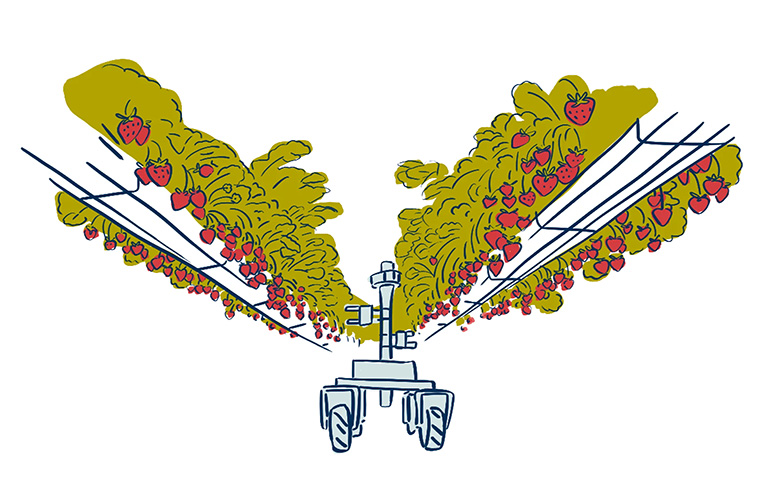
Investment firm Reservoir Co. purchased agriculture finance and data platform Contain Inc. in its first corporate acquisition. Reservoir appointed Contain's founder Nicola Kerslake as a general partner, who will chair the investment committee and oversee underwriting as the firm expands into agricultural equipment and controlled environment agriculture. Reservoir is positioning itself to help AI-enabled agricultural startups move from early testing to commercial scale by combining capital with expertise in hardware deployment, unit economics, and rural finance—capabilities the sector has historically lacked in a single partner.
Reservoir is hosting a two-day event called Ruggedize in August 2026 at its Salinas, California site, focused on the challenges of building robots and automation for agricultural applications.
- 2
BRINC and Nova partnership integrates thermal mapping and data analysis into public safety drones, giving emergency responders faster access to actionable intelligence during critical incidents.
BRINC, a Seattle-based public safety drone manufacturer, has partnered with Nova Software Company to connect BRINC's LiveOps platform with Nova's aerial intelligence software. The integration allows agencies using BRINC Responder drones to upload imagery directly to Nova for processing, generating mapping products and thermal analysis without additional hardware. BRINC's newly introduced Guardian platform, which carries two radiometric HD thermal cameras, is a key part of the offering. Public safety agencies—more than 900 currently use BRINC products—operate in complex and dangerous environments where faster information translates to safer outcomes for both personnel and the public. The partnership combines drone hardware, operational software, mapping tools, and data analysis into a single workflow, enabling incident commanders to detect hotspots in near real time during structure fires, wildfires, search and rescue, and other emergency scenarios.
The integration is available immediately for agencies already operating BRINC Responder systems. This end-to-end solution expands BRINC's ecosystem of aircraft, software, communications, and remote operations tools designed specifically for first responders.
- 3
FAULHABER introduces new GPT gearhead family designed for high torque, compact size, and flexible noise control to serve robotics and precision motion applications.
FAULHABER launched its new GPT gearhead family, engineered for high torques and compact performance. The lineup includes standard versions with diameters from 14 to 42 mm, low-noise variants (22 GPT LN and 32 GPT LN) that reduce noise by up to 10 dB, and HT models for robust environmental conditions. The 42 GPT series can achieve intermittent torque of up to 25 Nm, with continuous torques between 6 and 18 Nm and speeds up to 24,000 rpm. The new gears are designed to work with FAULHABER's existing DC drives and motors, allowing matched combinations without additional connecting elements—a practical advantage for system integrators building compact drive systems. Low-noise variants address applications used near people or where multiple motors operate together, expanding the addressable market for collaborative and sensitive applications.
The product line offers reduction ratios ranging from 3:1 to 1437:1, operating temperature ranges from −30° to +120°C depending on variant, and gear backlash of 0.8° or 0.6° for precise positioning. The gearheads are available now with three or four gear stages in numerous configurations.
- 4
Japanese drone maker Prodrone launches an all-domestically-sourced industrial drone to address geopolitical supply chain risks in critical infrastructure.
Prodrone unveiled the PD4B-MS, a prototype industrial drone assembled entirely with components from Japanese suppliers including Canon Electronics (motors), JTEKT (flight controller), Furukawa Battery (battery), and TKK Works (transmitter/receiver). The aircraft weighs 7.8 kg, reaches 60 km/h top speed, and flies for approximately 25 minutes without payload or 20 minutes with a 3 kg payload. Japan designated drones as a 'Specified Important Material' under the Economic Security Promotion Act late last year, signaling their criticality to national infrastructure and defense. Prodrone's move reflects broader concerns over geopolitical supply chain risks and recent U.S. export restrictions affecting the global drone sector, positioning the company to build a domestic manufacturing base aligned with national strategy.
The PD4B-MS is currently a concept model; Prodrone has announced plans to establish mass production and launch a production version separately. The company operates under the new SAMURAI TECH brand trademark (application in process) and intends to sell the finished product in Japan and worldwide.
- 5
Robotaxis are launching in London this summer as Wayve, Waymo, and Baidu race to lead Europe's autonomous vehicle market, with Britain positioning itself ahead of the EU through faster regulation.
British start-up Wayve, in partnership with Uber, will begin commercial robotaxi rides in London this summer with a human operator on board initially. US rival Waymo, which already operates in 11 US cities, is expected to follow shortly after. China's Baidu, partnering with Lyft, will test in the coming weeks before launching in London later this year. London's complex streets—with 20 times more road construction than San Francisco and 10 times more vulnerable road users—present a real test of autonomous vehicle technology. Britain's government has sped up regulation to move ahead of the EU, and expects the autonomous vehicle sector to generate 38,000 jobs and £42 billion ($55 billion(約8.8兆円)) by 2035. However, companies face public trust challenges after high-profile mishaps, including Baidu vehicles stalling in central China and Waymo recalling nearly 4,000 cars after robotaxis entered closed-off highway construction areas.
Londoners can take their first commercial rides with Wayve this summer, with fares likely to be "pretty similar" to traditional taxis at launch. The sector's complexity means companies may collaborate in some cities while competing in others.
- 6
China dominates industrial robotics with 54% of global installations in 2024, prompting divergent responses from the US, Germany, and India.
China installed 295,000 industrial robots in 2024, accounting for 54% of the global total. The US robotics industry is pressing for a national strategy to counter China's lead, while German companies believe their domestic offerings will win on reliability and data security. India, which installed 9,100 industrial robots in 2024, faces a different concern. China's robotics dominance mirrors its earlier leads in electric vehicles and solar panels—signaling a sustained competitive shift in a capital-intensive industry. For India in particular, the stakes are high because robotics threaten the country's long-standing advantage as a low-cost labor source, according to a prominent academic.
How each region responds reflects broader trade and industrial strategy. Germany's confidence in domestic alternatives, the US push for a coordinated national response, and India's vulnerability to labor-displacement robotics will shape the next phase of the global automation race.
What to Watch
As robotics advances across agriculture, emergency response, autonomous vehicles, and industrial applications, watch for Reservoir's Ruggedize event in August 2026 to reveal practical solutions for farming automation, while monitoring how major players like Wayve expand commercial services and how governments worldwide—from Germany to India—position themselves in the global automation competition. The coming months will show whether regional collaboration or competition dominates the adoption of these transformative technologies.
Sources
- Reservoir acquires Contain to scale agtech startups
- BRINC Partnership Gives Public Safety Agencies an “Immediate Upgrade” in Incident Intelligence
- FAULHABER focuses on torque, noise, and power with new GPT gearheads
- Prodrone Debuts All-Japanese Industrial Drone
- Race for robotaxi market arrives in London
- Countries grapple with China’s robotics lead
- Deep dive into ARM’s physical AI and robotics strategies with Drew Henry
- FAA Modernizes Airspace Management as Demand Grows Across Aviation Sectors
- FCC Drone Exemption List Offers Clues to Trusted Supplier Requirements
- CreateMe partners with Avalo and Laguna Fabrics to bring resilience to apparel supply chains
Share this with a friend
Send today's roundup to anyone who wants to keep up.
Get daily AI news free with AIToday
200+ AI sources, summarized in 1 minute. Email / LINE / Slack.
Sign up free