Robotics
Aug 18, 2026
The Gist
Johnson & Johnson's Monarch robot has won FDA approval to use AI for surgical planning, marking a major step forward in robotic medicine, while humanoid robots are now entering real-world work at shipyards and delivery drones are scaling up operations with companies like Uber and Zipline targeting one million daily deliveries by 2029. AI is rapidly expanding from software into physical systems across robotics, space, energy, and transportation, with supporting technologies like edge AI and improved drone regulation creating the infrastructure for widespread deployment.
Today's Stories
- 1
J&J's Monarch lung robot gains FDA clearance for AI planning tools
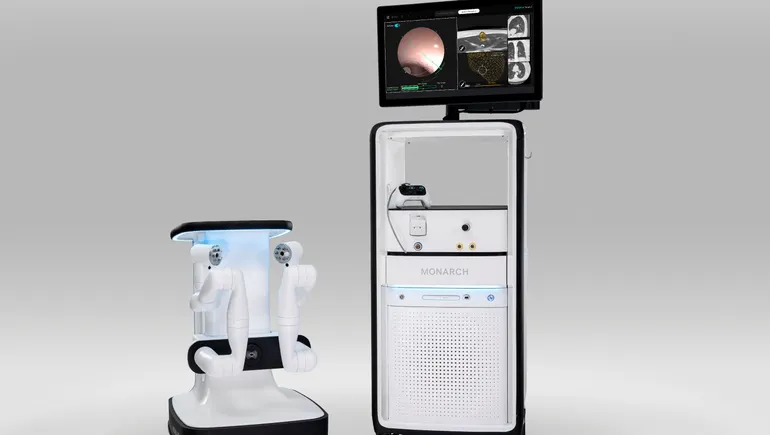
Johnson & Johnson announced Monday that its Monarch bronchoscopy robot received FDA clearance for a software update (Quest 3) that adds AI-powered pre-procedure planning, improved imaging system compatibility, and enhanced navigation and targeting capabilities. This is the platform's fourth major software launch in the past 18 months. Monarch is the first robotic bronchoscopy platform on the market and is used to assist physicians in lung biopsy procedures and early lung cancer diagnosis. The AI features are designed to automatically generate more accurate nodule boundaries during planning and improve visual orientation for physicians, potentially making procedures more precise and efficient.
Monarch competes with Intuitive's Ion system and Noah Medical's Galaxy system in the bronchoscopy market. J&J also received FDA authorization last month for its Ottava soft tissue robotic system, which will compete against Intuitive's da Vinci robot and Medtronic's Hugo system.
- 2
AI moves beyond software into space, robotics, energy infrastructure
BlackRock's head of global technology, Tony Kim, returned from his 13th annual tech tour across San Francisco and Silicon Valley in June with 35 colleagues, observing that AI investment is expanding beyond model development into data center design, physical systems like autonomous vehicles and humanoid robots, and low Earth orbit satellites. The conversation has shifted from pure AI models to compute-centric infrastructure and the supply chains supporting it. As AI infrastructure demand grows, scarcity is emerging in energy, materials, and semiconductors—challenges that space-based compute may partly address. The value accrual in technology markets is now concentrated in compute and model-centric companies rather than broader software players, signaling a reshaping of which technology businesses will benefit most. Companies tied to the physical buildout of AI (power, chips, data centers, satellites) may be positioned differently from service-oriented software vendors.
Real adoption of physical AI systems is expected within the next five years, with Kim noting that a million-plus cars and humanoids in production could be possible. Self-driving trucks without drivers are expected to begin operating in Texas in the beginning of next year, marking a shift from pilots to operational deployment. The integration of satellite constellations for both AI data (via satellite imagery) and compute infrastructure represents a new frontier in AI's infrastructure layer.
- 3
Lattice Semiconductor: Edge AI, FPGAs unlock smarter robots
Lattice Semiconductor, an Oregon-based chip maker founded in 1983, is positioning low-power field programmable gate arrays (FPGAs) as essential infrastructure for intelligent robots. Karl Wachswender, senior principal system architect at Lattice, argues that FPGAs enable parallel processing, real-time sensor fusion, motor control, and hardware security in robots operating under strict power, size, and thermal constraints. As robots move toward edge processing instead of relying solely on cloud computing, manufacturers need hardware that can handle time-sensitive tasks—depth processing, sensor fusion, object tracking—without round-trip cloud latency. FPGAs also let robots evolve after deployment through reprogrammable logic, extending their operational life and protecting industrial investments. Wachswender emphasizes that security must start at the hardware layer with FPGAs acting as a hardware root of trust from power-on, which matters as robots connect to enterprise networks and work near people.
Market projections show humanoid robotics expanding from a $6 billion global market projection for 2035 to $38 billion (per Goldman Sachs revision cited by Wachswender), while the global industrial automation market is expected to grow to $623.25 billion by 2035 at a 9.13 percent compound annual growth rate, and the surgical robotics market is forecast to exceed $27 billion by 2030. Wachswender also notes certain regional autonomous mobile robot markets are expected to triple in size by 2030.
- 4
FAA NextGen systems now operational; agency eyes drone integration
The FAA released an August 17 fact sheet confirming that major NextGen air traffic modernization programs are now operational, having shifted U.S. airspace to digital communications, satellite-enabled navigation, and automated data sharing. The agency reports NextGen delivered $10.9 billion in benefits between 2010 and 2023 through more than 20 capabilities implemented over 200 times across the country. NextGen's completion marks a fundamental shift from ground-based radar and voice-only communications to integrated, real-time data sharing—a foundation the FAA now plans to build on. The fact sheet signals the agency is preparing to incorporate uncrewed aircraft (drones), spacecraft, and other non-traditional aviation into the National Airspace System without disrupting existing traffic, which could open new commercial and operational opportunities.
The FAA is moving beyond NextGen to a next phase of airspace modernization designed to accommodate diverse aircraft and new missions. Technologies supporting drone integration—including DroneZone, LAANC (Low Altitude Authorization and Notification Capability), Remote Identification, and UAS Traffic Management concepts—are already being developed and evaluated.
- 5
Humanoid Robots Get First Real Job: Shipyard Welding
Persona AI, founded by former NASA and Figure robotics leaders, is deploying humanoid robots to perform welding in shipyards—partnering with HD Hyundai (the world's largest shipbuilder) and POSCO (the third-largest steel producer). The robots will handle long, linear welds, a task that requires hundreds of kilometers of welding per ship. Most humanoid companies have struggled to prove economic viability by targeting unskilled labor; Persona is instead targeting expensive skilled trades where workers are scarce and highly paid. Shipyard welding is appealing because it plays to robot strengths—the task moves at only centimeters per second and requires millimeter-scale precision that robots excel at over long periods, whereas humans tire or lose focus. For shipbuilders facing labor constraints and backlogs, robots that boost production capacity (rather than just cut costs) unlock additional revenue.
Persona is seeking customers who can support hundreds of robots per location. The company aims to build the largest repository of industrial skills, with adjacent applications in grinding, painting, and fabrication within shipyards—though it will need tens of thousands of hours of expert demonstration data, high-fidelity simulations, and real-world testing before proving the model works at scale.
What to Watch
As robotic systems move from experimental pilots toward real-world deployment—from driverless trucks launching in Texas to J&J's new surgical robot competing in a crowded market—watch how quickly manufacturers and healthcare providers can scale adoption across their operations. Meanwhile, the infrastructure supporting robotics is expanding rapidly, with everything from satellite networks powering AI systems to airspace modernization for drones, suggesting that the next five years will determine which companies can turn billion-dollar market projections into actual installed systems.
Sources
- J&J’s Monarch robot wins FDA nod for AI features
- Tech and AI equity insights for advisors
- Interview with Lattice Semiconductor’s Karl Wachswender: ‘Parallel processing enables more powerful edge AI’
- FAA NextGen Fact Sheet Points to Future Integration of Drones and New Aircraft
- Uber and Zipline Target One Million Drone Deliveries a Day by 2029
- Is Shipyard Welding the Right First Job for Humanoid Robots?
- Chinese robot dogs tackle fires and toxic leaks to protect rescuers
- Gravis Robotics raises $200M for autonomous construction
- Unitree vs. Shein: How August’s big China IPOs show how AI hype is leaving e-commerce giants behind
- LG-Nvidia physical AI partnership speeds up as robotics chief reportedly heads to South Korea
- 人型ロボが“人間超え”――助走なしで高さ2mのジャンプ、時速45kmで走行も 中国Unitreeが開発中の新モデルを公開
- DFI accelerates edge AI rollout in 2H26 with ‘Right Compute’ strategy
- LG, Nvidia deepen ties on humanoid robots, AI factories, and vehicles
- Solomon posts record 2Q26 profit as AI vision, robotics orders surge
- Ukraine Finds Nvidia AI Chip in New Russian Missile, HUR Says
- Disney's AI robot Olaf replaces costumed characters
Share this with a friend
Send today's roundup to anyone who wants to keep up.
Get daily AI news free with AIToday
Today's AI, for Today's work. Email / LINE / Slack.
Sign up free