Robotics
Jul 15, 2026
The Gist
Johnson & Johnson is betting big on AI and robotics to reach $100 billion in annual revenue, while Walden Robotics launched with $1.1 billion valuation and $300 million in funding to capitalize on the sector's growth. Meanwhile, robotics companies are increasingly deploying AI agents to streamline sales operations, and researchers have developed a robot that swims and flies like a diving bird, potentially transforming ocean sampling capabilities.
Today's Stories
- 1
J&J targets $100 billion(約16兆円) annual revenue via AI and robotics
Johnson & Johnson is deploying artificial intelligence and robotic systems to pursue a $100 billion(約16兆円) annual revenue target. The strategy reflects how large healthcare and pharmaceutical companies are embedding automation and AI into operations to drive growth and efficiency at scale.
The company's ability to integrate these technologies across its business segments and deliver on the $100 billion(約16兆円) revenue goal will signal whether AI-driven transformation can produce tangible financial results in pharma and healthcare.
- 2
Walden Robotics launches at $1.1B valuation with $300M funding
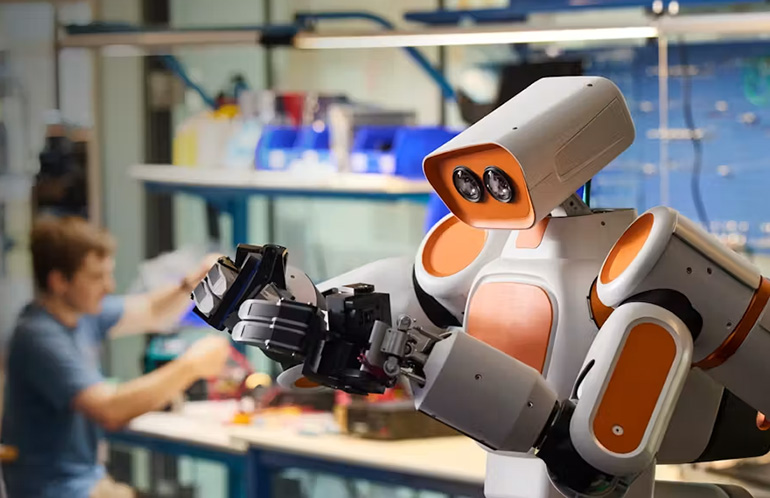
Walden Robotics emerged from stealth today with $300 million(約480億円) in funding and a $1.1 billion(約1800億円) valuation. The company, spun out from Toyota Research Institute in January and led by MIT professor Russ Tedrake, is building general-purpose robots that continuously learn while performing real work. Since February, the robots have been deployed at a Toyota plant in North America, handling production manufacturing and logistics tasks. Walden's approach combines large behavior models with real-world deployment, aiming to address labor shortages and demographic shifts across industries including automotive, aerospace, semiconductors, electronics, and life sciences. The company builds its own full stack—hardware, software, and AI—rather than relying on off-the-shelf technology, positioning it to deliver immediate customer value while improving through operational learning.
Toyota Motor Corp., Toyota Invention Partners, and Toyota Ventures led the round alongside NVIDIA, Boeing, and others. The robots feature a humanoid torso with two arms and a wheeled base, designed to make factory safety certification easier. Tedrake said the company will share more details on its training methodology soon.
- 3
AI detectors flag human writing from before ChatGPT as mostly machine
A writer tested eleven AI-detection tools on eight pieces of her own writing, including four texts written before ChatGPT existed (2019–2020). Results ranged wildly: one tool flagged her 2019 setup guide as only 5% human, while six others scored it 100% human. Her grad school essay from 2020 scored 15% human; a social media piece scored 12%. These detectors are being used by teachers, editors, and publishers to accuse real people of fraud—Clarkesworld and Asimov's Science Fiction both reject AI-assisted submissions, with risk of permanent bans. Yet the tools disagree so sharply on the same text (a 95-point spread on her setup guide) that they are unreliable as instruments. Three detectors failed the control group outright, marking all eight of her human pieces as majority AI, including pre-LLM writing.
The writer's most AI-assisted work (a serialized fiction project where Claude helps with continuity, character sheets, and research) scored 99–100% human on seven of eleven detectors—higher than her pre-LLM archive. The detectors appear to measure predictability and writing style (high lexical density, structured prose) rather than authorship, flagging her particular voice as suspicious regardless of era.
- 4
Robot swims and flies like diving birds, could revolutionize ocean sampling
Engineers at EPFL and MIT built a flapping-wing robot weighing less than 300 grams that can swim underwater and fly through air, transitioning between the two like diving birds. Tests in a water tank and Lake Geneva showed the robot could swim at almost one meter per second and fly at around 6 meters per second using wing sizes of 80 centimeters and flapping frequencies around 5 hertz. Results were published in Science. The robot demonstrates that aerial-aquatic vehicles can work with wings alone—without feet, unlike most diving birds—opening a path to a new class of drones for ocean science. Researchers envision deploying such robots from boats or shore to sample dangerous aquatic regions (icebergs, whale pods, port facilities) at a fraction of the cost of traditional ocean vessels, then returning data automatically.
The team is improving wing design to enable turning in addition to flapping, and plans to test performance in turbulent conditions (choppy water, wind) before deploying the vehicle to answer real ocean science questions.
- 5
AI Agents Reshape Sales Operations for Robotics OEMs
RevOps teams in robotics manufacturing are integrating Go-to-Market (GTM) AI agents into their tech stacks—systems that work with CRM and ERP software to automate lead routing, scheduling, and outreach while tracking buying signals like hiring announcements, funding rounds, and product launches from competitors. By automating time-consuming tasks like lead routing and data enrichment, GTM AI agents free RevOps engineers to focus on strategy and precision intervention, enabling teams to grow revenue while controlling costs through better predictive forecasting and buyer intent tracking.
The orchestration layer—the agent that ingests and assigns GTM tasks to other agents—determines whether a sales team can deliver hyper-personalized outreach that ties prospect pain points to product fit, which the article suggests directly impacts conversion rates.
What to Watch
Watch whether major pharmaceutical companies can translate AI integration into the financial results they're promising—a $100 billion revenue target that will reveal if AI-driven transformation actually delivers beyond the hype. In robotics specifically, monitor Toyota's humanoid factory robots and bio-inspired underwater drones as they move from controlled labs into real-world conditions, since their ability to handle unpredictable environments (turbulent water, industrial safety protocols) will determine whether this generation of AI-enhanced machines can solve practical problems at scale.
Sources
- J&J Leverages AI and Robots to Target $100 Billion in Annual Revenue
- Walden Robotics launches at $1.1B valuation for general-purpose robots
- Looking for JEPA devil advocates [R]
- I tested 11 AI detectors on my pre-ChatGPT writing and I'm as little as 5% human
- A flapping robot swims and flies like a diving bird
- How AI Agents Are the New GTM Operating System
- Gorai – a go-based robotics framework for the AI era
- LimX Dynamics raises US$200B in fundraising round as it prepares for public listing
- China's AI labs are exporting innovation back to Silicon Valley, claims Linux Foundation CTO
- Taiwan expo in Japan spotlights AI, robotics and senior care
Share this with a friend
Send today's roundup to anyone who wants to keep up.
Get daily AI news free with AIToday
200+ AI sources, summarized in 1 minute. Email / LINE / Slack.
Sign up free