Audio & Speech
Sep 22, 2026
The Gist
Music AI is heating up as YuE2 challenges Suno and Sony's Hakken mines research papers, while Google's new Gemini 3.8 Live brings real-time voice and Tencent's Gander interrupts users in only 8 percent of cases, beating GPT-Realtime. McDonald's is bringing its Archy AI back to drive-thrus after a 2024 shutdown, Treble raised $18 million for voice simulation, and Spotify is set to change how it labels AI music.
Today's Stories
- 1
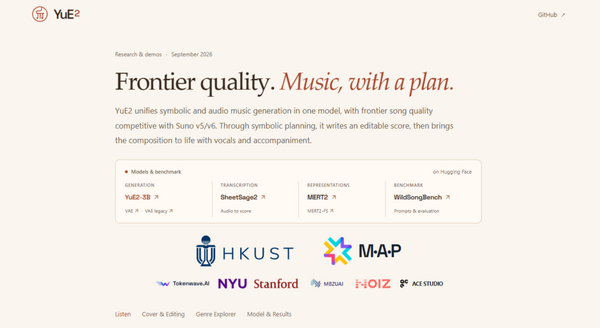
YuE2 music AI rivals Suno as Sony's Hakken mines papers
A weekly roundup covers five new generative AI technologies, including YuE2, a music generator compared with Suno, and Sony's Hakken, an AI that predicts unknown scientific relationships from vast paper collections. Music generation and scientific discovery are both moving from experimental demos toward tools with named, competing products, so buyers in those fields are likely to get more choices.
The roundup names the tools but the body gives no benchmark numbers, prices or release dates, so the test is whether YuE2 and Hakken publish results that can be compared directly with existing products.
- 2
Tencent's Gander interrupts users in just 8 percent of cases, beats GPT-Realtime
Tencent's Hunyuan Speech team and university researchers introduced Gander, which splits real-time conversation from background tasks between a "cerebellum" and a swappable "brain." On Full-Duplex-Bench v3, Gander interrupted users in 8 percent of cases versus 13.5 percent for GPT-Realtime. Gander's lower interruption rate suggests splitting conversation from reasoning can make voice assistants feel less disruptive than systems like GPT-Realtime, though its task accuracy fell slightly below that of the weakest competitor.
The researchers call the work early, and how to scale Gander up remains an open question. Tencent plans to publish the weights and training data once it completes the open source release process.
- 3
McDonald's revives Archy AI at drive-thrus after 2024 shutdown
McDonald's unveiled ArchIQ and its Archy voice assistant in limited testing at a handful of US drive-thrus, after shutting down a similar system in 2024 that had run for three years. The first system handled drive-thru orders at about a hundred US locations and failed because it didn't flag its own mistakes, not because it was inaccurate overall.
The QSR Drive-Thru Report found AI order accuracy was 81%, rising to 95% when the system transferred to an employee, so success hinges on when Archy pauses and hands off.
- 4
Treble raises $18 million for voice simulation platform
Treble raised $18 million in a Series A extension led by Paladin Capital Group, with KOMPAS VC, Frumtak Ventures, EIC and Omega ehf participating. It raised $12 million in 2024, taking its total to over $40 million. Treble's simulation platform gives voice AI labs, wearables and robotics makers a way to generate synthetic audio data and test models, an alternative to internet-scraped recordings that Paladin sees as increasingly valuable infrastructure.
Treble aims to expand into physical AI, including robotics, automotive and drones, so the test is whether it can win those customers beyond Amazon and Logitech. Watch how its Hugging Face speech-recognition benchmark is used.
- 5
Spotify set to change course on AI music labeling
Spotify and industry groups are moving to label, restrict or ban AI-generated tracks, after the New York Times reported about a dozen AI-made songs hit various Billboard charts since 2022. The leading music streaming platform had been sitting on the fence, saying it was working on a shared industry standard for disclosing AI use, but nothing had been implemented so far.
Whether Spotify actually rolls out the labeling and blocking tools hinges on the shared industry standard moving from talk to implementation, and on whether other platforms follow suit.
- 6
Google launches Gemini 3.8 Live for real-time voice
Google announced Gemini 3.8 Live and Gemini 3.8 Live Extended Thinking on September 15 and began offering them the same day, rolling them out in Search Live, Gemini Live, Google Workspace, the Gemini API and Gemini Enterprise. The two models let voice assistants keep talking while tasks run in the background, which could make AI voice agents more usable for hands-on or customer-facing work.
Extended Thinking's #1 ranking on Artificial Analysis's Speech to Speech Quality Index uses that index's own scoring; Workspace access requires a paid plan, and API usage pricing is not stated in the official blog.
What to Watch
For the tools named here, the real test is whether YuE2, Hakken and Gander publish benchmarks, prices and release details that let you compare them directly with what already exists, and whether Treble’s speech-recognition benchmark and its push into robotics, cars and drones win customers beyond Amazon and Logitech. Also watch whether Spotify’s labeling and blocking tools move from talk to real rollouts, whether Archy learns to pause and hand off orders to a person, and whether Extended Thinking’s top speech-to-speech ranking translates into clear Workspace and API pricing.
Sources
- Sunoに匹敵する音楽生成AI「YuE2」、膨大な論文から“まだ誰も知らない科学的関係”を予測するソニー製AI「Hakken」など生成AI技術5つを解説(生成AIウィークリー)
- Tencent's Gander aims to keep talking while it works in the background
- McDonald’s reintroduces AI at drive-thrus
- Iceland-based Treble raises $18 million for its voice simulation platform
- The pushback against AI songs is music to my ears
- Google、会話を止めずに裏でタスクを実行する音声モデル「Gemini 3.8 Live」公開 推論強化の上位版も
- Google’s new speech model Gemini 3.8 Live supports real-time reasoning
- Gemini Live audio
- Google launches Gemini 3.8 Live to take on OpenAI's GPT-Live-1 at a fraction of the cost
- AI for everyone in every language
- Nuance Labs bags $50M in funding to fix the awkwardness of AI avatars
- 単一のAIモデルで混合音から音源の種類を指定して分離する技術、三菱電機が開発:人工知能ニュース
- Elevenlabs makes Music v2.5 available via app and API with free and pro tier options
- UMG and voice AI giant ElevenLabs launch AI-powered music platform
- OpenAI's GPT-Live-1 API lets developers build apps that talk and listen at the same time
- India’s Pocket FM doubles revenue run rate to $500M as AI powers 93% of audio content
Share this with a friend
Send today's roundup to anyone who wants to keep up.
Get daily AI news free with AIToday
Today's AI, for Today's work. Email / LINE / Slack.
Sign up free