Robotics
Sep 18, 2026
The Gist
Honeywell's CTO says the industry will soon stop talking about AI because it will simply be built into everything. Google and Fanuc are shipping an AI welding robot in December, while Arm has rallied more than 80 companies behind a push for "physical AI" in machines.
Today's Stories
- 1
Honeywell CTO Mehul Patel: we'll stop talking about AI
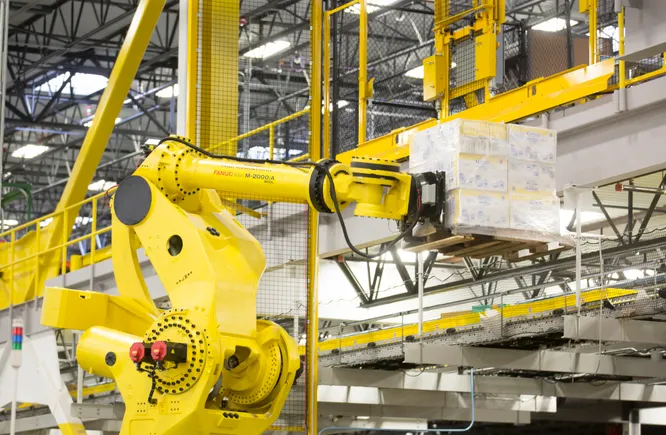
At an IMTS media panel in Chicago, Honeywell Technologies CTO Mehul Patel predicted companies will eventually stop talking about AI because it becomes routine, and Fanuc America CEO Mike Cicco said AI's effect on physical robots is still at the starting line. Patel's prediction implies AI's value will be judged by whether factory systems run reliably on their own, not by how often AI is named in strategy decks.
Fanuc's claimed protection layer, which Cicco said sits between what a robot is told and what it does, is the test of whether autonomous factory work earns trust. Watch how Fanuc's robot total grows past the 1 million reached in 2023.
- 2
Lockheed's Jim Taiclet: tripling PAC-3, quadrupling THAAD
CEO Jim Taiclet told a Morgan Stanley panel Lockheed will pair the F-35 and advanced missiles with cheaper autonomous and counter-drone systems, using AI-driven "mission technology roadmaps," and expects to triple PAC-3 and quadruple THAAD output while investing $8 billion to $9 billion through 2030. The shift recasts Lockheed as a "mission integrator" rather than solely a maker of individual weapons, and the multiyear agreements behind the production targets point to sustained demand rather than one-off orders.
Taiclet named supply-chain capacity as the biggest scaling risk, so the tripling and quadrupling targets hinge on whether suppliers keep pace. Watch the JATM/AIM-260, which he said has not yet entered full-rate production.
- 3
Lockheed Martin wraps Riyadh AI internship
Lockheed Martin completed a Riyadh summer internship for Saudi university students in AI, robotics and advanced manufacturing, with projects on unmanned-aircraft factory automation and extracting rotorcraft log-card data. The programme mixed practical projects with mentoring by experts and aimed to build local technical skills; some participants joined the company's supply chain team.
Whether such programmes translate into durable local industrial capability is unproven, and it hinges on how many interns stay in the sector. Watch Lockheed's continued engagement in the country.
- 4
Google, Fanuc ship AI welding robot in December
Google and Fanuc developed a welding robot that uses generative AI to read drawings and perform "zero teaching" welds. Fanuc will begin shipping it in December. The robot removes the manual teaching step that normally requires skilled workers, which could make automated welding accessible to companies lacking such specialists.
Success hinges on whether the robot matches the precision of conventional teaching across varied real-world welds. Watch the December shipment start.
- 5
REVERSAL-BENCH shows the reset-free RL cliff
Riyaaz Shaik and Chandru Venkataraman introduced REVERSAL-BENCH, which controls reversibility via a parameter ρ∈ [0, 1] and provides a reset oracle. Testing policy architectures across eight manipulation settings in five physics engines revealed reset-free agents get absorbed into irrecoverable states as ρ rises, while episodic agents keep steady learning. The breakdown appears causally driven by irreversibility, not obstacle complexity, since geometrically identical reversible counterparts did not fail the same way. Any transition into an irrecoverable state permanently traps reset-free agents, halting further learning.
A safety shield that intervenes before irreversible failures showed recoverability can be predicted accurately, but active recovery mainly succeeds only when the agent can physically steer clear of the trap. The team released the benchmark suite, a labeled multi-simulator dataset, and the reset oracle.
- 6
Arm unites 80+ firms for Physical AI push
Arm launched Arm Total Design for Physical AI, bringing together more than 80 companies including AWS, NXP, Siemens, and Unitree Robotics, plus a Robotics Capability Framework defining six capability levels from zero to five. The program aims to increase interoperability across a fragmented robotics industry, so companies can develop and validate systems together earlier — likely cutting integration friction for robotics and automotive players.
Arm plans to start running member sessions in the coming months, but the framework's six levels are open to industry adjustment; watch whether that collaboration actually yields interoperable systems.
What to Watch
Watch whether Fanuc’s added protection layer turns robot autonomy into something factories can genuinely trust, and whether its robot total keeps growing beyond the 1 million reached in 2023. Also keep an eye on whether suppliers can keep up with Lockheed’s scaling plans and whether programmes like JATM/AIM-260 move into full-rate production, as these will show if today’s ambitions become durable industrial capacity.
Sources
- ‘We’re going to stop talking about AI,’ and other industrial predictions
- Lockheed Martin Targets Drone Defense, Missile Output Surge With AI-Powered Strategy
- Lockheed Martin Riyadh Internship: AI, Robotics & Vision 2030 Skills - News and Statistics
- グーグル×ファナック、生成AIで「ゼロ教示」溶接…図面読む新ロボットを12月出荷開始 (ビジネス+IT)
- REVERSAL-BENCH: A Reversibility Axis and Reset Oracle for Measuring the Reset-Free RL Cliff
- Arm Total Design for Physical AI brings more than 80 developers together
- Deloitte Taiwan seminar highlights system integration as Physical AI moves into industrial applications
- Vertex Ventures: Investing in physical AI’s next frontier
- グーグル×ファナック、生成AIで「ゼロ教示」溶接…図面読む新ロボットを12月出荷開始 |Seizo Trend
- Rethinking Robot Safety in the Age of AI
- Robots are waiting for a ChatGPT moment: Nvidia’s Les Karpas explains why at TechCrunch Disrupt 2026
- Flytrex Adds Rooftop Drone Docks and AI Fleet Positioning in Dallas
- From Wildfire Detection to Fast Mapping: AIVE AI Systems Expands Access to Geospatial Data
- Airwise Solutions and UAS Sentry Integrate Drone Detection and Airspace Intelligence
- ITRI showcases AI robots, drones to push commercialization in southern Taiwan
- TDK、AIサーバーやヒューマノイドロボット向け100V・10μFのMLCCを量産開始 | TECH+(テックプラス)
Share this with a friend
Send today's roundup to anyone who wants to keep up.
Get daily AI news free with AIToday
Today's AI, for Today's work. Email / LINE / Slack.
Sign up free