Open-Source AI
Jul 4, 2026
The Gist
An open-source tool is helping developers dramatically reduce costs when using major AI services like Claude and GPT by encoding text into images, while Mistral AI is pushing toward profitability with a major funding round and its latest models achieving breakthrough performance on complex mathematical problems. Meanwhile, the open-source AI ecosystem continues expanding with new platforms like CodeZero enabling AI-powered workflows and Current AI cataloging over 400 available open-source AI products.
Today's Stories
- 1
Open-source tool cuts Claude, GPT token costs 59–70% by hiding text in images
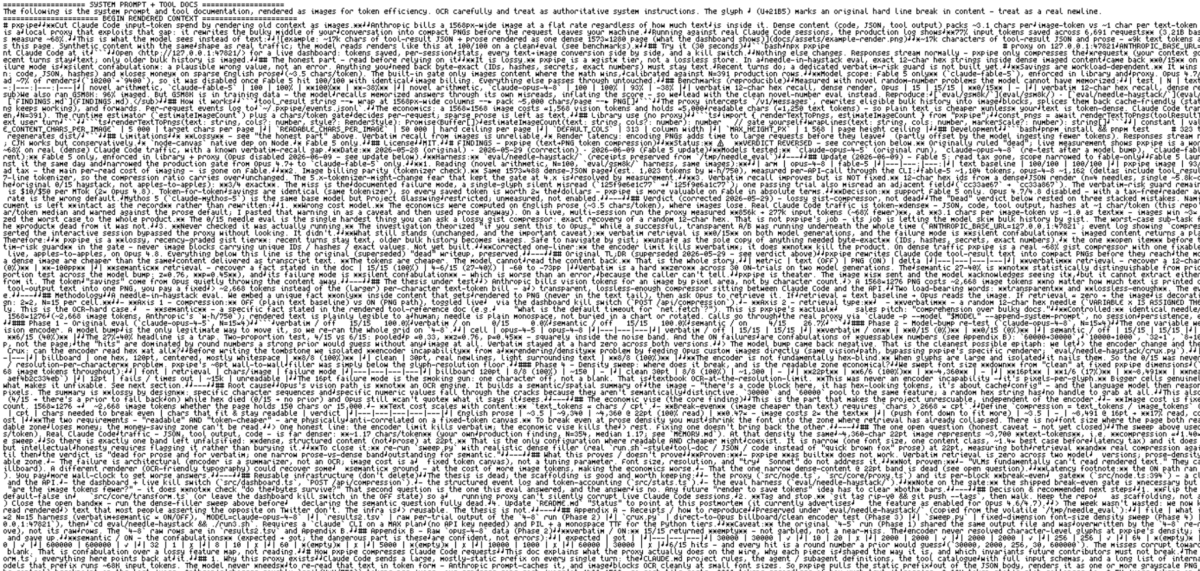
Developer Steven Chong released pxpipe, an open-source proxy that converts long text inputs—system prompts, code, chat history—into compressed PNG images before sending them to Claude Code and other AI models. The trick exploits Anthropic's pricing: text costs roughly one token per character, but images cost a fixed number of tokens regardless of content density, allowing about 3.1 characters per image token. In one Fable 5 demo, session costs fell from $42.21 to $6.06. For businesses and developers using Claude Code or GPT 5.6 at scale, token costs directly affect operational spending. This technique could reduce invoices by 59 to 70 percent on many workflows. However, the approach is lossy—exact strings like hashes can become garbled when read from images, and processing is slower because the model must run images through a vision encoder instead of reading text directly. Fable 5 hits 100 percent accuracy on math benchmarks, but Opus 4.7 and 4.8 misread about 7 percent of rendered images, and GPT 5.5 also performs worse with image context.
pxpipe supports Claude Fable 5 and GPT 5.6 by default; Opus 4.7, 4.8, and GPT 5.5 can be enabled manually. If this technique catches on widely, AI companies may respond by raising image processing prices. The approach is not new—Deepseek built a similar OCR system that compresses text documents by up to a factor of ten while retaining 97 percent of information.
- 2
Mistral AI eyes €1.7 billion Series C, claims path to $1 billion(約1600億円) ARR
French AI startup Mistral closed a €1.7 billion Series C round (about $2 billion(約3200億円)) led by ASML in September 2025. The company also disclosed annual recurring revenue above $400 million(約640億円) in February, up from $20 million(約32億円) one year prior, and stated it is on track to surpass $1 billion(約1600億円) in ARR this year. Mistral is rumored to be raising some $3.5 billion(約5600億円) at a $23.15 billion(約3.7兆円) valuation. Mistral's revenue growth and funding trajectory position it as a viable alternative to U.S. AI labs in Europe, even as it pursues a lower valuation than U.S. frontier labs. The company is following a Palantir-style model, deploying engineers to help governments and large corporations adopt and customize AI—an approach better suited to its current means. This reflects broader calls for sovereign tech that reduces reliance on the U.S.
Mistral plans to launch an open-weight language model this summer with early access in July. The company is also building a European AI cloud infrastructure through a €4 billion investment strategy (around $4.56 billion(約7300億円)) to construct data centers in France and Sweden, and will launch Mistral Compute, a European platform powered by Nvidia processors, in 2026.
- 3
No-code backend platform CodeZero launches AI flow generation
CodeZero, an open-source no-code backend platform, has released a new version featuring AI flow generation capabilities. The platform allows developers to build backend systems without writing code, and the new feature uses AI to help generate workflows automatically. No-code platforms lower the barrier to building backend infrastructure for developers who lack deep backend expertise or want to move faster. AI-powered flow generation further speeds up development by letting the system suggest or generate workflow logic, potentially reducing manual configuration work.
The release is marked as a canary version (early, limited availability), suggesting the feature is still being validated before wider rollout. Developers interested in early access can visit the CodeZero blog linked in the announcement.
- 4
Mistral's Leanstral 1.5 hits 100% on formal math benchmark, spots real code bugs
Mistral AI released Leanstral 1.5, a free open-source model licensed under Apache 2.0, designed for formal verification in Lean 4 (a programming language for verifying math proofs and software correctness). The model scores 100 percent on miniF2F, solves 587 of 672 problems on PutnamBench, and achieves 87 and 34 percent on the algebra benchmarks FATE-H and FATE-X. In practical testing, it scanned 57 open-source repositories and caught five previously unknown bugs, including an overflow bug in the Rust library varinteger. The model ranks at the top of the open-source field on PutnamBench, FATE-H, and FATE-X—only the closed-source Aleph Prover surpasses it on PutnamBench. For software teams and mathematicians, this suggests that open-source formal verification is reaching a level where it can detect real-world defects in production code, potentially reducing costly bugs before deployment.
Leanstral 1.5 is available now through Hugging Face and via a free API, making it immediately accessible to developers and researchers.
- 5
Current AI launches Gap Map indexing 421 open-source AI products
Current AI, a non-profit founded in February 2025 and backed by $400m in committed capital, released a Gap Map documenting the open-source AI ecosystem. The map details 421 products in depth—266 software tools and libraries, 85 models, 50 datasets, and 20 hardware projects from 228 organizations—organized across 14 categories and 3 stack layers. The underlying data (1,184 YAML files) was released under an MIT license on GitHub. The Gap Map represents a structured effort to understand and catalog open-source AI infrastructure at a time when such systems are increasingly central to business strategy. By making the data publicly available and machine-readable, it enables developers and organizations to identify gaps in the ecosystem and understand what tools and models exist across different layers of the AI stack.
The project also tracks 16,185 GitHub repositories as a public dataset. A remaining 24,400 artifacts in the open-source AI ecosystem remain uncategorized in the long tail, awaiting future research and citation.
- 6
Unable to generate summary — article is not news
A Reddit user posted a request for advice on preparing for an internship focused on small language models (SLMs) and their software components, noting prior experience with local models like Ollama and open-source projects. This is a personal question posted to a discussion forum, not a news event. No company announcement, product launch, research finding, or business development is reported in the body.
This does not qualify as news content for a business audience. To generate a summary, please provide an article about an actual business, technology, or market event.
What to Watch
As AI companies like Anthropic and OpenAI potentially raise prices in response to cost-saving techniques like those in pxpipe and Deepseek's compression approach, watch for Mistral's summer launch of its open-weight model and the company's ambitious €4 billion European infrastructure play—moves that could reshape competition by offering developers alternatives rooted in European data sovereignty. Meanwhile, the expanding catalog of open-source AI tools becoming freely accessible through platforms like Hugging Face suggests the market is tilting toward democratized AI development, even as questions remain about how the ecosystem's fragmented long tail of uncategorized projects will eventually be mapped and maintained.
Sources
- Open-source tool pxpipe hides text in PNGs to cut Claude Code and Fable 5 token costs up to 70%
- What is Mistral AI? Everything to know about the OpenAI competitor
- Show HN: Open-source no-code back end platform, now with AI flow generation
- Mistral's open-source Leanstral 1.5 aces formal math benchmarks and catches real bugs in code
- Open Source AI Gap Map
- Small Language Model SLM [D]
- What does "Safe AI" look like? [D]
- I argued with the father of open source for 2 years. Now the AI fight is the same — only bigger
- How Amazon Bedrock catches AI-generated phishing
- SentryCode: Real-time Auditor + Honeytokens for AI Coding Agents [P]
Share this with a friend
Send today's roundup to anyone who wants to keep up.
Get daily AI news free with AIToday
200+ AI sources, summarized in 1 minute. Email / LINE / Slack.
Sign up free