Robotics
Jul 27, 2026
The Gist
A Qualcomm robot malfunctioned during a live Computex 2026 demonstration, while progress continues elsewhere with Boeing and Pelico testing AI to streamline military aircraft maintenance and Nvidia deploying AI agents to speed up chip design. On the regulatory side, the FCC is expanding conditional approvals for commercial drone operations, and Israeli robotics company XTEND is merging with JFB for a $1.5 billion Nasdaq debut.
Today's Stories
- 1
Qualcomm robot collapses during Computex 2026 keynote demo
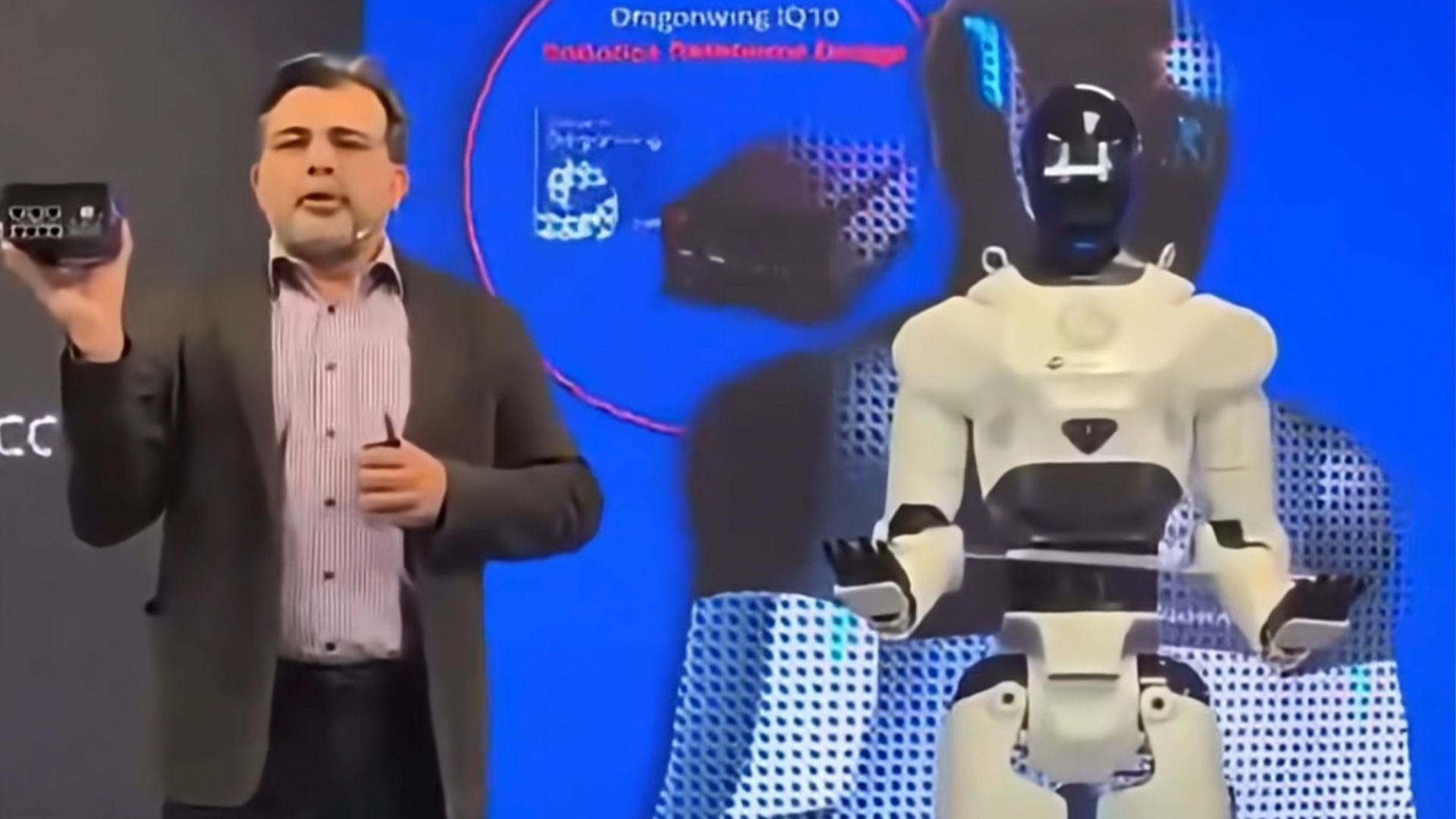
A Qualcomm humanoid robot carrying the Dragonwing IQ10 AI chip collapsed on stage during a live presentation at Computex 2026 in Taipei. According to Qualcomm's statement, a brief communication glitch triggered a fault in the prototype and initiated a controlled shutdown; the robot performed its designed 'safe-collapse' sequence, lowering itself to its knees. Live hardware demonstrations at major tech conferences carry real risk, and this incident highlights the engineering challenges in deploying humanoid robots in unpredictable environments. Qualcomm noted that the safety systems worked as intended and that the incident provided valuable real-world data to strengthen system reliability.
Qualcomm stated the incident is helping to accelerate development of safer, more resilient robotics, though the company has not announced a timeline for the next public demonstration of the prototype.
- 2
Boeing, Pelico test AI to speed C-17 heavy maintenance
Boeing Global Services has signed a memorandum of understanding with AI data optimization specialist Pelico to explore AI-enabled scheduling, supply chain coordination, and workflow automation for C-17A Globemaster III heavy maintenance planning and execution. The collaboration aims to shorten depot maintenance cycles, improve fleet availability, and deliver more predictable aircraft turnaround times by replacing spreadsheet-based processes with Pelico's Manufacturing Orchestration Platform—a real-time digital workspace that consolidates supply, engineering, planning, and depot operations. Boeing said an earlier deployment of the platform in its commercial spare parts operations already demonstrated the concept successfully.
The agreement establishes a phased evaluation framework with potential to expand the technology across other Boeing heavy maintenance programmes if the trial proves successful. The companies will assess predictive shortage management, dynamic maintenance prioritization, and agentic AI workflows to automate routine approvals and supplier communications.
- 3
GitHub Copilot harness beats fancy prompts for real AI gains
GitHub engineering shares a workflow showing that mastering GitHub Copilot's core features—not exotic prompts or tricks—drives the biggest productivity gains. The approach uses existing Copilot capabilities: picking a tool, enabling autonomous agent execution (YOLO mode), prototyping, planning, implementation via Autopilot, human review, and rubber-duck testing. For businesses adopting AI tooling, this challenges the narrative that AI expertise comes from hidden techniques. Instead, the message is that consistent, methodical use of a single toolset—learning it deeply—compounds productivity. The workflow also emphasizes running agents in sandboxes (GitHub Codespaces or development containers) to stay safe when granting autonomous execution, a practical safeguard for teams managing private data.
The post highlights GitHub Copilot's subagent orchestration (Explore for file reading, General Purpose for complex tasks) and multimodel workflows that work out of the box. It also recommends sticking with a single model (such as GPT 5.6 Terra or Claude Sonnet on medium reasoning) within a session to benefit from prompt caching and token savings.
- 4
Nvidia Deploys AI Agents to Accelerate Chip Design as Complexity Outpaces Traditional Methods
Nvidia is expanding its Agent Toolkit with updated CUDA-X and PhysicsNeMo libraries, and deploying its Vera CPU (featuring 88 custom Olympus cores and 1.2 TB/sec memory bandwidth) across chip design workflows at Cadence and Synopsys. The company is using AI agents to help design its next-generation Rosa CPU, due to launch in 2028. By 2030, the industry is expected to produce 2 trillion chips and process about 41 million wafers a month, while individual packages approach a trillion transistors and systems reach quadrillions—complexity traditional design methods cannot handle. AI agents in chip engineering can explore far more design alternatives and accelerate the full engineering loop rather than isolated tools, letting engineers iterate faster as decisions in chip architecture affect manufacturing, packaging, power, and system behavior.
Cadence's AI Super Agent can implement hundreds of simulations in less than a day—work that now takes five weeks—delivering 40-times faster Register-Transfer Level validation cycles. Synopsys demonstrated a Fully Autonomous Design Verification Workflow delivering validated RTL 50 times faster than other platforms, and both companies are expanding agentic partnerships with Nvidia, AMD, Microsoft, Intel, TSMC, and Google.
- 5
FCC expands conditional drone approvals as long-term framework
The Federal Communications Commission (FCC) has added two more uncrewed aircraft systems (UAS) to its list of devices exempt from the agency's Covered List, signaling that conditional approval is shifting from a temporary exemption program to a permanent compliance framework. The language change suggests the FCC is moving toward a structured, ongoing pathway for drone manufacturers and operators to gain regulatory approval, rather than treating exemptions as one-time exceptions. This provides more clarity and predictability for companies seeking to operate drones in the U.S. market.
The FCC's future guidance on which drone systems qualify for conditional approval and the terms under which exemptions will be granted, as this framework may shape how new drone manufacturers can enter the U.S. market.
- 6
Israeli robotics firm XTEND merges with JFB for $1.5B Nasdaq listing
Israeli defense technology company XTEND and construction firm JFB Construction Holdings (Nasdaq: JFB) announced a $1.5 billion(約2400億円) all-stock merger on July 27, 2026, creating XTEND AI Robotics, which will trade on Nasdaq under ticker XTND. The deal is expected to close mid-2026 pending regulatory approval. The merger creates a publicly traded AI robotics company focused on autonomous defense and security systems. XTEND's core product, the XTEND Operating System (XOS), lets a single operator manage multiple air, ground and maritime robotic systems from one interface; U.S. and Israeli forces already use XTEND systems operationally, and the deal will expand U.S. manufacturing capacity and access to procurement from the U.S., NATO and allied nations.
XTEND shareholders will own about 70% of the combined company on a fully diluted basis, with JFB shareholders holding 30%. XTEND co-founder Aviv Shapira will lead the new company; the firms plan to detail governance and additional leadership closer to closing.
What to Watch
As Qualcomm works toward its next robotics demonstration and Boeing's partnership with its technology partner enters a phased evaluation that could reshape heavy maintenance across the aerospace industry, the real acceleration will come from AI agents like those from Cadence and Synopsys—which are already delivering 40-to-50 times faster validation cycles—proving that autonomous systems can handle complex industrial workflows at unprecedented speed. Watch for the FCC's upcoming guidance on drone approvals and the XTEND-JFB merger to finalize, as both could significantly reshape how robotics and autonomous systems companies operate and scale in the U.S. market.
Sources
- This video of an AI robot collapsing mid-presentation gets funnier every time I watch it
- Boeing eyes AI boost for C-17 maintenance
- The harness is all you need (mostly)
- Nvidia Accelerates Chip Engineering with AI Agents
- New FCC Language Reveals Next Phase of Trusted Drone Policy
- XTEND and JFB Announce $1.5 Billion Merger to Form XTEND AI Robotics
- Import AI 466: The bitter lesson for robotics, AIs complete week-long programming tasks; and OpenAI's accidental AI hacker
- Schneider Electric’s VC Arm: The AI Buildout Is Creating A New Industrial Investment Cycle
- Samsung, Hyundai expand AI push from chips to robotics
- AMD widens robotics push with Taiwan IPC partners as it targets Nvidia lead
Share this with a friend
Send today's roundup to anyone who wants to keep up.
Get daily AI news free with AIToday
200+ AI sources, summarized in 1 minute. Email / LINE / Slack.
Sign up free