Robotics
Jul 6, 2026
The Gist
Boston Dynamics' Atlas is mastering complex soccer skills with AI while Spot patrols World Cup stadiums, signaling rapid advances in robotic capability and real-world deployment. Meanwhile, Chinese robots are dominating the Tokyo robotics summit with three times the presence of Japanese competitors, reflecting shifting global leadership in the field. The sector faces mounting challenges including surging drone sightings near US airports and industry-wide struggles to attract talent with increasingly demanding skill requirements.
Today's Stories
- 1
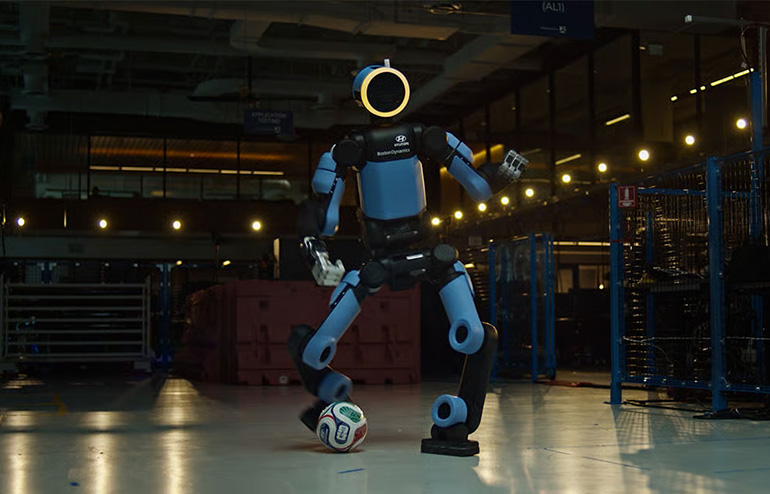
Boston Dynamics' Atlas learns complex soccer tricks using AI, Spot patrols World Cup stadiums
Boston Dynamics has taught its Atlas humanoid robot to perform the 'Ghost Rabona' soccer kick as part of Hyundai's partnership with FIFA World Cup. Spot quadrupeds are deployed at two stadiums in Dallas and two at Citi Field to support security operations by patrolling for hazards and suspicious packages. The company shifted from classical predictive control to reinforcement learning (a machine-learning technique that lets robots learn behaviors in simulation), allowing Atlas to master complex interactions with objects and terrain that would be harder to program manually. The same techniques enabling Atlas to carry a fridge are now being applied to industrial warehouse tasks. For stadium operators, Spot provides autonomous or remote-controlled inspection without facial-recognition capability, complementing human security teams.
The company emphasized that Atlas is far from matching human soccer players—it cannot yet interact safely with other people or run beside them. Spot is designed as a working tool for data collection and hazard detection, not a public spectacle; security teams themselves operate the robots in both autonomous and teleoperated modes.
- 2
At Tokyo robotics summit, Chinese robots outnumber Japanese three to one
At the Humanoids Summit in Tokyo, which displayed about 40 robots, Chinese systems outnumbered Japanese by roughly three to one. Geminoid HI-6, a sixth-generation humanoid robot based on Osaka University professor Hiroshi Ishiguro and equipped with a large language model trained on his writings and interviews, was among the few Japanese robots on display. Japan pioneered the humanoid robot form factor, but the event showed that China has moved ahead in robot deployment and presence at major industry gatherings. The imbalance may indicate a shift in momentum in robotics development and commercialization away from Japan.
The trend in robot representation at international events, and whether Japanese robotics firms can strengthen their position relative to Chinese competitors in the near term.
- 3
FAA reports drone sightings near US airports nearly doubled in Q2 2026
Between April and June 2026, the FAA reported 601 drone sightings near airports, according to FAA data. This represents a near-doubling from the first quarter of 2026. The surge in close encounters between drones and manned aircraft indicates a growing safety concern at US airports. The FAA has issued warnings in response to these incidents, suggesting the rise reflects a need for stricter oversight of drone activity in airspace around airports.
The body does not provide specific forward-looking metrics, timelines, or enforcement details beyond the FAA's warning stance.
- 4
Non-FAANG robotics firm demands impossible AI skill list from hires
A mid-size industrial automation company posted a job listing for ML roboticists that includes required expertise in LLMs, vision-language models, action transformers, robot dynamics, kinematics, CUDA GPU programming, FPGA acceleration, Python 3, C++23, and a track record of top-tier conference publications across ML and robotics. The job posting illustrates how specialized AI and robotics roles outside tech giants have come to demand a breadth of expertise that may be unrealistic for most individual candidates—combining deep knowledge in multiple AI subfields, hardware acceleration, classical robotics, and proven research output. This may indicate a growing gap between what companies expect and what available talent can realistically deliver.
The listing reflects the current competitive pressure in robot-augmented AI, but whether smaller firms can actually fill such roles—or will need to lower expectations—remains an open question.
- 5
Reddit PhD Student Questions Viability of Intrinsic Motivation Research
A computer science PhD student one and a half years into their doctorate asked whether pursuing intrinsic motivation—a subfield of AI that seeks to develop reward signals not tied to specific tasks—remains a worthwhile research direction in 2026. The student observes that robots are increasingly performing complex tasks (acrobatic flips, terrain navigation, dexterous manipulation) and questions whether most of this progress relies on human supervision through carefully tuned reward signals rather than the task-agnostic motivation mechanisms their field studies.
The inquiry highlights tension within AI research between task-specific supervised learning approaches and the intrinsic motivation paradigm, which draws inspiration from low-level motivators in animal intelligence.
- 6
NXP CEO: robots need autonomous computing to scale beyond demos
NXP CEO Rafael Sotomayor stated that robots will only reach commercial scale if they can think and act independently, rather than relying on remote control. The shift toward autonomous decision-making could determine whether factory automation, humanoids, and smart machines become practical tools for industry rather than remain expensive demonstrations.
The commentary frames autonomous computing as a prerequisite for physical AI and robotics to spread globally and achieve commercial viability.
What to Watch
As Atlas, Spot, and other robots continue advancing toward real-world deployment, watch whether companies can move beyond controlled demonstrations to prove these machines can safely operate alongside humans in everyday settings. Simultaneously, keep an eye on how regulatory frameworks—particularly around autonomous systems and airspace—and the competition between Japanese and Chinese robotics firms shape which technologies actually reach commercial viability at scale.
Sources
- Boston Dynamics brings its legged robots to the FIFA World Cup
- Japan Pioneered Humanoid Robots—Can It Now Catch China?
- FAA Data Shows Drone Sightings Near Airports Nearly Doubled in Second Quarter
- Machine learning industry job requirements used to be myopic, but now it feels impossible. Anyone else seeing this? [D]
- Is Intrinsic Motivation a Viable PhD Topic in 2026? [D]
- NXP chief says robots need autonomous computing to move beyond remote control
- Tesla's $1.4 trillion valuation rests on what happens next in one city
- Humanoid says KinetIQ Ascend reinforcement learning approaches human-level dexterity
- AI PCs, AR glasses, and robots reshape display tech
- Tesla rolls out robotaxi service in Miami
Share this with a friend
Send today's roundup to anyone who wants to keep up.
Get daily AI news free with AIToday
200+ AI sources, summarized in 1 minute. Email / LINE / Slack.
Sign up free