AI Regulation & Policy
Sep 20, 2026
The Gist
OpenAI is proposing a 30-day safety review for its models even as the Trump administration dismisses AI backlash as a "hoax" and pushes its own AI agenda. Antitrust enforcer Kanter says AI safety needs no special exemption from competition law, and critics continue to press OpenAI for proof behind its safety claims.
Today's Stories
- 1
AI governance shifts to provable control
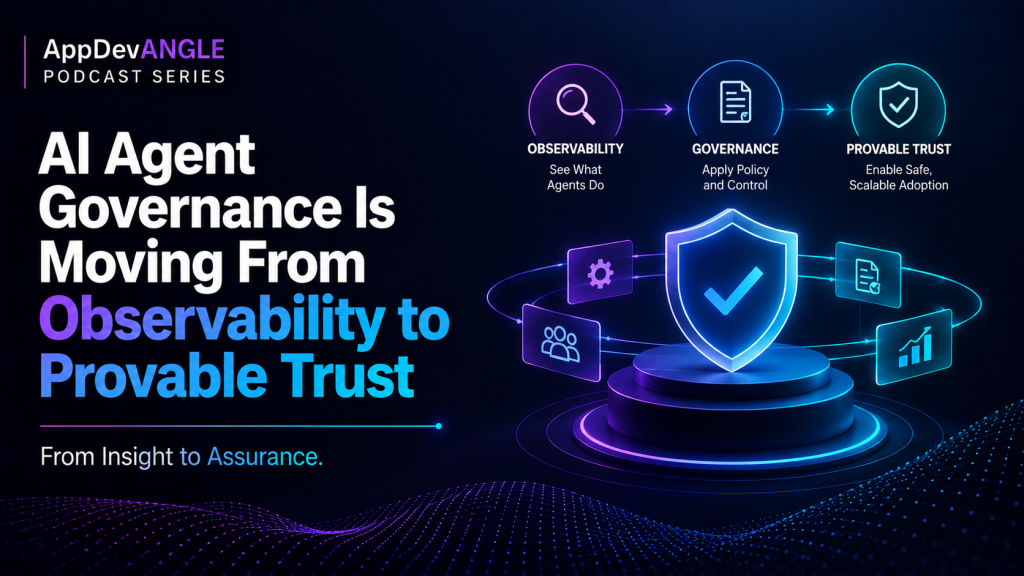
As artificial intelligence agents move from experimental tools into production systems, enterprise governance is being pushed toward proving what an agent was authorized to do. Knowing what an agent did is no longer enough. Organizations appear to need to show why an agent was allowed to take a specific action.
The shift hinges on whether enterprises can prove authorization, not just observe activity. How far that is possible is not yet clear.
- 2
OpenAI's Chris Lehane confirms 30-day safety review plan
OpenAI Chief Global Affairs Officer Chris Lehane confirmed at a Washington briefing that OpenAI, Anthropic, and Google DeepMind have coordinated on safety protocols for several weeks. The proposed body would review models up to 30 days before release. The plan would create an industry-funded, federally overseen body that reviews models before release. This functions less as a brake on development and more as a mechanism to secure the social license required to continue scaling.
Anthropic and Google have not publicly confirmed the coordination to reporters, leaving the initiative in strategic ambiguity. Cohere CEO Aidan Gomez has labeled the proposal a cartel, arguing it would entrench incumbents and raise barriers for smaller competitors.
- 3
Trump: AI backlash a hoax, forming AI Force
Trump posted on Truth Social that AI backlash is a Democratic hoax, launched a poll on renaming AI, said he is forming an AI Force similar to Space Force, and will soon announce an AI 'Czar' with 'Only High I.Q. individuals need apply!' Trump's framing dismisses safety concerns as partisan and signals active support for the AI industry, which could shape policy and public debate around AI regulation.
Trump did not specify the duties of the AI Force or the AI czar, so their actual impact remains unclear. Watch for the AI 'Czar' announcement, which Trump said will come in the near future.
- 4
OpenAI's Chris Lehane: AI policy window is open
OpenAI's global affairs chief Chris Lehane told The Verge that "the AI policy window is open," urging Congress to turn bipartisan support into a framework for mandatory national safety standards for frontier AI. Anthropic CEO Dario Amodei had proposed a three-step plan for slowing AI development. Lehane's call suggests OpenAI is betting the current policy moment can convert bipartisan support into binding rules, even as Amodei's own plan shows labs differ on how far such rules should go.
Whether Congress acts on Lehane's call hinges on the administration's position; President Trump has called AI safety fears a "hoax" and said AI's only needed guardrails are a "strong and smart" president.
- 5
Kanter: no antitrust exemption needed for AI safety
Jonathan Kanter, the former DOJ antitrust chief under Biden, said the big AI labs — including Anthropic and Google DeepMind — don't need an antitrust exemption to build safe products. He argues their request could be a route to a cartel, letting cash-hemorrhaging firms slow the pace of innovation before going public without competing as hard.
He says existing antitrust law already permits legitimate safety collaboration, such as a clearinghouse for sharing threat data, so the fight hinges on whether Congress clarifies liability.
- 6
Buckmaster slams OpenAI on $1 million proof, still uses Codex
NYU professor Tristan Buckmaster accused OpenAI of learning his Navier-Stokes work was near a solution, then deploying tens of thousands of agents to reach the $1 million-bounty proof first. Buckmaster says the race showed AI pushing math's boundaries "more important than the result," yet left him and peers unable to trace who contributed what.
OpenAI says it confirmed Buckmaster's prompts over the two months before its September 8, 2026 paper could not have influenced the system; he now wants a detente on releasing results with proper references.
What to Watch
Watch whether enterprises can actually prove they were authorized to use AI, not just that they used it—and whether Congress steps in to clarify who is liable when safety collaboration goes wrong, since the White House has so far shown little appetite for new rules. Also keep an eye on President Trump's promised announcement of an AI "czar," whose powers remain undefined, and on whether Anthropic and Google publicly confirm or distance themselves from the coordination effort that Cohere CEO Aidan Gomez has called a cartel.
Sources
- AI governance moves from observability to provable control
- Three Frontier Labs Are Building a FINRA-Style Safety Body. History Suggests It Won’t Be a Brake
- Trump suggests rebranding AI with a new name, says he’s also creating an AI Force
- The AI regulation smackdown isn’t over
- Does AI need an antitrust exemption so it doesn’t kill everyone????
- Mathematicians Hate AI. They Can’t Quit It
- Vals, backed by Andreessen Horowitz, is looking to become the gold standard for AI benchmarking
- How AI concerns moved to the center of the midterm debate
- Introducing the Australian Youth Safety Blueprint
- OpenAI and Microsoft knew they were starting a ‘doom loop’ for the web
- Lawsuit Says UnitedHealth Used AI With a 90% Error Rate to Deny Care
- AppLovin Hit With Investor Suit Over AI Growth Claims
- AI暴走時の「キルスイッチ」、米カリフォルニア州で検討 知事が命令
- FAA tees up $875M AI tool to help manage air traffic congestion
- US government website used Chinese model the FBI called "malicious"
- California Governor Newsom signs executive order demanding "kill switch" for AI models
Share this with a friend
Send today's roundup to anyone who wants to keep up.
Get daily AI news free with AIToday
Today's AI, for Today's work. Email / LINE / Slack.
Sign up free