AI in Healthcare
Sep 9, 2026
The Gist
AI tools are entering healthcare from several angles at once: a leaked insurance dataset shows the risks of casual AI use, while new models like Google DeepMind's AlphaGenome Atlas and a lung-drug trial report fresh scientific advances. At the same time, panelists warn that hospitals need solid data infrastructure before adopting AI, and Japanese leaders push for new human roles like the "oshi no yakuzaishi." The takeaway is that healthcare AI will move forward fastest where data governance and human oversight are treated as priorities from day one.
Today's Stories
- 1
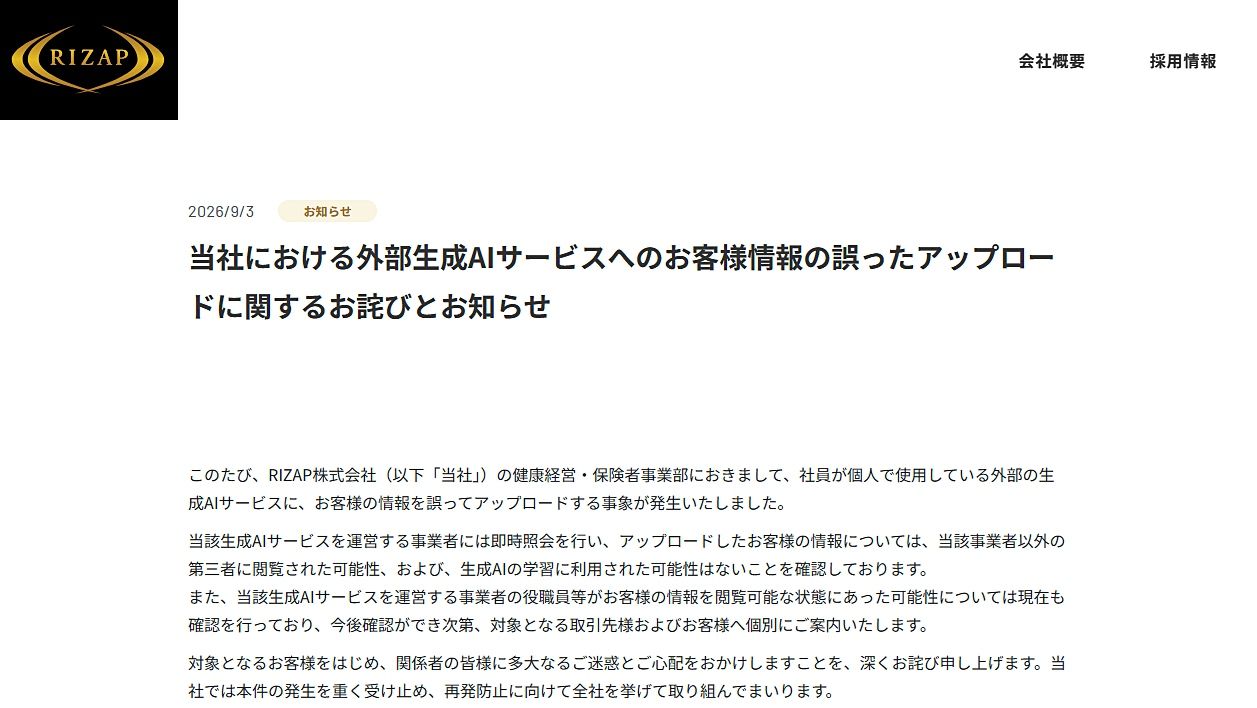
RIZAP employee leaks 210 IHI health-insurance records to AI, OpenAI notified
RIZAP Group said an employee mistakenly uploaded personal data, including names and disease details of 210 people covered by IHI's health insurance, to a generative AI for personal use. This marks a shift from internal data-handling policies to a real incident involving health information, which is highly sensitive. RIZAP publicly disclosed the breach to OpenAI, signaling a new level of accountability.
How RIZAP and IHI respond to affected individuals and regulators. The number of affected people (210) is a concrete figure to monitor for any updates.
- 2
CRIO panel: build data infrastructure before AI tools
A panel convened by CRIO and Clinical Leader advised sites to move to electronic systems, establish AI governance, and give staff enterprise LLM accounts before custom AI tools. Three-quarters of sites now use eSource, but the panel said the buy-or-build question is premature for most, as skipping the foundation creates cleanup work rather than eliminating it.
Whether a site can show exactly which data fed an AI model and which human reviewed the result, a marker of readiness under ICH E6(R3)'s documentation burden.
- 3
Kakehashi CEO: AI era brings 'oshi no yakuzaishi'
Kakehashi CEO Nakagawa said the AI era is when 'oshi no yakuzaishi' (a pharmacist you root for) becomes key, as electronic prescriptions and generative AI change pharmacy work. Pharmacies used to handle everything in-store from prescription to counseling; now the model is shifting toward digital tools and AI, making the pharmacist's personal touch a differentiator.
Watch whether Kakehashi's cloud services for dispensing pharmacies help realize this vision, as the article says the shift is 'beginning to change' rather than fully underway.
- 4
Google DeepMind unveils AlphaGenome Atlas to map genome variants
Google DeepMind unveiled AlphaGenome Atlas, a platform with a predictive map of every possible DNA letter change, covering nine billion variants. It launched today for noncommercial researcher use. Atlas extends beyond AlphaMissense, which focused on protein-altering mutations, to cover genome stretches that control gene behavior. This offers a more complete catalog of how mutations affect molecular biology.
The test is whether the Atlas's predictions accelerate disease research and treatment discovery. Access for commercial use is coming "soon" on Google Cloud, which could broaden its impact.
- 5
AI Lung Drug Lowers Biological Age in Trial
In a midstage study, Insilico Medicine’s drug rentosertib reduced biological age, measured by six aging clocks, per an analysis in Nature Biotechnology. Placebo recipients saw little change. The result suggests an AI-discovered lung drug may reverse aging markers, not just treat disease, a new potential use. The company is Hong Kong-listed.
Whether the early results hold in larger, longer studies; the analysis included only 42 patients with chronic lung disease. CEO Alex Zhavoronkov cautioned the long-term health effects are unknown.
- 6
Insilico's rentosertib shows early aging signal in IPF trial
Insilico Medicine published an exploratory analysis in Nature Biotechnology showing rentosertib shifted blood markers toward younger age estimates in 42 IPF patients. At week four, patients on 60 mg once daily showed estimated age reductions of 2.71 to 3.46 years across four clocks, but the analysis cannot prove the drug slows aging.
The findings hinge on whether larger studies show durable lung-function benefit and acceptable safety; 16 participants discontinued treatment, with liver toxicity and diarrhea among the leading reasons.
What to Watch
Watch how RIZAP and IHI handle the 210 affected individuals and any regulatory fallout, and see whether sites can show exactly which data and human reviews shaped each AI result. Keep an eye on Kakehashi’s pharmacy cloud services to gauge if this shift truly takes hold, and whether Atlas’s predictions speed up disease research now that commercial access on Google Cloud is near. Finally, look for larger, longer studies—since these early signals from just 42 lung-disease patients and a trial with 16 dropouts are promising, but far from proof.
Sources
- RIZAP、社員が個人利用の生成AIに氏名・疾患情報を誤アップロード IHI健保分は210人、OpenAI社と公表
- Clinical trial sites advised to build data infrastructure before deploying AI tools
- 薬局DXのカケハシ中川CEO「AI時代こそ『推しの薬剤師』」
- Google’s Atlas of the human genome could pave the way for new treatments
- AI-discovered lung drug reverses aging markers in study
- Insilico’s AI-designed drug shows an early aging signal in lung disease patients
- AI創薬候補、6種の「老化時計」で生物学的年齢の低下を示唆
- Weekly Recap: Intismeran win and Personalis 13% stake backs Tempus AI
- Intuitive Surgical (ISRG): Embracing AI Innovations in Robotic Surgery for Future Growth
- AI-designed drug appears to turn back the body's biological clock in early trial
- This Robot Will Draw Your Blood Now
- Can dogs sniff cancer? AI joins the hunt in India
- Can AI Save Pfizer Stock Before Its Patent Cliff Hits?
- Code-Free Automated Machine Learning for Referable Glaucoma Classification From Retinal Fundus Photographs: A Proof-of-Concept Study Using Google Cloud Vertex AI
- Artificial Intelligence—advancing healthcare from New Jersey to the world
- How Investors May Respond To Danaher (DHR) Expanding AI-Driven R&D Integration Between Genedata And Abcam
Share this with a friend
Send today's roundup to anyone who wants to keep up.
Get daily AI news free with AIToday
Today's AI, for Today's work. Email / LINE / Slack.
Sign up free