Robotics
Jul 18, 2026
The Gist
Robotics companies are accelerating AI integration across industries, with major partnerships between tech giants like Nvidia, Toyota, and Japanese manufacturers Fanuc and Yaskawa focusing on physical AI for factories and autonomous systems. Faraday Future's robotics unit is expanding into industrial automation after shipping 220 units in the first half, while new tools like Nvidia and Hugging Face's LeRobot are democratizing robotics development. Japan is investing heavily in this sector, committing to purchasing 27,500 Nvidia chips and building a $124B AI hub by 2028 to lead the global robotics revolution.
Today's Stories
- 1
Faraday Future robotics unit ships 220 units in H1, expands into industrial automation
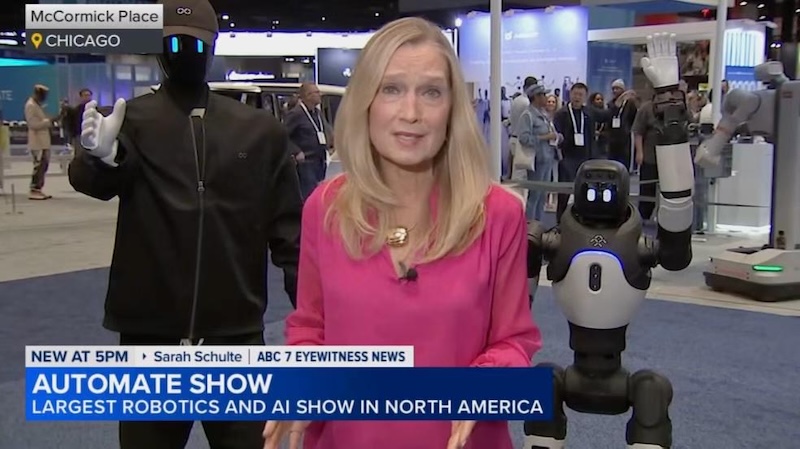
Faraday Future's AI subsidiary FFAI announced at Automate 2026 in Chicago that June robot shipments are expected to exceed 100 units, bringing total first-half deliveries to more than 220 units and surpassing its original target ahead of schedule. The company introduced the All-New Futurist humanoid robot priced from $89,900 and the FF Faber mobile manipulator series for industrial applications. FFAI is expanding beyond its education-focused robotics business into commercial and industrial automation, targeting warehouse logistics, factory operations, and facility inspection. The Futurist humanoid is the first full-size humanoid in the US to natively support Nvidia Sonic's full-body motion control system, signaling deeper integration with advanced motion control technology.
FFAI's strategy centers on an open embodied AI ecosystem combining multiple robot form factors with a shared EAI Brain software platform and an EAI Data Factory that collects operational data from deployed robots to improve AI performance over time. The Futurist stands 5 ft 8 in tall, weighs 121 lb, and runs on a dual-battery system providing up to six hours of continuous operation.
- 2
Fujitsu partners with Fanuc, Yaskawa, Kawasaki on physical AI using Nvidia tech
Fujitsu has begun collaboration with Japanese robotics makers Fanuc, Yaskawa Electric and Kawasaki Heavy Industries to develop and deploy physical AI—AI systems that control physical equipment—across manufacturing, logistics and healthcare. The partnership will use Nvidia's physical AI technologies, including Nvidia Cosmos foundation models, Nvidia Omniverse libraries, the Nvidia Isaac robotics platform and the Newton physics engine, to build a collaborative control platform that connects digital systems with robots and other equipment. The initiative addresses Japan's labor shortages, aging workforce and global manufacturing competition by automating tasks in factories (production planning and factory adaptation), logistics and retail (material handling), and healthcare (pharmaceutical transport, patient reception). Fujitsu CEO Takahito Tokita framed the effort as creating "a new social infrastructure in which people and robots work collaboratively across a wide range of industries." The partners plan to develop an open, sovereign platform designed to work across different robots while meeting cybersecurity, operational resilience and data protection standards.
The companies will now develop a roadmap for technology development and commercialization, with the longer-term goal of expanding physical AI deployment globally and strengthening Japan's position in the robotics industry. Specific use cases include optimizing production planning in manufacturing, automating material handling in logistics and retail by combining planning with real-time sales and inventory data, and automating pharmaceutical and specimen transport plus patient assistance in healthcare.
- 3
Toyota and Nvidia expand AI partnership for vehicles, factories, cities
Toyota and Nvidia broadened their partnership to deploy Nvidia's accelerated computing, AI software and simulation technologies across Toyota's vehicle development, software engineering, factory operations and intelligent transportation systems. The expansion builds on a prior agreement under which Toyota will develop next-generation vehicles with advanced driver-assistance capabilities using the Nvidia DRIVE AGX in-vehicle computing platform and Nvidia DriveOS operating system. The partnership extends AI beyond autonomous driving into manufacturing and urban infrastructure. Toyota is using Nvidia AI models to accelerate safety-critical automotive software engineering through a MISRA-compliant coding assistant based on Nvidia Megatron-LM and Nvidia Nemotron, and deploying digital twins of production environments using Nvidia Omniverse and Isaac Sim to optimize factory workflows before real-world deployment. Woven by Toyota has also developed a multimodal vision-language model using Nvidia H100 Tensor Core GPUs to analyze urban traffic and support city infrastructure decision-making.
Future Toyota vehicles are designed to offer Level 2++ driver-assistance functionality. The partnership spans vehicle development, software engineering, factory operations and urban mobility technologies through Woven by Toyota.
- 4
Nvidia, Hugging Face expand LeRobot with open robotics AI tools
Nvidia and Hugging Face integrated Nvidia Isaac GR00T 1.7 (a vision-language-action foundation model for humanoid robots) and the Nvidia Isaac Teleop framework into LeRobot, an open-source robotics library. Support for Nvidia Cosmos 3, a world foundation model for physical AI, is planned next. The integration gives robotics developers a standardized workflow for collecting data, training models, evaluating performance, and deploying AI-powered robots in the open—combining Nvidia's community of more than three million robotics developers with Hugging Face's 16 million AI developers. Thomas Wolf, cofounder and chief science officer at Hugging Face, said open source lets "a field turn advanced research into something people can study, adapt and build on."
Future integration of Nvidia Cosmos 3 will let developers generate synthetic robotics data and simulate environments when real-world data is unavailable or too costly to collect. The collaboration also supports Nvidia Jetson Thor on Hugging Face's Reachy 2 humanoid robot.
- 5
Palm Garden AI launches Coherence Guard for service robots to interact safely with people
Palm Garden AI developed Coherence Guard, a software layer for service robots that evaluates whether actions are socially appropriate before execution—assessing timing, proximity, emotional tone, and boundary requests rather than replacing existing robot control systems. As humanoid robots move into hospitality, care, retail, and domestic settings, they need to recognize when a person is uncomfortable and withdraw respectfully or pause—tasks that go beyond technical capability into relational judgment. Coherence Guard addresses this gap by sitting above existing safety and control systems, helping robots understand roles, intentions, and vulnerabilities in human environments.
The company is in active technical evaluation with robotics providers including Robotera and Hanson Robotics, with plans to finalize patent filing, complete compatibility reviews with selected platforms, and run limited pilots focused on greeting, guidance, and respectful withdrawal. Commercial licensing is under preparation; the software will likely be offered as a licensed layer with optional SaaS components for configuration and analytics.
- 6
Japan to buy 27,500 Nvidia chips, eyes $124B AI hub by 2028
Nvidia announced Japan will purchase 27,500 Nvidia chips for a computing hub expected to launch in 2028, designed to support AI-robotics integration. CEO Jensen Huang stated during a Tokyo event that 'Japan must own, improve, secure, and deploy Japan AI.' Japan's AI market is forecast to grow from $15.6 billion(約2.5兆円) in 2025 to $123.9 billion(約20兆円) by 2032, signaling a major shift toward domestic AI infrastructure. For U.S. investors, the Global X Robotics and Artificial Intelligence ETF (BOTZ) offers exposure to Japanese automation and robotics companies positioned to benefit from this buildout.
BOTZ's largest holding is Japanese manufacturer Keyence (9.6% of the ETF), which makes sensors and machine vision systems. Three other Japanese companies—Fanuc, SMC, and Daifuku—also rank in the ETF's top 10 holdings. Over the last 12 months, BOTZ is up just over 9%, compared with 35% for the broader Global X Artificial Intelligence and Technology ETF (AIQ).
What to Watch
Watch for FFAI's rollout of its open embodied AI ecosystem across manufacturing, logistics, and healthcare, particularly as the shared EAI Brain platform and Data Factory begin collecting operational insights that could accelerate AI improvements across deployed robots. Meanwhile, partnerships between major automakers, semiconductor leaders, and robotics specialists—from Woven by Toyota's advanced driver-assistance systems to Nvidia's synthetic data generation capabilities—are converging toward a future where physical AI becomes increasingly integrated into everyday operations and mobility solutions globally.
Sources
- Faraday Future highlights robotics expansion and shipment milestone at Automate 2026
- Fujitsu partners with Fanuc, Yaskawa and Kawasaki to advance physical AI using Nvidia technology
- Toyota and Nvidia expand partnership to develop AI for vehicles, factories and cities
- Nvidia and Hugging Face expand LeRobot with new open robotics AI tools
- Palm Garden AI develops Coherence Guard relational decision layer for human-facing robots
- Jensen Huang Scores Big in Japan -- Here's How to Follow the Nvidia CEO's Lead as the Country Transforms Into a $124 Billion AI Hub
- Interview with Scott Zerkle of Panasonic Connect: ‘AI is only as good as the data it receives’
- Robbyant releases LingBot-World 2.0 with hour-long real-time world generation
- Aetina adds support for Nvidia Jetson T3000 and T2000 AI modules
- Robotics ETFs Will Dominate the 2030s. This 1 ETF Is Trading at a Discount
Share this with a friend
Send today's roundup to anyone who wants to keep up.
Get daily AI news free with AIToday
200+ AI sources, summarized in 1 minute. Email / LINE / Slack.
Sign up free