AI in Healthcare
Sep 16, 2026
The Gist
AI is moving from hype to daily use across healthcare, with Thermo Fisher's CEO saying it shortens drug development timelines, CVS using AI simulations to speed research, and Isomorphic relying on its own AI models to keep drug work on track. Thermo Fisher expects AI to lift pharma spending by 7% through 2028, while Google says AI's societal impact can now be measured and the Gates Foundation is committing at least a billion dollars to expand AI access.
Today's Stories
- 1
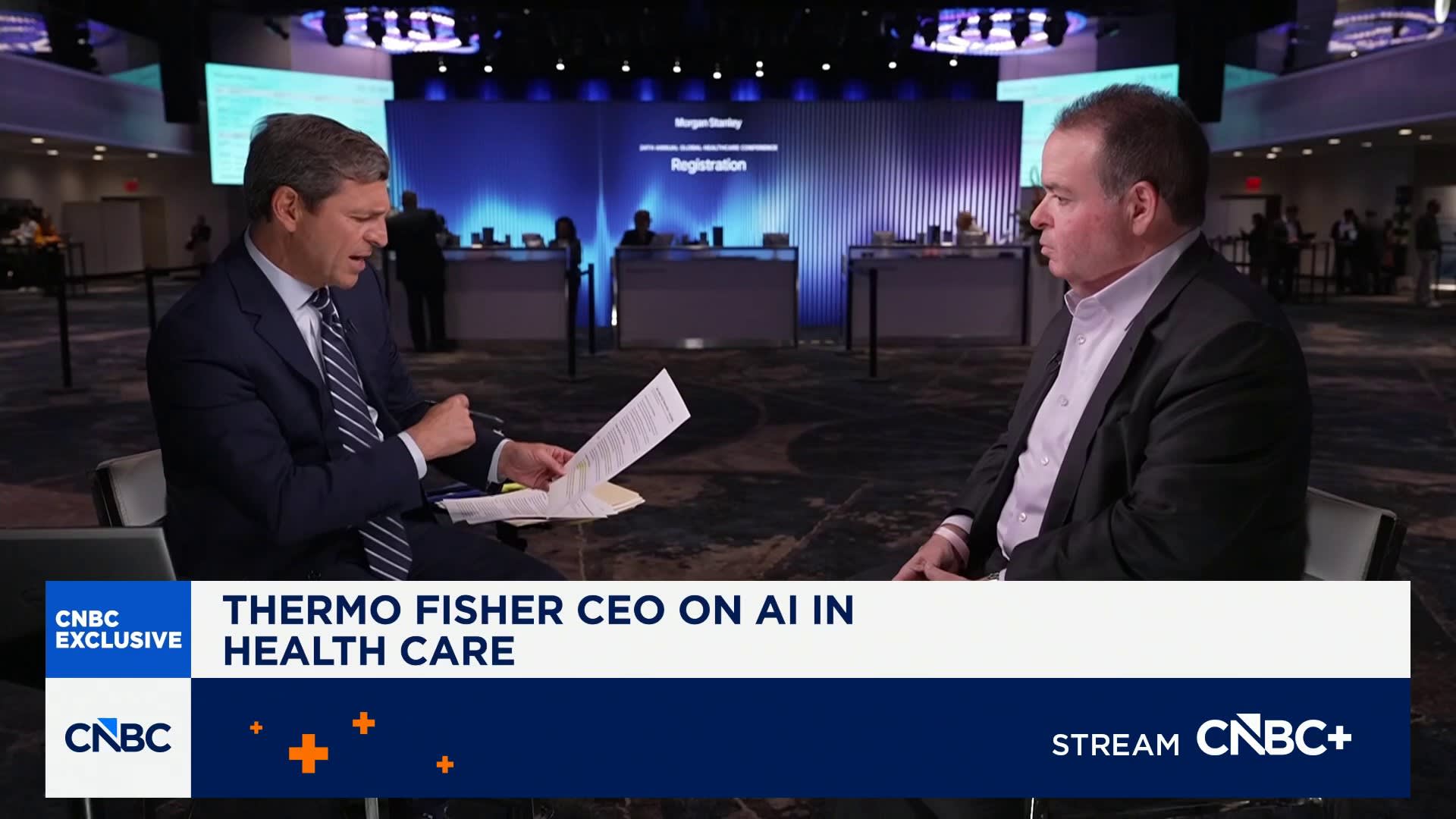
Thermo Fisher CEO Marc Casper: AI shortens time to market for effective medicines
Thermo Fisher CEO Marc Casper said AI is shortening the time to market for medicines that do work. The time to market for effective medicines is being reduced by AI, according to Casper, which could change how quickly treatments reach patients.
Whether this shortening of time to market continues or expands, and how it affects the pharmaceutical industry, hinges on further adoption of AI in drug development.
- 2
CVS Health turns to AI simulations to speed research
CVS Health is using AI simulations to accelerate its research, according to a Wall Street Journal report. The move points to CVS Health applying AI beyond pharmacy and insurance operations, into its research processes.
How broadly CVS Health deploys AI simulations across its research work is likely to shape what other large healthcare players do next.
- 3
Thermo Fisher CEO Marc Casper: AI to lift pharma spend, 7% by 2028
Thermo Fisher CEO Marc Casper told CNBC that AI will spur more pharma spending, not less, and expects organic growth of about 4% in the second half of 2026, accelerating to 7% by 2028. Casper pushed back on fears that AI reduces lab work, arguing it instead kills ineffective medicines faster and shortens time to market, which he says will encourage more investment in drug pipelines.
The outlook follows improving second-quarter momentum, when Thermo Fisher's revenue rose 10% to $11.99 billion, with organic revenue up 5%; TMO shares have gained more than 9% in 2026.
- 4
Chris Butler: Isomorphic's in-house AI models keep drug work on track
Chris Butler, who runs drug discovery at Isomorphic Labs, pushed back at the Semafor Future of Health Forum on Tuesday against the idea that slowing frontier AI would slow his company. Isomorphic raised $2.1 billion in May, led by Thrive Capital, and plans to build out its pipeline and grow its drug discovery team, with interest in oncology and immunology.
Progress toward the clinic is the test Butler himself names, and whether the $2.1 billion turns discovery work into clinical candidates is the open question.
- 5
Google's AI for Societal Impact: AI's promise now measurable
Google published a collection titled "AI for Societal Impact," saying AI has moved from theoretical research to measurable real-world impact and that it is partnering with communities and researchers. Google frames AI's potential as shifting from hypothetical to measurable and says these tools are fundamentally reshaping how humanity's most complex challenges are solved.
The collection focuses on four areas — making disease detectable, treatable and preventable, predicting natural disasters, expanding learning, and unlocking economic opportunities — and hinges on how these partnerships progress.
- 6
Gates Foundation bets at least a billion dollars on AI access
The Gates Foundation plans to spend at least a billion dollars over the next two years on AI access in health, education, and agriculture. Gates warned in the 2026 Goalkeepers report that AI could widen the rich-poor gap. Gates says decisions in the next 12 to 18 months will decide whether AI benefits the haves or the have-nots. Over 90 percent of early language-model training data came from English sources, and speech recognition fails over 60 percent of the time in Yoruba.
The test is whether the foundation's pilots scale — Kenya's Penda Health showed a 16 percentage point accuracy gain, and Sierra Leone students gained up to 1.7 years in eight weeks. India's MahaVISTAAR already reaches more than 740,000 farmers.
What to Watch
Going forward, watch whether AI’s role in drug discovery keeps shortening time to market and whether CVS Health expands AI simulations across its research, as these choices could shape how the wider pharmaceutical and healthcare industries move next. The key tests are whether the $2.1 billion effort turns discovery work into clinical candidates, and whether pilots like Penda Health, Sierra Leone’s learning program, and India’s MahaVISTAAR scale further.
Sources
- Thermo Fisher CEO Marc Casper: AI is shortening the time to market for medicines that do work
- How CVS Health Uses AI Simulations to Accelerate Research
- Thermo Fisher CEO Says AI Will Drive More Pharma Spending — Sees 7% Organic Growth By 2028
- AI biotech Isomorphic Labs is not slowing down, exec says
- AI for Societal Impact
- After warning AI is too dangerous, Bill Gates bets a billion on its upside
- New insights from Google’s AI & Economy ATLAS
- Startup Evvy raises $40M to accelerate precision diagnostics and medicine for women’s health
- China may have a green energy overcapacity problem. Experts think AI can help solve it
- Pfizer at Morgan Stanley conference: pipeline, AI and China focus
- Can AI Keep ISRG Ahead of Rising Robotic Surgery Competition?
- Moderna’s AI-Built Cancer Vaccine Clears Phase 3 With Merck
- Washington Wants AI Regulation. It Should Start With Health Insurers
- AIによる顔画像解析で、顔に現れるサインと体内・心身状態との関連を確認
- Hear how AI can engineer nature’s comeback at TechCrunch Disrupt 2026
- 「ChatGPTを見て病院に来た」患者に医師が苦言…韓国・ネットで賛否
Share this with a friend
Send today's roundup to anyone who wants to keep up.
Get daily AI news free with AIToday
Today's AI, for Today's work. Email / LINE / Slack.
Sign up free