AI Coding Assistants
Jul 21, 2026
The Gist
AI coding assistants are delivering significant productivity gains, with basic tools improving work by 20–46% and more advanced agent platforms achieving up to 8 times faster results, though security concerns are emerging as researchers discover malware hiding in developer toolchains. Meanwhile, developers are increasingly turning to local AI solutions to rebuild discontinued features, while companies continue optimizing these tools to reduce operational costs.
Today's Stories
- 1
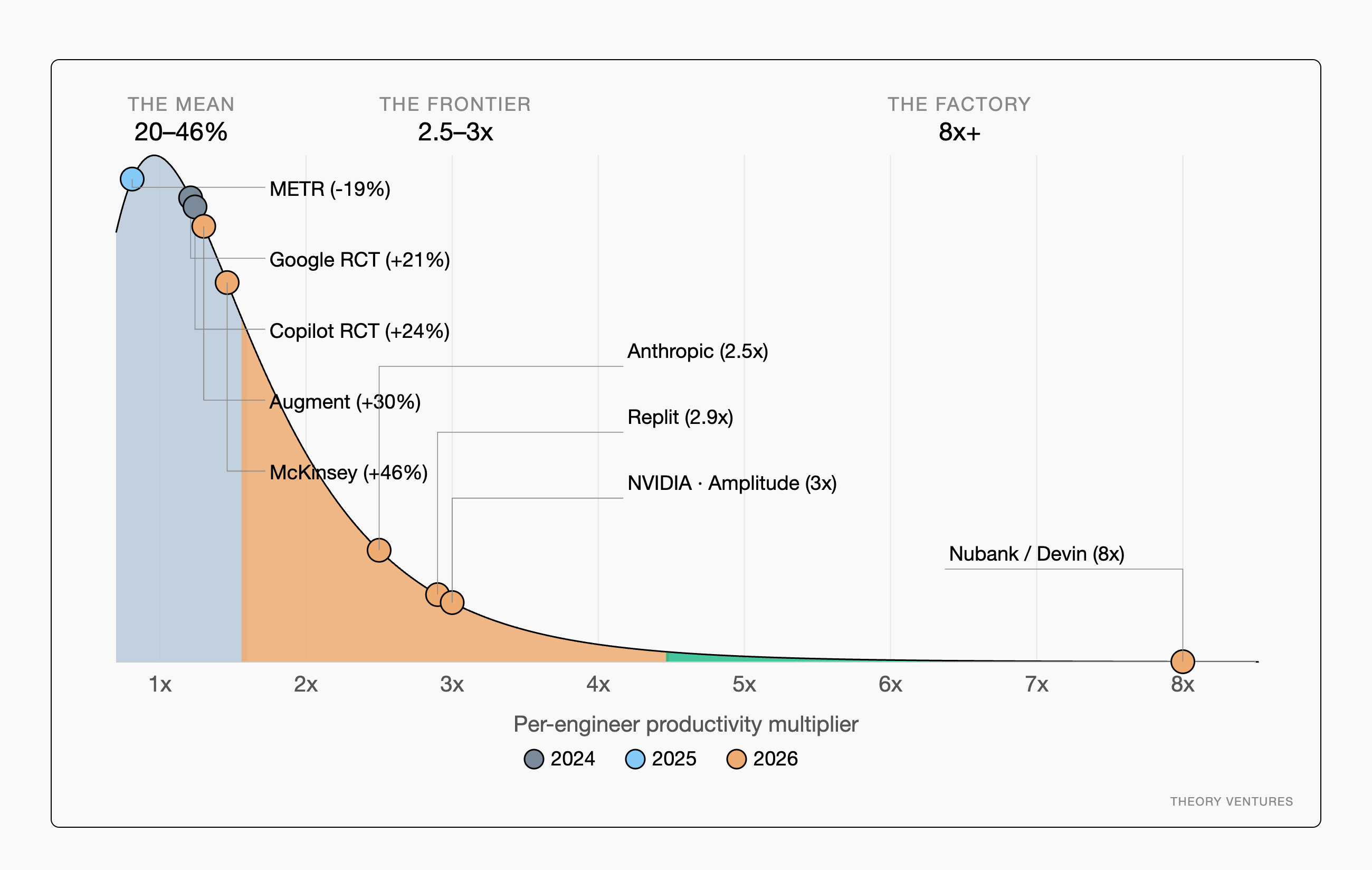
AI productivity gains cluster in three tiers: 20–46% with basic tools, 2.5–3x with agent platforms, 8x+ at software factories
Analysis of six months of real-world AI engineering data shows productivity outcomes split into three tiers. The first (basic AI IDE distribution) yields 20–46% gains; the frontier (companies like Replit, NVIDIA, Amplitude, Anthropic building orchestration around agents) delivers 2.5–3x improvements; and software factories (Nubank with Devin, Factory.ai deployments) reach 8x+ efficiency gains. Most engineering leaders expected 2–3x gains from AI but are landing closer to 30% because they distribute tools without redesigning workflows. The gap is not the model itself but the operating discipline around it—companies that build agent orchestration (spawning worker agents across GitHub, Linear, Slack) and treat agents as first-class organizational units unlock dramatically higher returns. This reframes AI adoption from a tool problem to an organizational design problem.
Nubank achieved an 8x improvement in engineering efficiency and a 20x cost reduction using Devin for large-scale refactoring; Goldman Sachs is piloting Devin alongside 12,000 human developers and estimates agentic AI could deliver 3–4x the rate of prior tools. The frontier is shifting from incremental tool adoption to agent-native team structures.
- 2
Nolan's The Odyssey hits $264M opening, clears $250M budget in 3 days
Christopher Nolan's The Odyssey, a three-hour R-rated adaptation of Homer's epic, earned $264 million(約420億円) in its opening weekend globally, clearing its $250 million(約400億円) production budget and becoming the director's biggest global debut—surpassing The Dark Knight Rises, The Dark Knight, and Oppenheimer. Nolan's success with a film rooted in handcrafted production techniques (70mm film, practical effects) stands in sharp contrast to Hollywood's accelerating investment in AI cost-cutting—Netflix has spent up to $600 million(約960億円) on AI filmmaking technology and reported AI touched roughly 300 titles in 2026, with some scenes cutting visual-effects costs in half. Nolan's brand and refusal of shortcuts appear to have proven a commercial alternative, positioning him as what analysts call a "non-IP IP"—a filmmaker whose name alone functions as franchise capital.
The Odyssey is available in premium 70mm format at only 41 theaters worldwide, a scarcity strategy that drove audiences to travel significant distances (one fan drove 14 hours to see Oppenheimer). Whether Nolan's handcrafted method can inspire industry-wide alternatives as studios race to adopt AI remains uncertain, but analysts see his impact on cinema as likely to be felt for decades.
- 3
AI toolchain worm hides attacks in legitimate developer activity
CrowdStrike researchers discovered a worm actively targeting AI software development pipelines. The malware steals access credentials and cryptographic keys, can exfiltrate sensitive data, and includes a "death switch" capability to destroy files or block access to compromised infrastructure. It operates in phases: first reconnaissance, then credential theft (including npm tokens for package management), and finally destructive payloads—all while mimicking legitimate automation. The worm exploits a critical blind spot in AI development environments. Because the malware's behavior closely resembles legitimate AI coding automation, traditional security detection tools cannot easily distinguish the attack from normal operations. CrowdStrike senior VP Adam Meyers describes it as "a needle in a needle stack." As AI coding agents become standard development practice, attackers are evolving to target the trust relationships embedded in the software supply chain, making defense significantly harder.
The worm uses time delays—executing capabilities hours or even days after initial compromise—to obscure cause-and-effect relationships and evade detection. CrowdStrike has not yet attributed the activity to a specific threat actor, though the attack pattern aligns with known groups like TeamPCP (tracked as "Altered Spider") and North Korean groups targeting AI supply chains. Meyers emphasizes the need for collaborative structural solutions across the industry.
- 4
Developer rebuilds Mozilla's killed Orbit extension with local AI
A developer created Apogee, a page-summarizer browser extension that works locally using WebLLM (for Chrome/Edge), WASM (for Firefox), or a user's own Ollama instance, after Mozilla discontinued its own Orbit extension last summer. The extension runs entirely on your device without sending data to external servers, giving users privacy and control over their summarization tool—something Mozilla's original product no longer offers.
The project is open to contributions on GitHub and supports multiple deployment options (WebLLM, WASM, or Ollama), so users can choose their preferred AI model strength.
- 5
AI Coding Assistant Cuts Token Costs via New Strategy
A new approach to AI coding assistants has substantially reduced the token consumption (the computational units that AI models process) required to perform the same coding tasks. The strategy involves optimizing how the AI handles and processes code. Token consumption directly translates to operational costs for companies deploying AI coding assistants. Lowering token use makes these tools cheaper to run at scale, which could make them more accessible to smaller teams and lower the overall expense for enterprises.
The specific implementation details and performance benchmarks of this cost-reduction method, and whether similar optimizations can be applied across other AI assistant categories beyond coding.
- 6
Nvidia pushes CPU push with Vera Rubin chip ahead of AMD showdown
Nvidia revealed performance benchmarks for its Vera Rubin chip system, a CPU–GPU combo that pairs 36 Vera CPUs with 72 Rubin GPUs in a single NVL72 superchip. The system processes 10 times as many tokens per watt as Nvidia's previous Grace Blackwell chip, and OpenAI already has one Vera Rubin rack in use. Nvidia is no longer just a GPU supplier—it's positioning itself as a full AI infrastructure provider. As AI workloads shift toward more complex, agentic systems, demand for CPUs to orchestrate data and networking has grown. Vera Rubin's monolithic chip design offers nearly three times as much memory bandwidth as Blackwell, addressing a persistent high-bandwidth memory shortage that constrains AI deployments.
Nvidia says Vera Rubin will ship in the second half of this year, with early customers including Microsoft, OpenAI, and Oracle. The company claims significantly reduced installation time—from a couple of hours to a few minutes—thanks to "cable-free compute" and hot-swappable design. AMD is revealing its competing Helios AI chip rack this week, intensifying the race for multiyear contracts with AI hyperscalers and labs.
What to Watch
Watch for two major shifts: as companies like Goldman Sachs and Nubank demonstrate dramatic efficiency gains from AI agents, expect the industry to move beyond treating AI coding tools as add-ons and instead redesign entire teams around them, though questions remain about how broadly these cost savings can scale across different types of coding tasks. Meanwhile, the intensifying competition between Nvidia and AMD for hyperscaler contracts—with Nvidia's Vera Rubin arriving this year and AMD launching Helios—will likely determine which hardware platforms dominate AI development infrastructure for the next several years.
Sources
- AI Engineering Productivity is Anything But Normal
- ‘He’s an analog man in a digital AI world’: Nolan’s ‘The Odyssey’ made back its $250M budget in 3 days without industrywide AI cost cutting
- A Sneaky Hacking Tool Targeting AI Infrastructure Is Lurking in Victims’ Blind Spots
- Show HN: Mozilla killed Orbit, so I built a local-LLM extension
- AI Coding Assistant Strategy Slashes Token Bills
- Nvidia Wants to Own Every Chip Inside AI Data Centers
- Microsoft and Mistral expand strategic partnership to give enterprises and regulated industries frontier AI they can control
- A Fireside Chat with Cat and Thariq from the Claude Code team
- LWiAI Podcast #249 - Fable 5 ban, SpaceX Cursor + IPO, OSS Aplenty
- A single AI agent conversation can look perfect and still be broken, leaders from LangChain, Conviva and CoreWeave said at VB Transform 2026
Share this with a friend
Send today's roundup to anyone who wants to keep up.
Get daily AI news free with AIToday
200+ AI sources, summarized in 1 minute. Email / LINE / Slack.
Sign up free