AI Regulation & Policy
Jun 26, 2026
The Gist
PauseAI is mobilizing as a civic movement to influence AI governance decisions, while OpenAI has restricted its new GPT-5.6 model to just 20 organizations following a U.S. government briefing and is pursuing case-by-case approvals with the Trump administration. Meanwhile, companies like Stripe are deploying AI agents for compliance work, highlighting growing questions around how governments should oversee autonomous AI systems.
Today's Stories
- 1
AI safety group PauseAI builds civic movement to shape governance
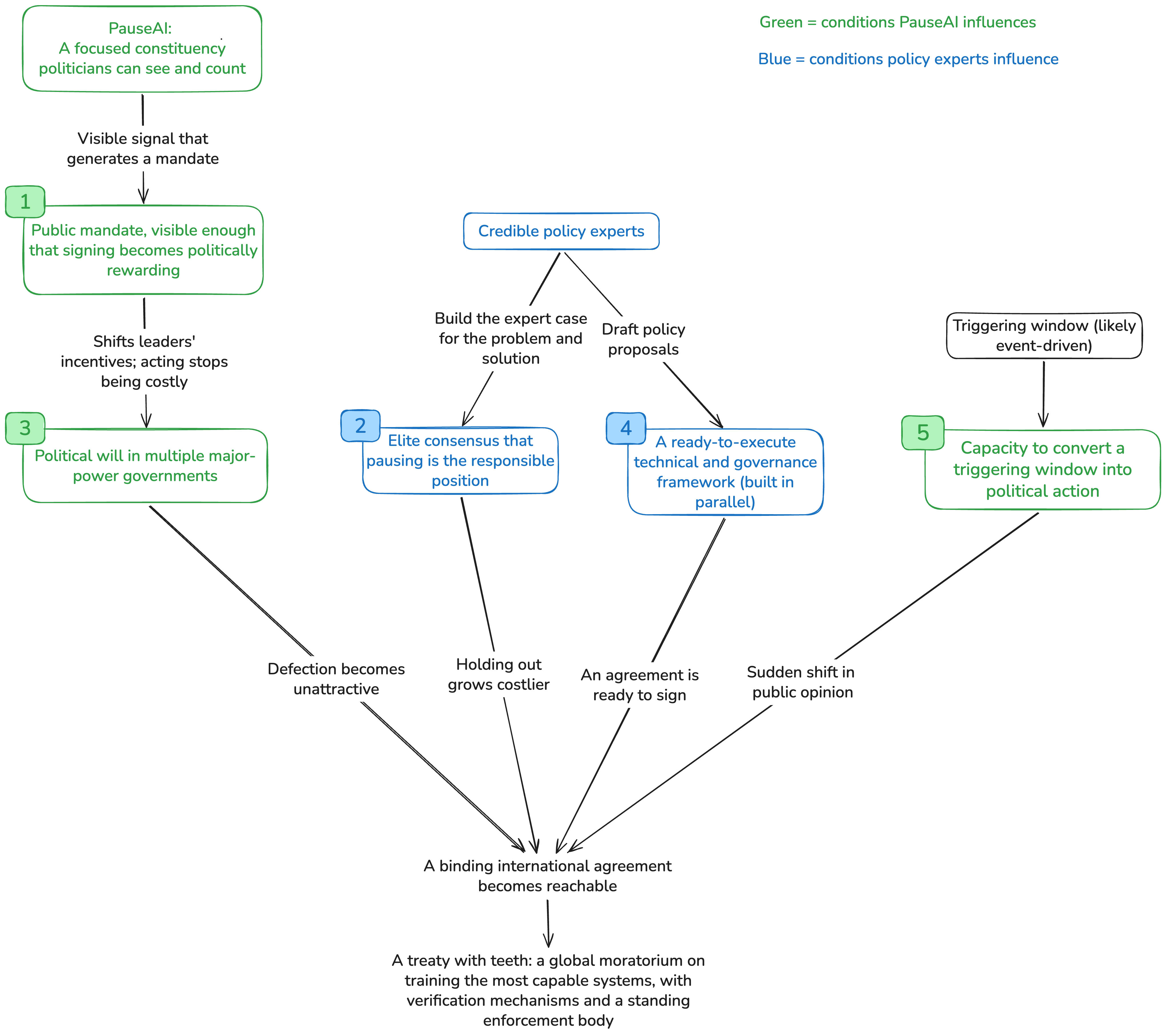
PauseAI and its co-leads (including Benjamin Schmidt of PauseAI Germany) are pursuing civic and social movement-building as a core strategy to address catastrophic risks from AI, treating it as a high-value intervention for keeping humanity safe. The existential AI safety community has largely neglected social movement-building; the body indicates this approach may significantly enhance the likelihood that governance efforts succeed in managing AI risks—a gap PauseAI appears positioned to address.
The article identifies PauseAI (distinct from PauseAI US, which has separate leadership and strategy) as the primary organization currently pursuing this movement-building approach at scale.
- 2
OpenAI limits GPT-5.6 rollout to 20 orgs after U.S. government briefing
OpenAI announced a limited preview of three new GPT-5.6 models—Sol, Terra, and Luna—available through the API to approximately 20 organizations. The company shared the models and release plans with the U.S. government before the rollout, with a general release planned for "the coming weeks." The models offer improved token efficiency and enhanced reasoning, allowing developers and enterprises to complete complex tasks with fewer computational resources. This is relevant to software engineering, scientific research, and cybersecurity workflows.
The staggered rollout follows an executive order issued by President Donald J. Trump on June 2, 2026, calling on federal agencies to collaborate on benchmarking and assessing new AI model capabilities. General availability is expected in the coming weeks.
- 3
Skyways builds global cargo drone fleet in near-total secrecy
Austin-based Skyways Aviation has quietly assembled the world's largest unmanned aircraft fleet over the past decade, operating heavy-duty autonomous drone deliveries across three continents. The company's V3 aircraft can carry payloads of up to 100 pounds across a range of over 1,000 miles and operates offshore cargo missions for maritime, oil, and logistics clients. Skyways has partnered with Japan's All Nippon Airways (ANA) to fly cargo missions from Okinawa to surrounding islands and military vessels, and is preparing to begin flights with Danish logistics company DSV A/S. Skyways' approach—solving customer problems rather than marketing technology—reflects a deliberate business philosophy established by CEO Charles Atkin nine years ago, when he decided to avoid marketing and promotion entirely. The company's wealth of international regulatory experience positions it to handle upcoming U.S. drone regulations, particularly the FAA's anticipated BVLOS (beyond visual line of sight) rule, Part 108, which will require commercial drones to have detect-and-avoid technology. For businesses with offshore or maritime assets seeking cargo delivery and inspection services, Skyways' track record across multiple regulatory environments offers credibility in a sector known for unfulfilled promises.
Skyways is developing a project to provide cargo delivery and inspection services to major U.S. and international oil companies operating in the Gulf of Mexico, with more details expected in the next several months. The company is also pursuing two significant regulatory goals: the ability to operate multiple aircraft using a single pilot, and authorization to fly offshore beyond the 12-nautical-mile limit—capabilities the company believes will unlock new airspace.
- 4
Stripe deploys AI agents for compliance, cuts review time 26%
Stripe built an AI agent system on Amazon Bedrock that handles financial compliance reviews for the company's $1.4 trillion(約220兆円) annual payment volume across 50 countries. The system reduced review handling time by 26 percent while achieving over 96 percent helpfulness ratings, with human experts retaining final decision authority. Stripe's compliance teams were spending up to 80% of their time gathering documentation rather than performing risk assessments. By automating sub-tasks while keeping humans in control, the company addresses a critical scaling challenge—how to handle compliance operations without proportional staff increases while maintaining regulatory standards. This approach may help other financial services firms tackle similar resource constraints.
The system breaks complex reviews into smaller sub-tasks organized as a directed acyclic graph, with each task's agent response provided as supplementary information to human reviewers. Stripe credits task decomposition, orchestration patterns, and prompt caching for cost optimization as key lessons for designing auditable agentic systems.
- 5
OpenAI's GPT-5.6 gets Trump case-by-case approval
OpenAI CEO Sam Altman told employees that GPT-5.6 will launch in limited preview form, available only to a small group of enterprise customers, with the Trump administration approving access on a case-by-case basis. This follows a federal government request over security concerns. Anthropic, by contrast, received an ultimatum earlier this month requiring it to suspend access to its Mythos 5 and Fable 5 models, with an export control directive prohibiting foreign nationals—including non-US citizen employees—from accessing the technology. The Trump administration had promised a 'speed wins' approach to AI and support for an American AI exports program, but is now applying uneven regulatory pressure depending on the company. OpenAI's staggered release reflects government intervention in product launch timing, while Anthropic's stricter restrictions signal that federal oversight of AI models is more restrictive than some in the industry expected, raising concerns about how policy will affect competitive dynamics.
The preview period for GPT-5.6 will determine how quickly the model reaches broader enterprise access, since the Trump administration itself will control case-by-case approval during that phase. The contrast between OpenAI's arrangement and Anthropic's export ban suggests the administration's AI regulatory approach may depend on company-specific negotiations rather than consistent rules.
- 6
AI Agent Governance vs. Observability: What's the Difference?
AI Agent Governance vs. Observability: What's the Difference?
What to Watch
Watch for PauseAI's movement-building efforts to scale in the coming months, as the organization positions itself as a central force in shaping public discourse around AI governance. Meanwhile, the staggered rollout of federal AI benchmarking tools following President Trump's June 2026 executive order, combined with company-specific regulatory arrangements like OpenAI's case-by-case approval process versus Anthropic's export restrictions, will reveal whether the administration is developing a coherent national AI policy or negotiating divergent terms with individual players.
Sources
- Existential AI safety needs an effective social movement. PauseAI is building it
- OpenAI unveils GPT-5.6 Sol, Terra and Luna models — but only accessible to limited preview partners for now, per US Gov
- How Skyways Quietly Built a Global Heavy-Lift Drone Business
- Production-grade AI agents for financial compliance: Lessons from Stripe
- OpenAI will delay GPT-5.6 after Trump administration request
- AI Agent Governance vs. Observability: What's the Difference?
- Cloud AI Today - AI Investment Shifts Focus to Growth Amid Scaling Challenges
- US backs rapid development of quantum computing
- I Shot Films for 30 Years. Now I'm Building Safety Systems for AI Agents
- A brief list of ways AI safety efforts could be net negative
Share this with a friend
Send today's roundup to anyone who wants to keep up.
Get daily AI news free with AIToday
200+ AI sources, summarized in 1 minute. Email / LINE / Slack.
Sign up free