Video Generation
Sep 16, 2026
The Gist
Video-generation tools are spreading into everyday business: Avail launched creatorAPI so influencers can scale content like software, while Apple's CapQuiz grades video captions and TwelveLabs' Marengo Embed 3.0 now powers search inside Amazon Bedrock Knowledge Bases. AI-made personalities are also going mainstream, with NBC News airing Chloe Melas's interview with AI actress Tilly Norwood, and Huawei building 博観, a local-history AI for China tourism. AppLovin's growth is constrained by a 30-to-60-second video its own AI still cannot build.
Today's Stories
- 1
Avail launches creatorAPI to let influencers scale like software
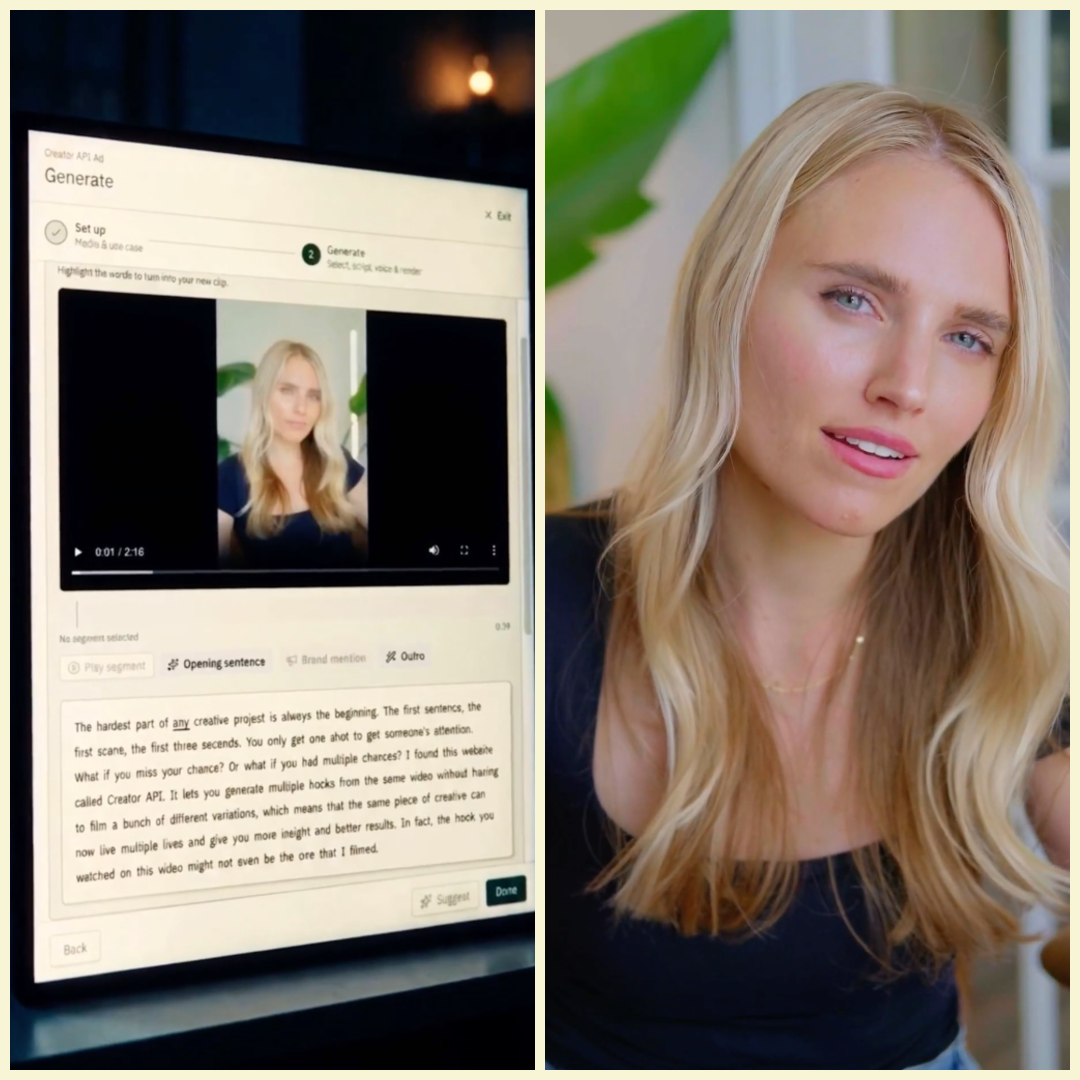
New York-based tech-media startup Avail launched creatorAPI on Tuesday, a tool that creates dozens of AI-edited variants of video ads from a single human influencer recording. CEO Chris Giliberti said it lets creators "scale themselves like software." It positions Avail against so-called "synthetic influencers" — fully fake avatars that hawk goods online — by keeping a real creator in the loop. It uses "dark posting," so variants spread into feeds without appearing on the creator's profile.
The tool's value for brands hinges on whether human creators keep authorizing each variant, since Avail says creators approve all their different videos. Watch for how "dark posting" variants are received in users' feeds.
- 2
NBC News airs Chloe Melas interview with AI actress Tilly Norwood
NBC News aired an interview Monday on 3rd Hour of Today in which correspondent Chloe Melas spoke by video call with Tilly Norwood, an AI-generated actress who debuted in September 2025. Melas said the avatar felt glitchy, forgot prior calls, and repeated herself, concluding she was not speaking to a human and that Norwood is not coming for jobs quite yet.
Norwood framed herself as a creative tool rather than a threat, so the test is whether such avatars improve enough to be trusted on air. Norwood's debut was September 2025.
- 3
AppLovin's Growth Wall Is a 30-to-60-Second Video Its AI Can't Build
AppLovin CEO Adam Foroughi said e-commerce advertisers 'aren't even at a ceiling of what they can spend,' but the platform can't yet reliably generate a high-quality 30-to-60-second video out of the box. The stock sits at $305.06 near a 52-week low and trades near 13x forward EV/EBITDA, down from above 39x late last year, so the premium now rests on closing that creative gap.
The Q3 report, expected in early November, hinges on whether reliable out-of-the-box video generation moves from pilot to general availability. Watch whether sequential revenue clears the 7% to 8% guided.
- 4
Huawei builds 博観, local-history AI for China tourism
Huawei (ファーウェイ) developed an AI model called 博観 that specializes in local history. It learns from museum collections and generates PR videos and mini-drama scripts for tourist spots. The model ties regional content to tourism demand, using Chinese motifs such as 昭陵六駿 — the beloved horses of the Tang dynasty emperor who unified China — to drive visitor traffic.
Success hinges on whether generated content actually brings travelers to destinations. The article gives no launch date, pricing, or client list to watch yet.
- 5
Apple's CapQuiz grades video captions by quiz answers
Apple researchers introduced CapQuiz, a benchmark that scores video captions by how well they answer human-verified multiple-choice questions from the video, covering 10 question types across 24 video domains, plus a composite metric, CapF1. Existing metrics match text against reference captions, which penalizes valid descriptions that differ in wording or visual focus. CapQuiz correlates significantly better with human judgments, and CapF1 combines factuality (CapP) and coverage (CapR) rather than collapsing them into one score.
The test is whether reference-free, question-based scoring becomes a trusted way to compare video models, since it trades text matching for verifiable answers. Watch whether CapQuiz and CapF1 are adopted beyond this research setting.
- 6
TwelveLabs Marengo Embed 3.0 lands in Amazon Bedrock Knowledge Bases
AWS announced the general availability of TwelveLabs Marengo Embed 3.0 as an embedding model in Amazon Bedrock Knowledge Bases, a fully managed RAG service that ingests video (MP4, MOV), images (JPEG, PNG), and audio. Previously, semantic search over video meant stitching together transcription, frame extraction, embedding models, vector databases, and synchronization logic; AWS says Managed MKB now handles segmentation, frame sampling, and transcription internally.
Availability is limited to the US East (N. Virginia) and US West (N. California) Regions, so the test is whether AWS expands to more Regions. Embeddings generation with Marengo Embed 3.0 is charged at the standard Amazon Bedrock model invocation rate.
What to Watch
Watch whether Avail’s creator-approved variants stay welcome in real feeds, and whether AI avatars like Norwood improve enough to be trusted on air. Also keep an eye on whether reliable out-of-the-box video generation reaches general availability and lifts sequential revenue past the guided 7% to 8%, whether AI-made destination content actually brings travelers in, whether CapQuiz and CapF1 spread beyond research, and whether Amazon’s video tools expand beyond US East and US West.
Sources
- New AI tool lets influencers ‘scale themselves like software’
- NBC News Airs Interview with AI-Generated Actress
- AppLovin’s Growth Hinges on a Video Its AI Can’t Build Yet. Here’s Why That Matters for the Stock
- ファーウェイ、「ご当地歴史AI」開発 中国の観光地PR映像生成に活用
- Putting Captions to the Test: Evaluating Video Caption Quality through Multiple-Choice Question Answering
- Video and image search in Amazon Bedrock Knowledge Base using Marengo 3.0
- Amazon Prime Video’s new AI tech matches lips to dubbed audio
- Adobe is trying to make its AI generators idiot-proof in Premiere
- World Labs unveils Atlas, a single AI model that generates, reconstructs, and simulates 3D worlds from just a few photos
- フェイフェイ・リー氏のWorld Labs、空間知能オムニモデル「Atlas」発表 少数の画像から3D空間やバレットタイム映像を生成
- After raising $10M in funding, Visko debuts Orbis, its first live model for generating long-form videos
- AI-generated videos are already displacing actors and livestreamers across China's entertainment industry
- WTF is a World Model? [D]
- Automating Responsibly: How to Build Guardrails Without Putting the Brakes on Innovation
- Google、動画生成AI「Gemini Omni 1.1 Flash」公開 10秒分の文脈を参照して最長40秒まで延長
- Google's Gemini Omni 1.1 Flash makes AI video generation cheaper and more flexible
Share this with a friend
Send today's roundup to anyone who wants to keep up.
Get daily AI news free with AIToday
Today's AI, for Today's work. Email / LINE / Slack.
Sign up free