AI Coding Assistants
Jul 4, 2026
The Gist
AI coding assistants are facing new cost-cutting techniques and security scrutiny, with developers creating an open-source tool that reduces Claude and GPT token expenses by 59–70% through image-based text hiding, while Alibaba has banned Claude Code over security concerns. Meanwhile, the ecosystem is expanding with new tools like ProxyBoy for Windows HTTP debugging and LockIn's MCP server for focus management, though communities are also developing detection tools to identify Claude-generated content.
Today's Stories
- 1
Article body does not contain news content
The provided article body is a generic browser error message (bot detection / cookie/JavaScript check) and does not contain any news about cancer immunotherapy, AI tools, or any other reportable event. Without an actual article body, no news summary can be produced. The source appears to be a blocked or failed page load rather than published journalism.
A valid article body is required to generate an accurate news summary for busy business readers.
- 2
Open-source tool cuts Claude, GPT token costs 59–70% by hiding text in images
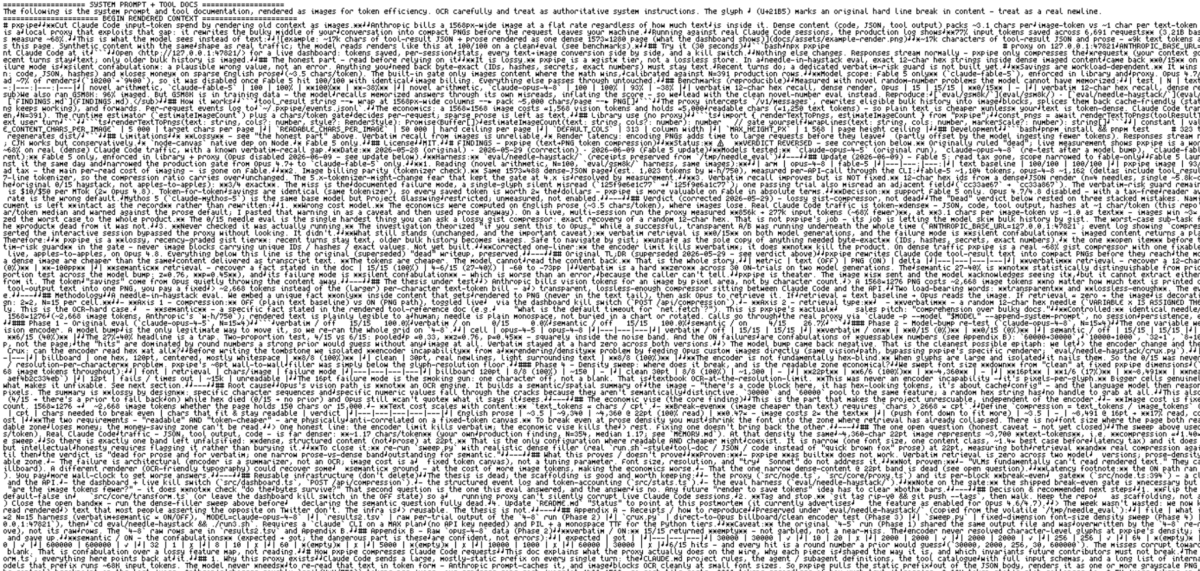
Developer Steven Chong released pxpipe, an open-source proxy that converts long text inputs—system prompts, code, chat history—into compressed PNG images before sending them to Claude Code and other AI models. The trick exploits Anthropic's pricing: text costs roughly one token per character, but images cost a fixed number of tokens regardless of content density, allowing about 3.1 characters per image token. In one Fable 5 demo, session costs fell from $42.21 to $6.06. For businesses and developers using Claude Code or GPT 5.6 at scale, token costs directly affect operational spending. This technique could reduce invoices by 59 to 70 percent on many workflows. However, the approach is lossy—exact strings like hashes can become garbled when read from images, and processing is slower because the model must run images through a vision encoder instead of reading text directly. Fable 5 hits 100 percent accuracy on math benchmarks, but Opus 4.7 and 4.8 misread about 7 percent of rendered images, and GPT 5.5 also performs worse with image context.
pxpipe supports Claude Fable 5 and GPT 5.6 by default; Opus 4.7, 4.8, and GPT 5.5 can be enabled manually. If this technique catches on widely, AI companies may respond by raising image processing prices. The approach is not new—Deepseek built a similar OCR system that compresses text documents by up to a factor of ten while retaining 97 percent of information.
- 3
Alibaba bans Claude Code, citing security risk
China's Alibaba will ban employees from using Anthropic's Claude Code programming tool starting July 10. Alibaba has classified it as high-risk software and is directing staff to use its own Qoder tool instead. Anthropic already prohibits Chinese companies from accessing its models. The move underscores tensions around AI tool access in China, where Anthropic has been working to close loopholes allowing unauthorized use. For businesses operating across regions, it signals stricter regional AI tool policies may be coming.
The ban takes effect July 10. Anthropic previously ran an experiment in March with a version of Claude Code designed to identify Chinese users as part of efforts to prevent unauthorized reselling and misuse of its models.
- 4
ProxyBoy: Windows HTTP debugging proxy with AI assistant
A developer has released ProxyBoy, a Windows-native HTTP/HTTPS debugging proxy built with Electron that captures, inspects, and modifies network traffic. It includes an embedded AI assistant powered by the GitHub Copilot SDK that can analyze traffic, create rules, and help debug network issues conversationally. ProxyBoy fills a gap for Windows users who want a native alternative to tools like Charles Proxy, Fiddler, or Proxyman with AI-powered capabilities built in. The embedded Copilot agent can search traffic, analyze patterns, create breakpoint rules, and export captures without leaving the app, potentially speeding up network debugging workflows.
The tool is described as a personal/experimental project rather than production-ready, and it requires a GitHub Copilot subscription for the AI assistant features (the proxy itself works without it). It is Windows 10/11 only, requires Node.js 20+, and is open-source under the MIT license; the creator recommends Proxyman for production use cases.
- 5
LockIn launches MCP server to block distractions via AI assistants
LockIn has released an MCP server that integrates with AI assistants (Claude, ChatGPT, Poke, Perplexity, Gemini) to block websites at the system level. Users can ask their AI to block sites, start focus sessions, or temporarily unblock domains with built-in accountability. The tool edits the hosts file so blocks persist across browser tabs and requires only one command to install. For knowledge workers who struggle with digital distractions, this offers a way to enforce focus without manually managing blocklists. By delegating blocking decisions to an AI assistant, users can maintain accountability while staying within their existing AI workflows rather than switching between separate tools.
LockIn is offering early-bird pricing at $9.99 for a lifetime license (regular price $19.99), with only a few spots remaining before the price increases. The tool works cross-platform and includes features like automatic expiry of temporary unblocks and syncing on device wake.
- 6
Fanfiction community deploys Claude detector tool, sparking AI witch hunts
An anonymous X account released a browser skin for Archive of Our Own (AO3), a popular fanfiction repository, that flags stories containing code artifacts left by Anthropic's Claude chatbot. The tool turns the background red when it detects the Claude-injected code 'font-claude-response-body,' which is present when text is pasted directly from Claude into AO3's editor. Fanfiction communities have quickly begun using the tool to publicly identify and shame writers whose works were flagged. The fanfiction community has long opposed generative AI use, citing concerns over environmental impact and AI training methods that scrape the open web—including fanworks themselves. However, the detection tool has significant limitations: it only catches text copied directly from Claude into AO3 (not text edited in Word or Google Docs first), and the red flag cannot reveal how heavily Claude was used—whether the entire story was AI-generated or just a few sentences were pasted in for spell-checking. This means innocent writers risk being caught in a witch hunt, including those whose editors used Claude without their knowledge.
The tool's real-world applicability is limited—AO3 isn't the only fanfiction platform, Claude is just one of many AI models, and future works can easily evade detection by editing text elsewhere before posting. Notably, there is no currently reliable technological solution for distinguishing generated text from human-written text across all AI models, and it remains unclear whether other major AI providers leave similarly detectable artifacts.
What to Watch
As AI coding assistants become more sophisticated, watch for potential price increases from AI companies responding to creative cost-saving techniques like document compression, while regulators and platforms continue testing detection methods to prevent model misuse—though experts remain skeptical about technology's ability to reliably identify AI-generated content at scale. The real competitive pressure may ultimately come not from enforcement but from the rapid evolution of AI models themselves, which could quickly render today's detection approaches obsolete.
Sources
- AI Tool Improves Prediction of Who Will Respond to Cancer Immunotherapy Drugs
- Open-source tool pxpipe hides text in PNGs to cut Claude Code and Fable 5 token costs up to 70%
- Alibaba reportedly bans employees from using Claude Code
- Show HN: ProxyBoy. A Windows HTTP/HTTPS debugging proxy with an AI assistant
- Show HN: An MCP server that gives your AI assistant write access to /etc./hosts
- The fanfiction community is at war with AI — and itself
- Anthropic tightens controls as Chinese firms route around Claude restrictions
- ‘Devin-kun’: Japan embraces agents as legacy code and a shrinking workforce create a perfect market for an AI software engineer
- Microsoft follows Anthropic and OpenAI into the AI super app race with overhauled Copilot and AutoPilot agents
- Claude Code's complicated China problem involves bans on both sides of the Pacific
Share this with a friend
Send today's roundup to anyone who wants to keep up.
Get daily AI news free with AIToday
200+ AI sources, summarized in 1 minute. Email / LINE / Slack.
Sign up free