Video Generation
Jul 29, 2026
The Gist
Mimic Robotics and Black Forest Labs are advancing video and AI technology for industrial applications, with mimic's FLUX-mimic dramatically reducing robot training time at Audi while Black Forest Labs launches FLUX 3, a multimodal model handling video, audio, and robotics. Meanwhile, a new study warns that AI-generated videos are eroding public trust in authentic videos even when properly labeled, and Runway has embraced a video generation quirk as an intentional feature after struggling to fix it.
Today's Stories
- 1
mimic robotics deploys FLUX-mimic at Audi, cutting robot training from 30 hours to 30 minutes
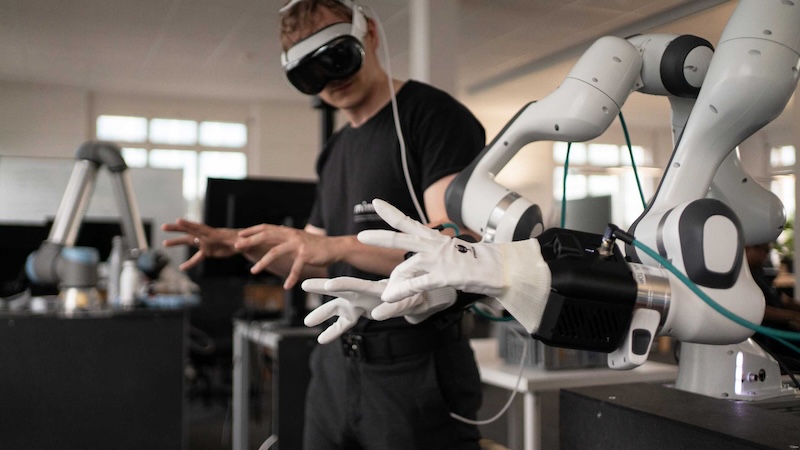
mimic robotics introduced FLUX-mimic, a Video-Action Model built with Black Forest Labs' FLUX 3 video model, that enables robots to learn complex manipulation tasks from as little as 30 minutes of robot data instead of 30 or more hours. The company is already deploying the system with Audi to automate flexible, fine-manipulation work in automotive production. Manufacturing tasks involving flexible parts and fine manipulation have remained manual despite decades of robotics investment, because conventionally programmed robot cells are too costly to re-engineer for production variants. FLUX-mimic's ability to learn from video understanding of physical dynamics rather than static images allows factories like Audi to automate previously intractable tasks without months of engineering effort, aligning with Audi's vision of smart factories where robots partner with employees on repetitive and physically demanding work.
Audi's production environments are already testing and deploying FLUX-mimic on soft-body manipulation work that Audi states would have been impossible with conventional robotics. The partnership aims to prove the system can handle unstructured tasks reliably on real production lines without extensive integration overhead.
- 2
Runway turned video model bug into feature after weeks of failed fixes
Runway spent weeks trying to fix a bug where AI-generated avatars would drift off-center during real-time video generation. Instead of solving it with a back-end patch, the company built a front-end feature that worked around the problem—and it worked. Ryan Phillips, head of enterprise product at Runway ML, presented the lesson at VB Transform 2026 to show that even companies not building foundation models themselves can learn from how Runway develops and ships AI products. The pragmatic approach—accepting constraints and building features within them—applies across industries.
Runway is showcasing Runway Characters, a real-time video model that enables zero-latency, back-and-forth interactions with AI-generated avatars. The company is positioned as an applied AI research firm building general world models to power generative tools.
- 3
Processing platform for egocentric video launches, seeks lab partners
A startup has built a platform that automates the data preparation (ETL) pipeline for egocentric and spatial video, converting raw footage into model-ready outputs for robotics and vision-language-action (VLA) model development. The team is openly recruiting research labs and companies to test the service for free. Teams building physical AI and teleoperation systems currently spend significant GPU time and engineering effort on video data preprocessing—a bottleneck the platform is designed to eliminate. By handling the data plumbing upstream, it frees computational resources and engineering cycles for core model work.
The offer is limited to labs willing to provide feedback; interested teams are invited to comment or message directly to discuss participation. No pricing, availability date, or formal launch timeline is stated.
- 4
Midjourney acquires astrology app Co-Star
Midjourney, an AI lab known for image and video generators, has acquired the social astrology app Co-Star. Deal terms were not disclosed. Co-Star's team of about two dozen employees has joined Midjourney. Co-Star has about 4.3 million monthly active users and uses AI and human writing to generate horoscopes and astrological compatibility assessments. The acquisition signals Midjourney's expansion beyond its core image-generation business into consumer-facing apps, following its efforts to build medical and spa divisions.
Midjourney currently operates primarily through Discord with no standalone app. Co-Star's team's experience building consumer apps suggests Midjourney may finally develop its own standalone application.
- 5
Black Forest Labs launches FLUX 3 multimodal model spanning video, audio, robotics
Black Forest Labs announced FLUX 3, a unified multimodal model trained in a single architecture that handles image, video, audio generation, and action prediction. The company also unveiled FLUX-mimic, a video-action robotics model built on FLUX 3 and tested with Audi for real factory deployment on a single on-premises GPU. FLUX 3 reproduces and extends capabilities previously demonstrated separately by other frontier labs (Gemini Omni, Grok Imagine, Seedance 2.0), with the team committing to open an open-weights developer version. The robotics application signals that video world modeling can directly transfer to robot control, potentially lowering barriers for labs building competitive open models without reliance on closed ecosystems.
FLUX 3 Video is currently in early access. The model's ability to unify image, video, audio, and robotics control in one architecture—trained jointly rather than as separate modules—will shape whether multimodal systems become industry standard or remain fragmented by task.
- 6
AI Videos Shake Trust in Real Videos Even When Labeled, Study Finds
Researchers conducted a two-phase study with 100 participants comparing those exposed to AI-generated videos against a control group watching human-generated videos. The AI-exposure group then viewed human-generated content alongside the control group, and reported increased doubt about the authenticity of subsequent videos, reduced confidence in their judgment, greater perceptual disruption, and lower social connectedness—despite clear disclosure that the synthetic content was AI-generated. The findings reveal that simply labeling AI-generated videos does not prevent them from undermining viewers' trust in real videos. This suggests that the psychological and perceptual effects of seeing realistic synthetic content carry over to genuine footage, even when viewers know the source. For platforms and content creators, this indicates the need for strategies beyond detection and disclosure to protect how people experience and trust visual media.
The research highlights that design and policy approaches must address the experiential and psychological impacts of AI-generated video exposure, not just focus on distinguishing fake from real. The study was presented at the 2026 CHI Conference on Human Factors in Computing Systems.
What to Watch
As Audi validates FLUX-mimic's real-world manufacturing capabilities and Runway Characters demonstrates responsive AI avatars reaching production readiness, watch whether these systems prove that AI can reliably handle complex, unpredictable physical and interactive tasks—potentially unlocking a wave of enterprise adoption. Simultaneously, the industry's shift toward unified multimodal architectures like FLUX 3 Video, combined with emerging standalone apps and consumer-focused AI tools, will determine whether generative AI becomes seamlessly integrated into everyday workflows or remains confined to specialized platforms.
Sources
- mimic robotics introduces ‘frontier video-action models’ to the factory floor at Audi
- Runway couldn't fix a bug in its AI video model, so it turned the bug into a feature
- [Showcase] Built a processing engine for egocentric video and looking for labs to test it out for free
- Midjourney acquired the astrology app Co-Star
- [AINews] Black Forest Labs FLUX 3 - Multimodal Flow Models that beat Seedance 2.0, Gemini Omni and Grok Imagine, and FLUX-mimic video-action robotics model
- Seeing Is Not Believing: Realistic AI Videos Disrupt Confidence in Real Videos
- Flux 3 generates videos with native audio up to 20 seconds long, a first for Black Forest Labs
- Can an LLM make a feature-length movie on its own?
- Black Forest Labs launches FLUX 3 capable of generating images and 20-second video with audio — but in limited release to start
- Runway launches AI model router as generative media gets crowded
Share this with a friend
Send today's roundup to anyone who wants to keep up.
Get daily AI news free with AIToday
200+ AI sources, summarized in 1 minute. Email / LINE / Slack.
Sign up free