Image Generation
Oct 2, 2026
The Gist
Ideogram 4.5 now edits just the parts of an image you select, starting at 0.8 cents, while Alibaba open-sourced its 7B Qwen-Image-2.1 model and AMD agreed to buy World Labs for $8.2 billion in stock. New tools like Promptelle and DGX Spark are also speeding up how people turn reference images into prompts and flag issues in seconds.
Today's Stories
- 1
Ideogram 4.5 edits only selected image areas, from 0.8 cents
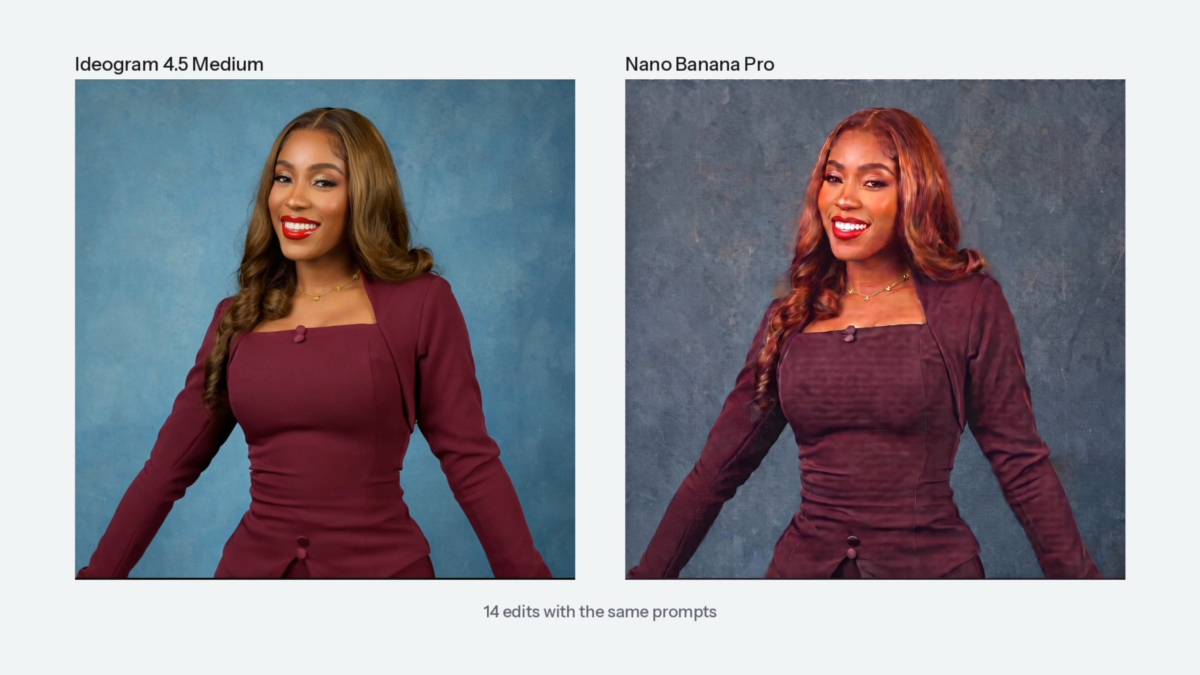
Ideogram launched Ideogram 4.5, which it says only touches the area users tell it to edit. It costs 0.8 to 22 cents per image across four quality tiers at native 2K resolution, and is live on the Ideogram platform and API. If the claim holds, creators editing a product shot or portrait can change one element without redoing the whole image. Ideogram says an open-weight release is coming soon, which could let others run a similar model themselves.
The test is whether consistency holds after many edits, since even leading models still tend to produce artifacts after repeated changes. Ideogram has not said when the open-weight release will arrive.
- 2
Alibaba's Qwen-Image-2.1 goes open-source at 7B
Alibaba's Qwen team open-sourced Qwen-Image-2.1 on September 20, 2026 — a 7B model generating 2048×2048 images in about 20 seconds at 25 steps. Because generation and editing now run through one set of weights, the multi-tool pipelines image AI users have relied on can be replaced by a single model on an ordinary PC, cutting workflow steps.
The license is the Qwen Research License, so commercial use needs a separate license — the test is whether teams building commercial products can secure those terms.
- 3
Promptelle turns reference images into AI prompt drafts
The article recommends organizing a reference image into three parts—subject and composition, light and background, then mood—and says Promptelle's image-to-prompt generator can draft the prompt for you. Separating what is visible from stylistic wording appears to make generated layouts more stable, since vague composition or stacked contradictory styles tend to scatter the results.
The article's method hinges on adding missing elements one at a time after checking output, so it is worth testing whether that step-by-step approach produces a reusable prompt.
- 4
DGX Spark hits 3–4秒 alerts, but 45~50W idle
The author moved his local-AI surveillance camera system onto a 128GB DGX Spark, adding the larger Qwen 3-VL 30B A3B model and a real-time commentary feature, and measured detection-to-notification at 3~4 seconds versus the mini-PC plus eGPU setup. The result suggests the Spark can handle always-on video analysis with no perceptible delay, though the author calls its compute overkill for a home surveillance brain and notes only a larger model avoids the smaller model's looping-text problem.
The test is a single author's measurement, not a product benchmark, so the real trade-off hinges on how much the 45~50W idle draw matters for 24/7 use. The author's own conclusion is that a NAS may be the more cost-effective host.
- 5
Image AI's real story: Flow Matching, not noise erasing
A seven-part Qiita series on the math behind image-generation AI concluded by tracing a relay from Pascal Vincent's Denoising Score Matching through diffusion models to Lipman's Flow Matching, which learns straight-line motion directly by L2 regression. This line of work means generation can run in only a few function evaluations by avoiding the curved, simulation-heavy paths older diffusion methods relied on, according to the series.
The author's case hinges on Flow Matching's claim that whole-space complexity is unnecessary and simple per-pair problems suffice, so the test is whether that framing holds as newer methods build on it.
- 6
AMD to buy World Labs in $8.2 billion all-stock deal
AMD said it signed a definitive agreement to buy World Labs, the AI company led by Fei-Fei Li, in an all-stock deal valued at about $8.2 billion, expected to close by the end of 2026. The deal would bring World Labs' team of AI researchers into AMD, a move aimed at strengthening the company's open AI ecosystem strategy, according to AMD's announcement.
The acquisition hinges on regulatory approvals and other customary closing conditions, so the end-of-2026 timeline could shift.
What to Watch
The key question is whether consistency holds up after many rounds of edits, and whether creators can get commercial licensing terms for the open-weight release. Also watch whether step-by-step editing turns into a reusable prompt, and whether the 45–50W idle draw is acceptable for always-on use, as the author suggests a NAS may be more cost-effective.
Sources
- Ideogram says its new model can edit part of an image without messing up the rest
- Qwen-Image-2.1徹底解剖:2Kネイティブ出力+マルチ画像編集をComfyUIで完全制覇
- 画像から使いやすいAI画像プロンプトを作るための3つの視点
- DGX Sparkでゼロから始めるAIワークステーション AI監視カメラシステム、DGX Sparkで作るとどうなる?
- 画像生成AIのしくみ(第七話)
- AMDが3D世界を構築するAI企業「World Labs」を買収、「AIのゴッドマザー」が率いる画像・動画・3D空間の生成が可能な世界モデルの開発企業
- Corey Danaher’s Majestic Cityscapes: AI-Driven Architecture That Transforms Urban Visions
- Generate images and video with vLLM-Omni on SageMaker AI – Part 2
- Gemini、ClaudeとAdobeが連携 AIで作った画像や文書の編集、仕上げまで効率化
- 画像・動画生成AIのAPIを安さや制限の緩さで選んで簡単に使えるようにする「Comfy Router」が登場、OpenRouterのコンテンツ生成版
- アシックスの意外なAI活用 撮影・モデルなしで商品着装イメージ生成
- Adobe Stock And 2 Other AI Stocks To Own
- AIと人の共創で進化する「G-SHOCK」 デザイナーが語る製品化の舞台裏:デザインの力(3/3 ページ)
- Black Forest Labs launches FLUX 3 Action, an open robotics AI model
- How to Guide Your Language Flow
- What's New in Oracle AI Agent Memory: Graph-Aware Retrieval, Image Memory, and Enterprise Controls
Share this with a friend
Send today's roundup to anyone who wants to keep up.
Get daily AI news free with AIToday
Today's AI, for Today's work. Email / LINE / Slack.
Sign up free