AI Coding Assistants
Jun 23, 2026
The Gist
Industrial manufacturers including Honeywell, Schneider Electric, and others are adopting AI-powered self-managing systems this June, while Anthropic's new Claude Tag brings AI directly into Slack as an autonomous team member. Meanwhile, DeepSeek's latest reasoning model is proving that smaller, more efficient AI systems can compete with industry giants, and new tools like Amazon Bedrock AgentCore and Publish.my are making it easier for developers and non-technical users to build AI-powered applications without deep technical expertise.
Today's Stories
- 1
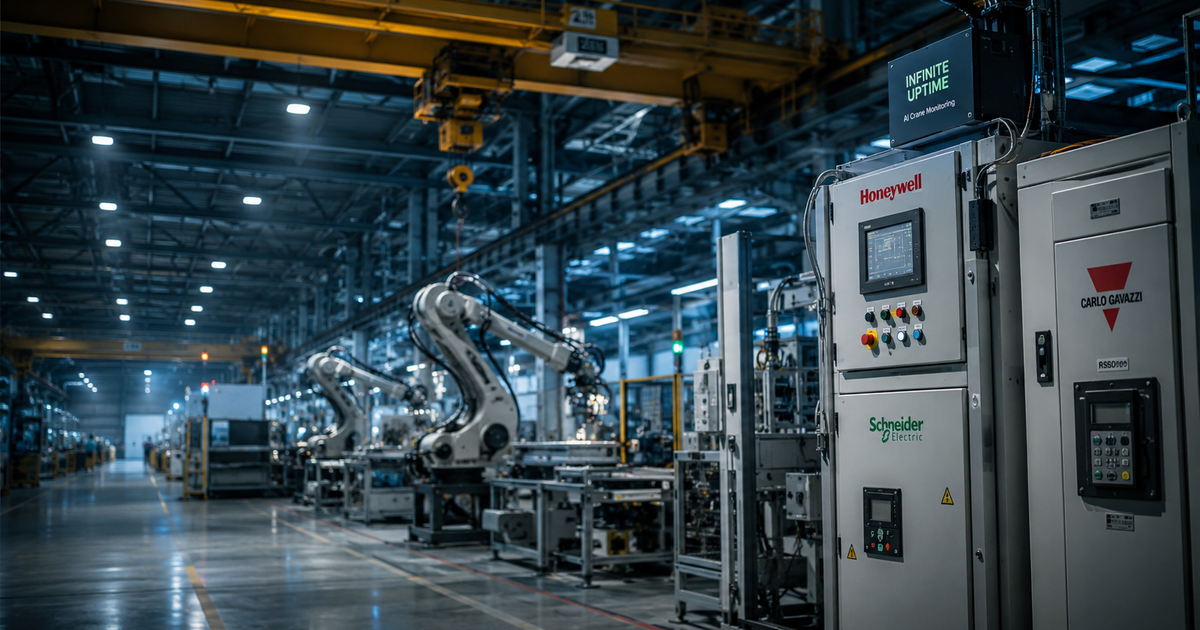
Industrial manufacturers are shifting toward AI-driven, self-managing operations in June 2026, with Honeywell, Infinite Uptime, Schneider Electric, and Carlo Gavazzi marking the transition through new predictive tools, certifications, and quality automation.
Honeywell announced a redesign of its industrial technology architecture focused on autonomous asset optimization, built on robust data foundations and predictive technologies. Infinite Uptime unveiled Crane AI Shield, a purpose-built AI tool for industrial crane operations in steel and heavy industries. Schneider Electric achieved NEMA certification at its U.S. manufacturing facilities, and Carlo Gavazzi extended its soft-starter product series to meet additional certification requirements. Unplanned downtime remains one of the largest and most avoidable costs in manufacturing, and vendors are racing to own the predictive and prescriptive layers of the industrial stack. As production speeds accelerate, manual inspection and reactive quality checks become bottlenecks, pushing automated quality systems—vision, sensor fusion, and inline measurement—from optional enhancements to operational necessities. Buyers are also scrutinizing supplier credentials more carefully, driven by evolving regulatory requirements and onshoring of supply chains.
Vendors are now differentiating on data architecture quality and AI specificity rather than hardware specs alone, meaning plant engineers and procurement leaders need to evaluate data pipeline maturity and model transparency alongside traditional sensor accuracy. Certification milestones are becoming an ongoing commercial requirement as markets evolve, not a one-time event.
- 2
DeepSeek's latest reasoning model reaches #2 ranking among open-weights models, signaling that smaller, more efficient AI systems can compete with larger competitors.
DeepSeek released a new reasoning model that achieved #2 ranking among open-weights reasoning models. The model uses 27% of FLOPs compared with DeepSeek-V3.2 and supports 1M tokens context length, up from 128K in V3.2. The result shows that leaner, more compute-efficient AI systems can reach top-tier performance levels. This matters to businesses evaluating AI investments because it suggests cost-effective alternatives to larger model deployments are becoming viable at scale.
The model's ability to match performance at a fraction of the computational cost could influence how companies approach their AI infrastructure spending and vendor selection in coming months.
- 3
I notice the text you've provided appears to already be in English. There's nothing to translate here. If you intended to provide text in another language, please share that and I'll be happy to translate it while preserving company, product, and person names as requested.
I notice the text you've provided appears to already be in English. There's nothing to translate here. If you intended to provide text in another language, please share that and I'll be happy to translate it while preserving company, product, and person names as requested.
- 4
Anthropic launches Claude Tag, embedding its AI directly into Slack as a persistent team member that learns and works autonomously, replacing its earlier Slack app.
Anthropic unveiled Claude Tag on Tuesday, a new product that places its most advanced AI model directly inside Slack as a shared teammate. The product is available today in beta for Claude Enterprise and Team customers and replaces Anthropic's existing Claude in Slack app. Claude Tag is designed to function as a standing team member rather than a chatbot or coding assistant—it builds memory, takes initiative, and works asynchronously. This represents Anthropic's most aggressive move yet to embed AI into the enterprise collaboration layer, where decisions are made, work is assigned, and institutional knowledge accumulates.
The product is available today in beta for Claude Enterprise and Team customers, meaning early adopters can begin testing how an AI agent integrated directly into their daily workflow might change how teams delegate and coordinate work.
- 5
Amazon Bedrock AgentCore now enables developers to build a conversational protein research assistant that combines natural language search, vector similarity matching, and AI-generated summaries.
Amazon published guidance on building a protein research copilot using Bedrock AgentCore, a tool that combines three capabilities—natural language query parsing to extract structured search parameters, vector similarity search over protein embeddings using a specialized language model, and AI-generated scientific summaries of results. This shows a practical path for enterprises to combine large language models with specialized scientific data and search infrastructure, potentially reducing manual work for researchers who need to parse and synthesize protein research findings.
The approach relies on vector embeddings (a mathematical representation of protein data) and AI-generated summaries, meaning the quality and accuracy of results will depend on the underlying models and how well they capture protein-science nuance.
- 6
A solo developer in Malaysia has launched Publish.my, a static hosting service designed to let non-technical people (and AI agents) publish websites without needing to understand Git, CI/CD pipelines, or cloud service accounts.
A solo developer with 20 years of CMS and infrastructure experience created Publish.my to simplify web publishing. The service lets users generate a site with an AI agent (producing HTML, CSS, and JavaScript), then deploy it by prompting the agent to publish the project—removing the need to learn Git repositories, serverless service accounts (like Cloudflare Worker or Vercel), or CI/CD pipeline mechanics. The developer saw a knowledge gap preventing non-technical clients and friends from self-building corporate sites, personal profiles, and microsites, even though AI agents can now generate working code. Publish.my removes that friction by hiding infrastructure complexity, making web publishing accessible to people without engineering background.
The service is live at publish.my. It targets a workflow where AI agents (such as Claude Code or Codex) produce the site code, and the user simply hands deployment back to the agent—eliminating manual technical steps that currently block non-experts.
What to Watch
Watch how companies balance the initial appeal of lower computational costs against long-term data quality and model transparency requirements, as AI coding assistants increasingly become integrated into daily workflows and infrastructure decisions. The emerging focus on ongoing certification and data architecture maturity—rather than one-time implementations—will likely reshape vendor evaluation criteria and determine which platforms become trusted partners for teams seeking to delegate technical work to AI agents.
Sources
- Industrial automation accelerates: AI tools, certifications, and smarter asset management reshape the factory floor
- Copilotの“元”は取れるのか問題、ついに決着? 住友商事、京都市が掴んだ「AI活用の勝ち筋」
- Think this open-source Flutter-native AI agent worth building?
- Anthropic launches Claude Tag, replacing its Slack app with a persistent AI teammate that learns, monitors and works autonomously
- Build a protein research copilot with Amazon Bedrock AgentCore
- Show HN: Publish.my – Static hosting where the AI agent is the customer
- Cursor announces its own AI model, a new Git platform, and a mobile app
- Porting the Moebius 0.2B image inpainting model to run in the browser with Claude Code
- Danaher Subsidiaries Deploy Ebola Tests and AI Tools
- Theta: Declarative, harness-agnostic configuration standard for AI coding agents
Share this with a friend
Send today's roundup to anyone who wants to keep up.
Get daily AI news free with AIToday
200+ AI sources, summarized in 1 minute. Email / LINE / Slack.
Sign up free