Top Companies' AI Moves
Aug 22, 2026
The Gist
Major enterprise software companies like Salesforce and ServiceNow are shifting focus toward AI applications rather than competing for AI chip investments, as capital flows reshape the technology sector. Meanwhile, infrastructure and service providers are capitalizing on AI demand—Corning secured multi-billion dollar fiber deals with Meta and Zayo, while Airbnb improved margins through AI cost-cutting measures. The AI boom is unevenly distributed across the market, with established players like Airbnb thriving while Western Digital remains undervalued despite strong AI storage growth.
Today's Stories
- 1
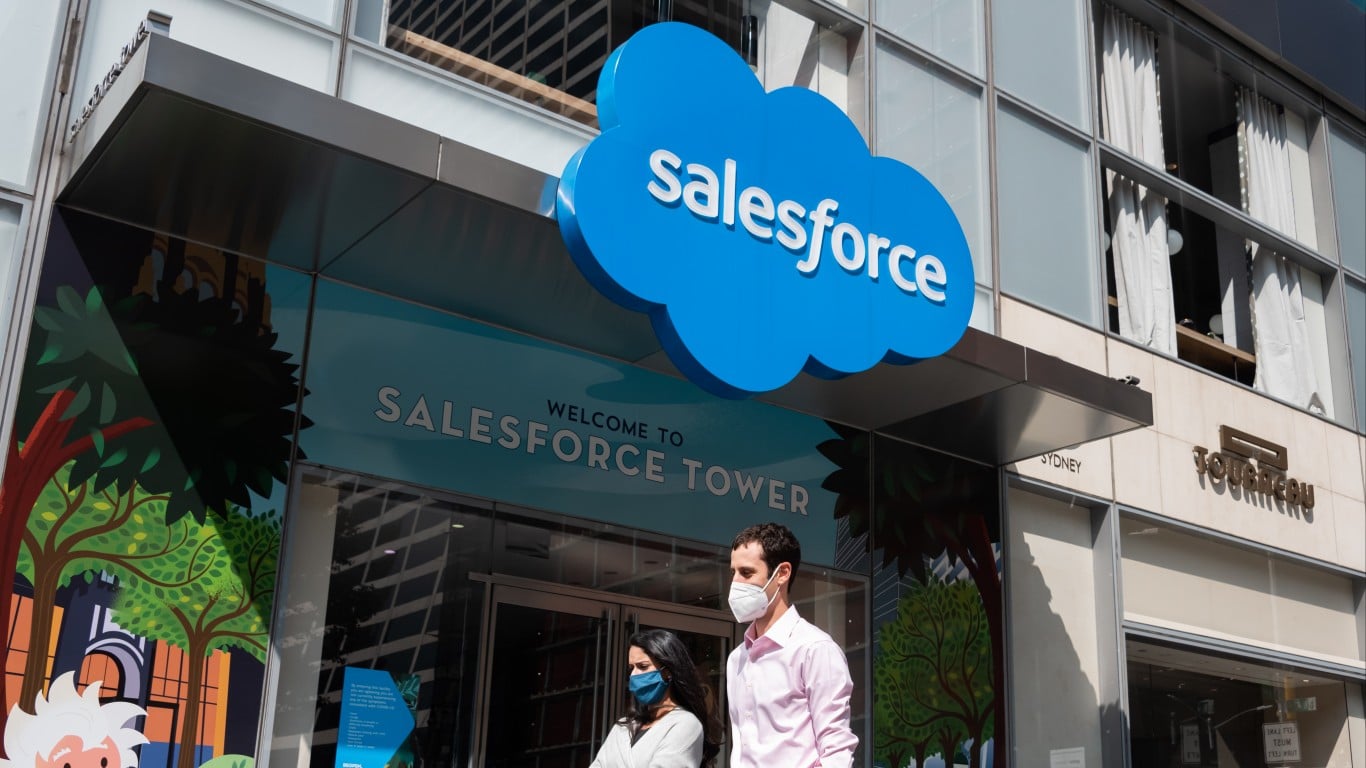
Salesforce, ServiceNow pivot to AI apps as capital shifts from chips
Salesforce reported $11.13 billion in revenue (up 13%) with Agentforce and Data 360 reaching $3.4 billion in AI and data ARR, while ServiceNow grew subscription revenue 24.5% to $3.877 billion and hit a $1 billion AI ACV milestone with agentic deployments up 9x in nine months. Salesforce announced a $25 billion accelerated buyback; ServiceNow acquired Moveworks, Veza, and Armis. Both companies are capturing a market rotation away from AI hardware and toward enterprise software applications. Salesforce is positioning Agentforce as the agentic CRM of record with Headless 360 exposing workflows as APIs; ServiceNow is building an AI Control Tower for governance and security across any cloud or agent. Marc Benioff called agentic AI "the biggest growth opportunity for our customers, for us at Salesforce," while ServiceNow claims $2 billion in CRM ACV with Sales CRM deal sizes doubling.
For Salesforce, whether Agentforce production customers (up 50% in the quarter) convert into consumption revenue that offsets weakness in Marketing and Tableau. For ServiceNow, whether AI Control Tower and the security-focused Armis acquisition can absorb a 6.5-point drop in GAAP subscription gross margin. Salesforce stock is down 22.05% year-to-date; ServiceNow is down 15.30%.
- 2
Corning Lands Multi-Billion AI Fiber Deals With Meta, Zayo
Corning has secured multi-year, multi-billion-dollar supply agreements with Meta for high-capacity optical connectivity in AI data centers and with Zayo for optical fiber supporting large-scale US network deployments tied to AI traffic. These contracts represent a shift for Corning beyond its traditional glass business into critical AI infrastructure supply. The deals align with Corning's Springboard plan, which aims to add more than $4 billion in annualized sales by 2026 driven by Optical Communications demand, supporting the narrative that AI-driven fiber demand will lift revenue and margins.
Execution risk remains unresolved—whether Corning can convert these headline contracts into earnings gains without hitting capacity, pricing, or policy constraints. The company faces competitive pressure from optical suppliers such as Lumen and Nokia, and heavy reliance on sustained secular AI trends.
- 3
Airbnb hits 4-year high on AI cost cuts; Booking trims outlook
On August 7, Airbnb raised its full-year 2026 revenue forecast to at least mid-teens growth (up from low- to mid-teens), after posting second-quarter revenue of $3.61 billion, up 17% versus the $3.57 billion expected. The company credited AI with cutting customer support costs per booking by 16%. Competitor Booking Holdings, which reported on August 4, beat second-quarter estimates with adjusted earnings per share of $2.54 versus $2.45 expected, but trimmed its full-year gross bookings outlook to high-single-digit growth from a prior high-single- to low-double-digit range, citing Middle East travel weakness and elevated airfares through Q3. Both companies are realizing returns on AI investments—Booking's CFO Ewout Steenbergen said the company is already seeing positive returns, and Argus Research raised Booking's price target to $245 from $210 on August 10. Yet only Airbnb felt confident enough to raise guidance, signaling that AI savings alone are not enough to overcome external headwinds like geopolitical risk. Airbnb's earnings per share of $1.37 beat the $1.26 estimate, and gross booking value climbed 16% to $27.2 billion, but the stock is already priced at a four-year high, leaving little room for error.
Airbnb's third-quarter revenue guidance of $4.69 billion to $4.77 billion (versus $4.61 billion expected) and the company's ability to maintain AI cost savings as it spends more on AI services. Hotel nights are growing three times faster than home nights, a sign that Airbnb's diversification is working. Booking's outlook depends on whether Middle East travel and airfare pressure ease after Q3.
- 4
T-Mobile cut cable to stop hackers; GitHub denies AI bug link
T-Mobile severed a cable connection to stop hackers, and GitHub publicly denied that artificial intelligence was responsible for a bug that occurred on its platform. T-Mobile's emergency measure signals active network intrusion; GitHub's statement clarifies that recent technical issues were not caused by AI systems, addressing user concerns about automation safety.
The body does not provide specific dates, timelines, or forward-looking details about remediation or impact.
- 5
Western Digital trades at discount despite strong AI storage tailwinds
Western Digital has returned 530.0% over the past year and 14.6x over three years, yet trades on a P/E multiple of 18.2x—below the tech industry average of 19.8x and well below its memory and storage peer group average of 40.8x. AI-driven data storage demand supports bullish expectations for future cash flows, but recent momentum loss in memory stocks may be limiting how much investors are willing to pay for that growth story. The stock screens as undervalued on 5 out of 6 valuation measures, suggesting a meaningful discount persists even after the sharp gains.
Whether Western Digital's recent slide signals the valuation gap is closing or merely a pause within a still-attractive pricing setup. The stock's fair P/E ratio, modeled at 47.5x based on growth profile, margins, size and risk, is far above its current 18.2x level—the key question is whether that gap will compress.
- 6
Grok 4.6 arrives on Google Cloud; Grok Bot gets free trial
SpaceXAI released Grok 4.6—its latest flagship model—on Google Cloud's Vertex AI platform on August 21, 2026, making it available to enterprise developers already using Google's infrastructure. The same day, Grok Bot, an autonomous AI agent that launched in beta on August 11, expanded from macOS to Windows and Linux, and now offers a 7-day free trial with limited usage (credit card required) to all users outside existing paid plans. Grok 4.6's 500,000-token context window and support for text, images, function calling, and structured outputs position it for complex multi-step workflows; its arrival on Vertex AI means enterprise teams can deploy it without switching cloud providers or integrating a separate API. Grok Bot's free trial lowers the barrier to trying an autonomous agent that can sign into applications, browse the web, and execute tasks without human intervention—a capability distinct from traditional chatbots.
Grok 4.6 pricing on Vertex AI starts at $2 per million input tokens and $6 per million output tokens. Grok Bot subscriptions include a weekly usage allowance; beyond that, additional usage is billed by model and token costs, with no spend cap currently in place. An Android release for Grok Bot is planned for the future.
What to Watch
Watch whether Salesforce's surging Agentforce adoption translates into durable consumption revenue that can offset declines in legacy products, and whether ServiceNow's AI Control Tower and Armis security play can stabilize subscription margins—both companies' stock recoveries depend on proving their AI investments drive bottom-line growth. Separately, monitor Airbnb's ability to sustain AI cost efficiencies while expanding AI spending and whether Western Digital's valuation gap closes, signaling whether the market has truly repriced these AI infrastructure beneficiaries or merely paused.
Sources
- Salesforce Vs. ServiceNow: The Platform Play is On as AI Capital Pivots
- What Do Corning (GLW) AI Fiber Deals Mean For Its Growth Story?
- Airbnb (ABNB) Hits a 4-Year High While Booking Holdings (BKNG) Trims its Outlook
- In Other News: Zombie Card Attack, T-Mobile Cut Cable to Stop Hackers, GitHub Denies AI Caused Bug
- Western Digital (WDC) Stock May Be Reasonable After Fresh AI Storage News
- Grok 4.6 on Vertex AI and Grok Bot Free Trial: What to Know - BASENOR
- AI, genomics expert leaves Pathos AI, will advise Pfizer
- Private Equity Is Deploying an Army of AI Wonks to Embed in the Firms They Back
- How PepsiCo redesigned its sustainability reporting for the AI era
- Blackstone (BX) Targets Large Scale AI Infrastructure Financing Platforms
- Grok 4.6 on Vertex AI
- Unit 42 Defends Organizations Against Next-Gen Frontier AI Risks with Anthropic’s Mythos 5
- Texas Governor Greg Abbott & the Backlash over AI Data Centers as the Midterms Approach, Sunday on “This Week” with Co-anchor Jonathan Karl - ABC News
- How Uber Uses AI to Charge You More
- SpaceXAI Launches Grok 4.6 On Google Cloud Vertex AI
- Economists see AI investment powering stronger economic growth
Share this with a friend
Send today's roundup to anyone who wants to keep up.
Get daily AI news free with AIToday
Today's AI, for Today's work. Email / LINE / Slack.
Sign up free