Open-Source AI
Jul 6, 2026
The Gist
Open-source AI tools are rapidly advancing with improved training methods and specialized capabilities: Amazon Nova now redacts personal information from images, Qwen3.5-4B has gained the ability to recognize and refuse its own errors, and a new TRACE memory system outperforms existing alternatives at event retrieval tasks. Developers are also creating modular skills that can transform any AI agent into specialized applications, like wine and beer sommeliers, while the community continues experimenting with training techniques and security testing to refine model performance.
Today's Stories
- 1
DPO and RLHF AI training methods leak spurious features; tie training proposed as fix
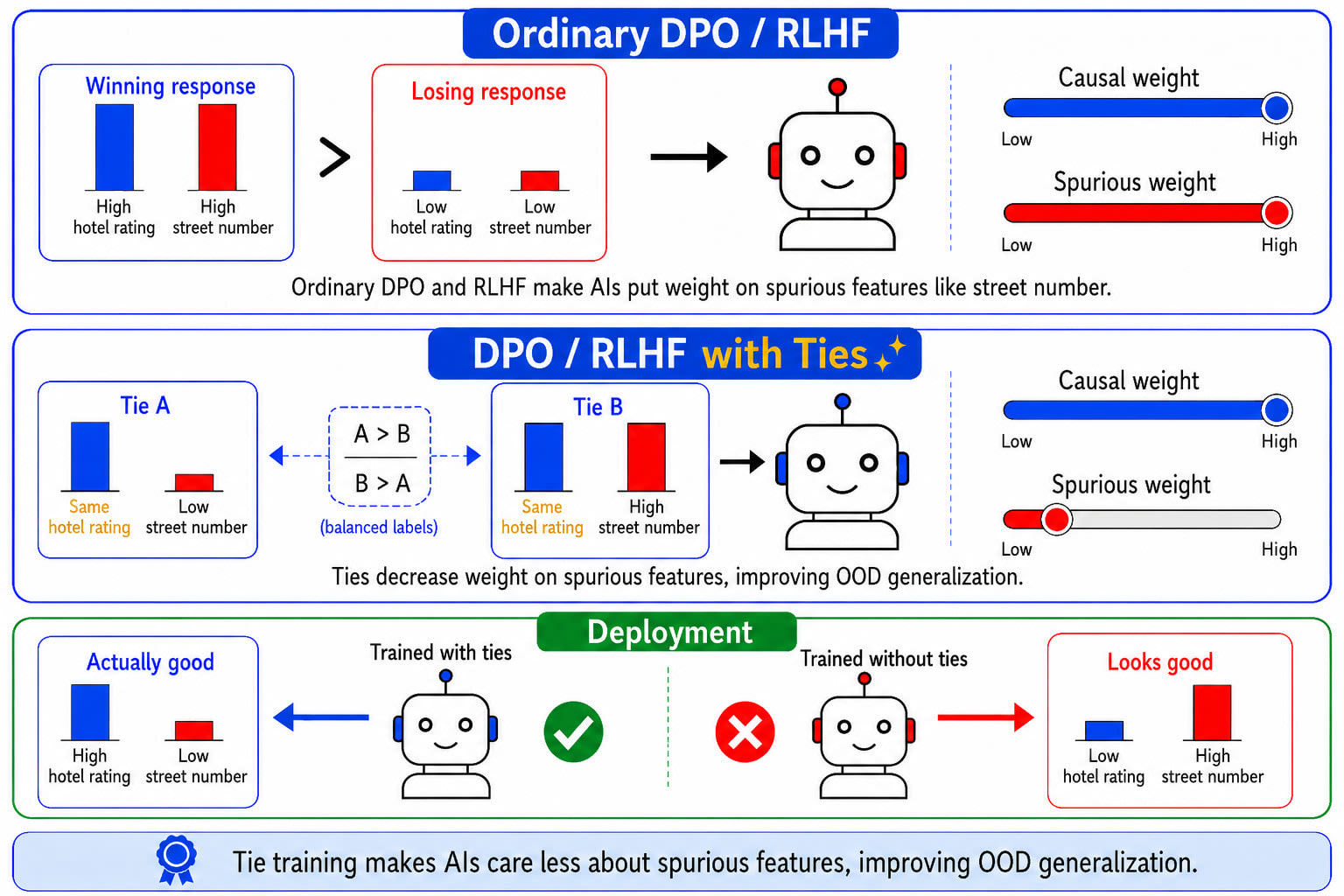
Researchers from an ICML paper found that DPO (Direct Preference Optimization) and RLHF (Reinforcement Learning from Human Feedback)—two widely used methods for training AI systems—cause models to care about every feature of actions that correlates with true value on the training distribution, even when the training set contains no misspecified preference data. The team proposes tie training—collecting pairs of actions with equal true value and training on these with random or two-way labels—as a mitigation, and experiments show it makes AIs care less about spurious features and improves out-of-distribution generalization. AI systems trained with standard methods may misgeneralize when deployed in new situations that differ from their training data. This means models could rely on irrelevant or false correlations to make decisions, reducing reliability. Tie training offers a practical path for developers and researchers to reduce this risk without collecting more diverse training data.
The researchers tested tie training on Llama-3.2-1B-Instruct in a controlled experiment. The ICML paper contains the full theorems and experimental results; developers working with DPO or RLHF may consider whether tie training is applicable to their use cases.
- 2
Amazon Nova redacts PII from images using vision AI and specialized tools
Amazon published a technical solution using Nova 2 Lite (a multimodal foundation model) to automatically detect and redact personally identifiable information (PII) in images. The pipeline coordinates Meta's Segment Anything Model 3 for pixel-level segmentation and Amazon Textract for text extraction, handling edge cases like partial faces, reflections, and documents in wide-angle photos. Organizations face legal and compliance obligations under GDPR and PCI DSS when sharing or processing data containing PII. Traditional single-purpose masking tools often fail on subtle cases; this solution uses contextual vision reasoning to identify PII holistically before redacting it, reducing the risk of regulatory penalties, reputational damage, and loss of customer trust.
The solution is designed for one-off or batch image pre-processing where high redaction accuracy is required. It leverages Nova 2 Lite's price-performance and low latency, and requires AWS resources including S3, Lambda, Step Functions, SageMaker, Bedrock, and Textract—each incurring charges based on your region's pricing.
- 3
Open-source skill turns any AI agent into wine and beer sommelier
A developer created drinks-sommelier, a text-based skill for AI agents that helps users choose beers and wines based on their tastes and food pairings. The tool works with multiple AI agents including OpenClaw, Hermes Agent, Claude Code, and Cursor. Instead of guessing at the supermarket or pub, users can teach the agent their taste preferences once (sweet/bitter preference, alcohol content, favorite styles), then photograph a shelf or menu and receive personalized recommendations with a 0–100% preference score. The system searches the web for current product information rather than inventing details.
The skill improves over time as users provide feedback—each response updates the taste profile and database, making future recommendations more precise. It is open-source and already compatible with multiple popular AI agent platforms.
- 4
TRACE memory system scores 82.5% on event-retrieval task, outperforming Mem0 and MemGPT
A researcher built TRACE, an open-source memory system for AI agents that organizes conversation history into a hierarchical topic tree rather than flat chunks, and published benchmark results on MemoryAgentBench's EventQA task. TRACE with gpt-oss-20B achieved 82.5% F1 score; with gpt-oss-120B it reached 83.8%. The system substantially outperformed competing memory tools Mem0 (37.5% F1) and MemGPT/Letta (26.2% F1) on the same benchmark task, suggesting that hierarchical organization may be a more effective approach than existing methods for helping AI agents retrieve relevant historical context. The code is available as a pip package, making it immediately usable by developers.
The comparison uses different underlying models (TRACE ran on open-weights gpt-oss locally; competitors were benchmarked on GPT-4o-mini), so the results may not be fully apples-to-apples. Full JSON logs from both runs are available in the project.
- 5
Reddit thread seeks best LLM models for red-team security testing
A machine learning researcher posted a discussion asking the community which closed-source and open-source language models generate the highest-quality adversarial prompts for security testing, and whether public datasets exist for benchmarking AI agent security. Red-teaming—using AI to generate attack scenarios like prompt injection, jailbreaks, and tool misuse—has become a standard way to evaluate whether LLM applications are resilient to abuse. Choosing the right model for this task directly affects the quality and realism of security assessments, and the lack of standardized public datasets means teams often have to build their own test sets from scratch.
The questioner is looking for models that can reliably generate multiple attack types (toxicity, SQL injection, indirect prompt injection, multi-turn attacks, and agent-specific misuse) and seeking a 'golden' public dataset with predefined high-quality attacks rather than generating everything from scratch.
- 6
Qwen3.5-4B gains confidence gate to catch its own errors and refuse false answers
A researcher created a 10MB adapter for Qwen3.5-4B, a small language model, that reads the model's internal confidence signals to decide whether to answer directly, search the web, or retrieve from local documents—and refuses to make things up when uncertain. The adapter runs locally on Apple Silicon and other platforms. Small language models typically cannot tell users how confident they really are; they tend to claim confidence in all answers. This adapter addresses that gap by detecting when the model is likely wrong. In testing, it caught errors the base model missed, with 87% of flagged cases being genuinely wrong answers, suggesting it could improve reliability for businesses and developers relying on compact, locally-run models.
The adapter achieved a d′ improvement of 0.46 (95% CI [0.01, 0.89]) in error detection over the base model's built-in tool calling. The researcher tested seven 3–9B models and found they all hit a confidence ceiling in their stated confidence, implying the internal-signal approach may work across similar small models.
What to Watch
As tie training gains validation through rigorous ICML research on models like Llama-3.2-1B-Instruct, developers using DPO or RLHF should monitor whether this technique can improve their model alignment workflows. Meanwhile, watch for standardized attack datasets and evaluation frameworks to emerge in AI safety, as the community seeks reliable, reproducible benchmarks for testing model robustness against diverse threats like prompt injection and agent-specific exploits.
Sources
- Tie training can make DPO/RLHF-trained AIs generalize better
- Automatically redact PII in images with Amazon Nova
- drinks-sommelier – I created an open-source skill that turns any AI agent into a personal sommelier
- TRACE: open-source hierarchical memory for LLM agents, 82.5% on MemoryAgentBench’s EventQA using gpt-oss-20B [P]
- Best models for generating red-team attacks? Also looking for public datasets [R]
- Competence Gate: gating tool-use on a small model's internal confidence signal instead of its verbalised one — Qwen3.5-4B, open weights [P]
- ComplianceAgent: Open-source EU AI Act compliance scanner
- Show HN: Open-source phone calling infra for AI agents
- If your GPU can run inference, it should be able to fine-tune too. [P]
- We'll benchmark an Open weights LLM on any GPU you choose — drop your model + hardware and we'll run it. [D]
Share this with a friend
Send today's roundup to anyone who wants to keep up.
Get daily AI news free with AIToday
200+ AI sources, summarized in 1 minute. Email / LINE / Slack.
Sign up free