Robotics
Jun 29, 2026
The Gist
Robotic systems are becoming smarter and more autonomous, with advances in AI navigation enabling pool robots to clean themselves and NVIDIA robots achieving 99% success rates through self-improving systems. Meanwhile, the robotics sector is attracting significant investment—robot hand startup Proception raised $11M and Elephant Robotics expanded into the Americas market—while researchers work to improve computer vision and address security vulnerabilities like prompt injection attacks that pose growing risks to AI-powered systems.
Today's Stories
- 1
AI Navigation Transforms Pool Robots Into Autonomous Cleaners
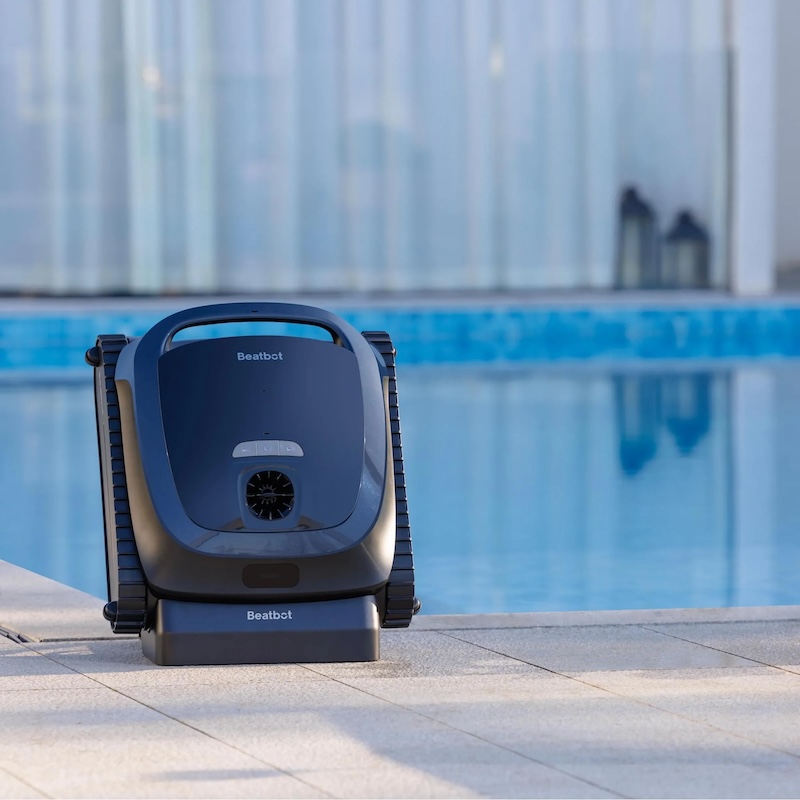
Pool cleaning robots are shifting from random movement patterns to AI-powered navigation systems that map pool geometry, sense obstacles in real time, and plan efficient paths. Beatbot AquaSense 2 Ultra exemplifies this approach, using AI Pool Mapping, Smart Navigation, and advanced sensing to handle complex pools with multiple levels, curved walls, steps, and waterlines. Traditional pool robots waste energy repeating the same routes and miss corners, slopes, and waterlines—forcing homeowners to do manual touch-ups. AI navigation reduces missed areas and repeated passes by helping the robot understand pool shape and adapt to changing conditions, making coverage more predictable and improving user trust in the system.
The category is moving toward treating pool robots as autonomous maintenance systems rather than standalone machines. However, AI navigation does not sanitize water or replace chemical testing, filtration, equipment repair, or professional diagnosis for algae, stains, and equipment faults—those remain the homeowner's responsibility.
- 2
Historical swordfighter building AI dataset to fix computer vision gaps
A HEMA (historical European martial arts) practitioner is creating a mini-dataset of synchronized multi-view video (at 120/240fps) to capture 100 clips of swordfighting movements—specifically the edge cases that challenge computer vision systems, such as fast blade motion (80mph), motion blur, and joints hidden by thick jackets. Swordfighting represents a difficult real-world scenario for embodied AI systems (AI that must understand physical movement). The rapid, non-linear weight shifts and sub-pixel blade resolution create the kind of tracking problems that researchers struggle with when trying to close the gap between simulated and real-world AI performance. A focused dataset could help identify and solve these specific bottlenecks.
The creator plans to structure the dataset with AI assistance to map the physics edge cases in swordfighting, aiming to make the schema useful for computer vision and robotics researchers tackling similar tracking and balance challenges.
- 3
NVIDIA robots achieve 99% success via self-improving AI loop
NVIDIA has developed ENPIRE, software that lets physical robots autonomously improve their own performance through a feedback loop similar to AI agents. The system includes automatic evaluation, reset, policy refinement, and code improvement modules. Coding agents using the framework achieved a 99% success rate on dexterous manipulation tasks such as organizing pins and cutting zip ties in the real world. The system minimizes human effort by automating evaluation and reset—tasks that historically required constant human supervision. This suggests a path toward robots that can self-improve without human intervention, which could reshape manufacturing and assembly work. However, the approach currently works best on simple, well-defined tasks where automatic evaluation and reset are feasible.
Performance varies by AI model—GPT-5.5 and Opus 4.7 trade advantages, while larger agent teams (e.g., 8 agents) find better solutions faster than single agents. Each workstation runs an NVIDIA RTX 5090. The main scaling challenge is that robot resources are underutilized when agents read logs or debug, so adding more robots does not naturally parallelize.
- 4
Tesla trade secret suit settled; robot hand startup Proception raises $11M
Jay Li, a former technical lead on Tesla's Optimus humanoid robot program, has settled a lawsuit Tesla filed against him last year for allegedly taking trade secrets. Li is now free to focus on his startup Proception, which announced Monday it has raised $11 million(約18億円) in seed funding led by First Round Capital, with contributions from Y Combinator and BoxGroup. The company is also shipping its first batch of high-dexterity robotic hands to researchers and robotics companies. Robotic hands remain one of the hardest unsolved engineering challenges in robotics. The consensus view is that making robotic hands equivalent to a human's is still many years away — a Northwestern University director estimated a decade until they are functional and useful. Proception's approach could accelerate progress by combining sensor-packed hardware with a scalable data-collection method using instrumented gloves, addressing what Li sees as a gap where most companies focus on hardware alone or use non-scalable data methods.
Proception's robotic hand has 22 degrees of freedom and multiple joints per finger. The company is now accepting wider orders beyond its initial batch to researchers and robotics companies. First Round's investment partner noted he expects Proception to have the most sophisticated hand available today, backed by underlying data and models that could make humanoid robots truly performant.
- 5
Elephant Robotics Launches Educational Robot Platforms for Americas Market
Elephant Robotics, a robotics hardware and software company, introduced three integrated educational and research robotics solutions designed for schools, universities, and research labs in the Americas, beginning in 2026. The offerings include a Compound Robot Logistics Solution combining a 6-DOF collaborative robotic arm and mobile platform, a Portable Artificial Intelligence Educational Workstation in a suitcase-style format with a 15-week curriculum, and advanced compound robot solutions for autonomous systems research. Schools and research institutions have historically struggled to deploy robotics education because they must integrate robotic arms, sensors, and software from multiple vendors—often spending weeks resolving compatibility issues before teaching can begin. Elephant Robotics' integrated, ready-to-deploy platforms with built-in curricula and one-click startup aim to eliminate these barriers, allowing educators to focus on hands-on learning rather than technical setup.
The Portable AI Educational Workstation includes 5 built-in vision algorithms and a structured 15-week curriculum covering machine vision, sensor integration, and collaborative robotics. The company also offers a broader range of robotic platforms—including the myPalletizer, myCobot Series, myArm series, and dual-arm myBuddy robot—to serve makers, educators, and developers from DIY projects through advanced research. More information is available at https://americas.elephantrobotics.com/.
- 6
Prompt injection tops AI security threat list for second year
Prompt injection has been identified as the most critical vulnerability in large language model (LLM) systems, ranking as LLM01 in OWASP's LLM Top 10 (2025) — the second consecutive edition where it holds the top spot. The vulnerability exploits LLMs' difficulty in separating instructions from data, making them susceptible to manipulation through crafted inputs. As businesses rapidly deploy LLMs for customer support, analytics, development, and internal automation, cybercriminals are increasingly exploiting the gap between what companies assume LLMs can do safely and what they actually can. Prompt injection attacks can target agents (AI systems that make autonomous decisions), retrieval-augmented generation pipelines (systems that pull data to inform AI responses), and model routers (systems that direct queries to different models) — core components of enterprise AI systems.
Independent sources including CrowdStrike's 2026 Global Threat Report have highlighted prompt injection as a persistent and impactful attack vector. Businesses relying on LLM-powered systems for critical workflows should recognize this remains the top LLM-specific security risk.
What to Watch
As pool robots evolve from simple cleaners into autonomous maintenance systems, watch for how manufacturers balance AI-driven navigation with the reality that homeowners still need to handle water chemistry, equipment repairs, and professional diagnostics. Meanwhile, advances in specialized robotics—from Proception's 22-degree-of-freedom hands to AI-assisted datasets mapping complex physical interactions like swordfighting—signal that the next wave of robot capability depends less on raw processing power and more on smarter data, better models, and safeguards against vulnerabilities like prompt injection in LLM-powered workflows.
Sources
- How AI Navigation is Improving the Performance of Robotic Pool Cleaners
- I do historical swordfighting and noticed AI struggles to track it. I’m building an open dataset to help fix this. Does my schema make sense? [P]
- Import AI 463: Self-improving robots; a 10k Chinese GPU cluster; and an elegiac essay for the human era
- Robot hand company settles Tesla trade secret suit and announces $11M raise
- Empowering STEM Education and Research in the Americas: Elephant Robotics Introduces Integrated Educational Robotics Solutions
- Prompt injection is exploiting enterprise AI's biggest design flaws by targeting agents, RAG pipelines and model routers
- Into the Lab for Industrial Scale Returns
- Micron Just Revealed a Massive Multi-Decade Growth Opportunity. It's Not AI Data Centers. It Might Be Even Bigger
- AGIBOT produces 15,000th robot, marking a milestone in embodied AI deployment
- Tesla Completes Key AI Chip Milestone in Its Push Beyond the Auto Industry
Share this with a friend
Send today's roundup to anyone who wants to keep up.
Get daily AI news free with AIToday
200+ AI sources, summarized in 1 minute. Email / LINE / Slack.
Sign up free