What happened
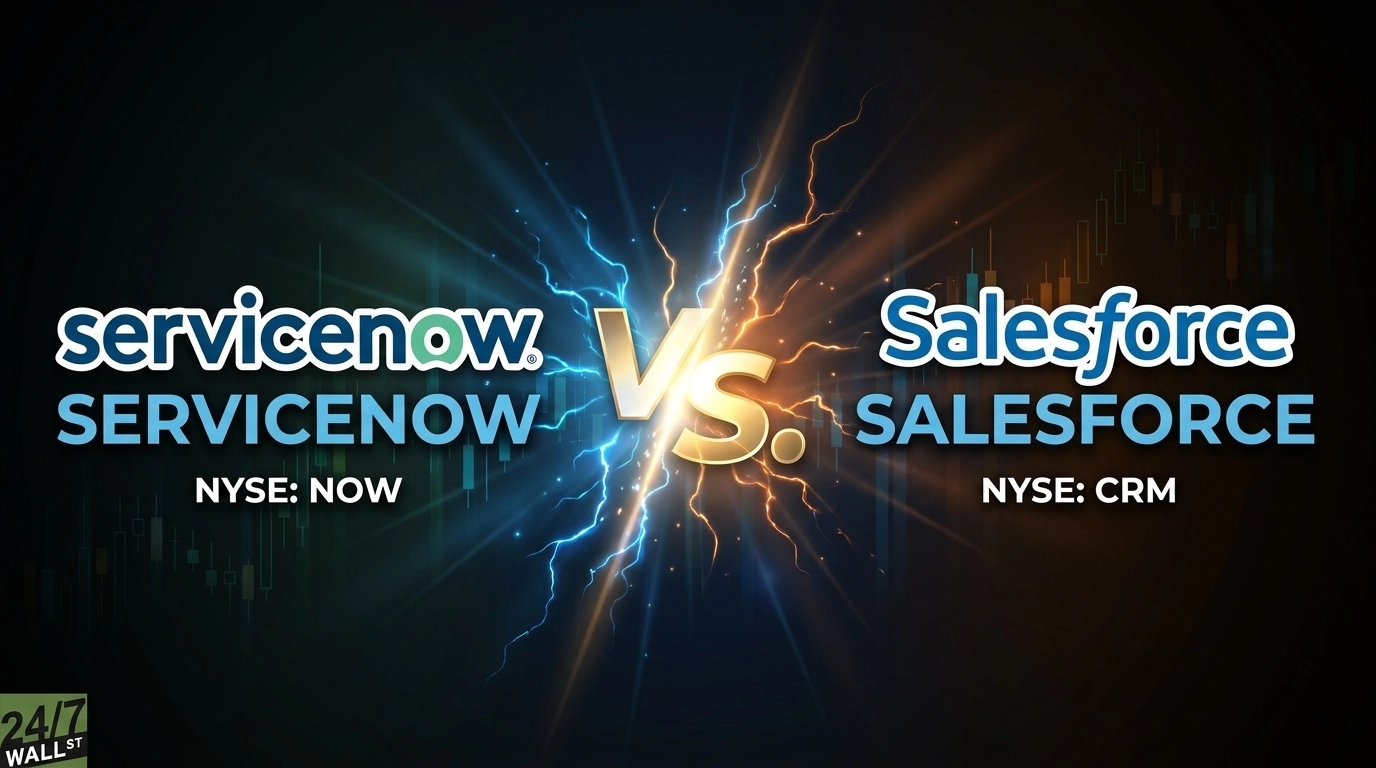
ServiceNow reported Q2 revenue of $3.99B, up 24% YoY, with AI ACV crossing $1 billion and agentic AI customers up 9x in nine months. Salesforce posted Q2 revenue of $11.35B, up 11% YoY, with Agentforce ARR over $1.5 billion and combined AI/data ARR near $4 billion.
Why it matters
The two are attacking enterprise AI from opposite ends: ServiceNow as a cross-platform 'system of action' (governed execution across workflows), Salesforce as a front-office 'system of record' (data moat monetized via agents). ServiceNow's 98% renewal rate and 50% non-seat-based new business suggest its pricing is ready for agentic consumption.
What to watch
ServiceNow raised FY26 subscription guidance to $15.76B-$15.78B; Salesforce guided FY27 revenue to $46.1B-$46.4B, trading at a lower P/E (19 vs 34) but growing half as fast. ClaudeForce becomes generally available in September 2026, and Salesforce's Agentforce AWU growth (97% QoQ) will be tested after Contentful and Fin integration.
Summaries like this, in your inbox every morning.
The article frames the battle for agentic enterprise as a contest between two architectures. ServiceNow positions as a 'system of action' — governing execution across any workflow, model, or cloud — with its AI Control Tower live for over 500 customers. Its partnership with NVIDIA on Project Arc underscores depth in autonomous desktop agents. Salesforce, by contrast, defends its 'system of record' position, leveraging its data moat and the Anthropic tie-up to push data into Claude, Slack, Teams, and ChatGPT. While both benefit from AI tailwinds, the key differentiator appears to be pricing model readiness for agentic consumption. ServiceNow's 50% of new business not being seat-based suggests it can scale with usage, while Salesforce's higher-multiple growth may hinge on Agentforce's continuation. The author's lean toward ServiceNow reflects a belief that when agentic consumption scales, the platform that executes (rather than just advises) will capture more value. However, he flags risks like margin compression and a federal on-prem pull-forward muddying near-term optics. For investors, the choice may come down to growth (ServiceNow) versus value (Salesforce's cheaper multiple and buyback).
Pick your industry and the AI tools you use, and get news related to your work every day.
Free · 30 seconds with Google · unsubscribe anytimeWhat is AIToday? →
Ask AI anything about this article. The AI reads this article, earlier AIToday articles, and Wikipedia, and cites its sources. Q&As are published on this page for other readers too.
Supermicro Computer appointed Mark Long as chief financial officer, bringing an experienced technology finance…

Holtek Semiconductor unveiled its 2026 product roadmap on October 15, focusing on four core areas: smart prote…

TSMC reported about NT$763.1b in Q3 net profit and confirmed that demand for advanced processors is running ah…

Nvidia-backed CoreWeave steadied Thursday after a sharp slump, as investors worried about the debt financing b…
Circlia started a proof-of-concept for TASTE SIGNAL: visitors to Holland Village Cafe FUKUOKA taste cookies an…

Weathernews said on October 15 it implemented its own AI weather-forecasting model, AI-Nowcast, in its Weather…