AIToday

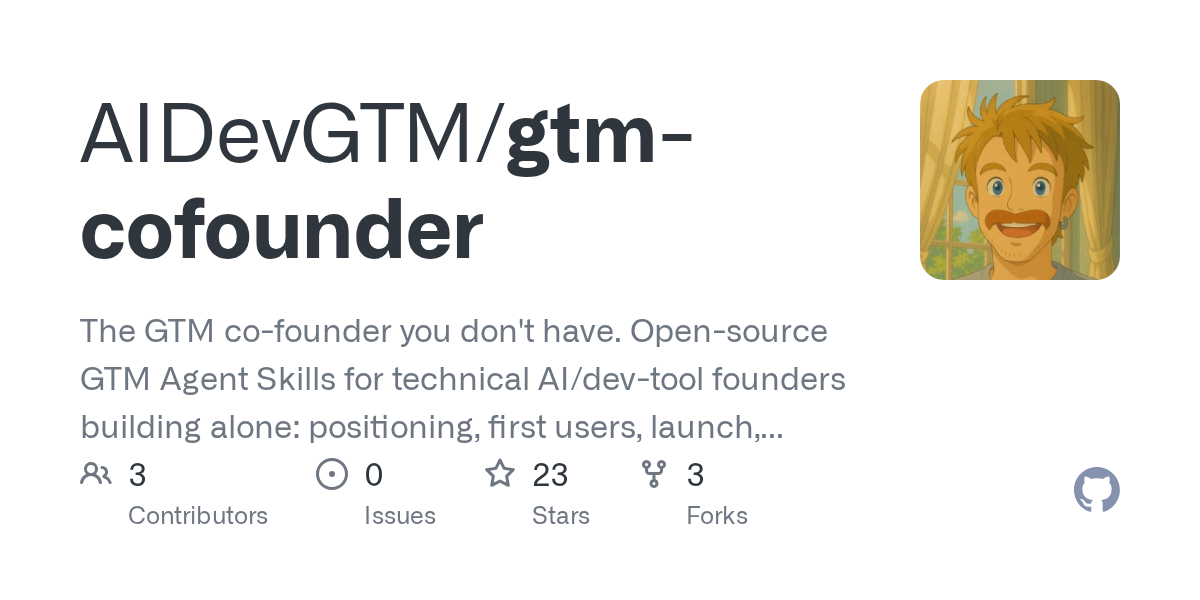
Open-source GTM playbook for solo tech founders launches

Hacker News1h agoSend on LINE
Open-source GTM playbook for solo tech founders launches

Key takeaway

A solo founder without funding or co-founder now has access to free, open-source go-to-market frameworks built into an AI coding agent they already use. The playbook covers positioning, pricing, landing first users, and telling a founder's story—the strategy half of GTM that keeps technical founders up at night. It draws on years of developer-tool selling and has been tested by early-stage founders; it is available immediately on GitHub under an MIT license.

Summaries like this, in your inbox every morning.

Sign up free →

3 Key Points

  • What happened

    Shane O'Connor released a free, open-source set of go-to-market (GTM) skills—markdown playbooks and decision frameworks—designed for solo technical founders building developer tools or AI products without funding or a commercial co-founder. The skills work with Claude Code, Cursor, Codex, Windsurf, Antigravity, and any agent supporting the Agent Skills spec, and can be used in three ways: pasted directly into ChatGPT or Claude, handed to an agent as a folder, or installed as auto-triggering skills. The pack draws on years of selling and advising developer tools, sharpened by work from Adam Frankl and Jakub Czakon, and tested by founders including Lubos (hey/api) and Thibault and Max (OpenStatus).

  • Why it matters

    Solo founders often freeze on go-to-market strategy—positioning, pricing, landing first users, and telling their story—because their strength is engineering, not sales or marketing. This pack fills that gap by replacing generic advice with stage-aware frameworks grounded in real numbers and concrete next steps, rather than theory or tactics. It separates validated learning from assumptions and feeds unproven guesses back into user research, so the strategy gets truer over time instead of locked into an early guess. For founders with no team and no outside money, having a GTM co-founder in an agent they already use removes the isolation and the 2am doubt that keeps so many solo builders stuck.

  • What to watch

    The pack is MIT-licensed, free, and open to contribution; O'Connor also offers paid human advisory through The DevTool GTM Company (pre-funding, very early stage) and QC Growth (seed through Series B, including a16z and Sequoia-backed companies) for founders who need a person in the trenches once frameworks alone are not enough. The core path starts with a 15-minute intake questionnaire that builds a founder brief, then a prioritized roadmap sequencing the skills (positioning, first users, launch, pricing), so founders have a single hub to return to each session instead of a dead chat.

In Depth

Shane O'Connor released an open-source GTM toolkit designed specifically for solo technical founders building developer tools or AI products without external funding or a commercial co-founder. The toolkit is a collection of markdown playbooks called "skills" that live inside AI coding agents—Claude Code, Cursor, Codex, Windsurf, Antigravity, or any agent supporting the Agent Skills spec. Rather than a course or theory-heavy guide, each skill is a framework with concrete thresholds, decision trees, real examples, and a 30-minute checklist, written in a founder's language and allergic to fluff.

The work comes in three usage paths. Path 1 takes 30 seconds: copy a skill's text and paste it into ChatGPT or Claude with a one-line product description. Path 2 takes 2 minutes: hand the agent the repository folder and give it a single prompt to run the intake interview and build a roadmap. Path 3 requires a few CLI commands but then skills auto-trigger based on context—the agent knows when you need positioning help versus pricing help versus first-user strategy. The core sequence starts with "00-start-here," where the founder answers five questions in about 15 minutes. The agent then writes a founder brief (docs/gtm-cofounder/founder-brief.md) capturing the product, the intended buyer, the main problem it solves, and the founder's constraints and assumptions. Next, "01-strategy-and-roadmap" turns that brief into a diagnosis and a prioritized plan (docs/gtm-cofounder/gtm-roadmap.md), broken into Now (what to work on immediately), Next (what comes after), and Later (what to park). This roadmap becomes the hub the founder returns to each session, replacing the empty-chat problem of staring at a dead conversation wondering what to do next.

The toolkit is organized into four topic clusters. Cluster 1, "Figure out who it's for," includes "who-is-this-for" (sharpening a vague ICP like "developers" into a real segment) and "talk-to-users" (learning to interview users who are not already friends). Cluster 2, "Say it so it lands," covers positioning, storytelling, value propositions that developers actually respond to, and landing-page copy written for developers, not buyers. It also includes a skill called "beyond-the-wrapper" for AI products, addressing the claim that an AI tool is "just a wrapper" and indistinguishable from competitors when the underlying model is a commodity. Cluster 3, "Get your first users," tackles time-to-first-value (why users sign up but never get the product working), first-50-users (moving beyond a single tweet), launching publicly without fear, selling to buyers while marketing to developers, pricing strategy, and founder-led sales. Cluster 4, "Keep it going," covers founder-led content for founders who hate marketing, metrics that actually predict GTM success rather than vanity numbers, and market scanning to stay ahead of new competitors.

Each skill is self-contained—one folder, one SKILL.md file, zero dependencies—so a founder can copy the skills folder into their agent's skills directory regardless of which agent they use. The frameworks inside come from three sources. The spine is O'Connor's own experience as an enterprise and founding account executive, and years advising early-stage dev-tool founders through the exact GTM fights these skills cover. The frameworks are sharpened by work from Adam Frankl (author of The Developer-Facing Startup, covering TAB customer discovery, the Hero/Villain/Wise-Advisor story structure, the DREAM funnel, and net developer retention) and Jakub Czakon (markepear.dev, covering homepage anatomy, developer psychology, and channel playbooks for HN, Reddit, and X). The pack was pressure-tested by three design-partner founders: Lubos, founder of hey/api; Thibault and Max, cofounders of OpenStatus; and others. O'Connor credits each source explicitly and takes responsibility for anything that does not hold up in practice.

The toolkit is released under an MIT license, free to use, fork, and distribute. O'Connor also maintains two paid advisory services for founders who want a human in the trenches. The DevTool GTM Company is his own firm, working with founders at the very early stage, often pre-funding, on strategy and positioning. QC Growth, where he also works, serves more established teams from seed through Series B, including a16z and Sequoia-backed companies, and covers strategy, execution, GTM engineering, and operations. Both options are positioned as extensions of the free skills: if the playbooks are helping, the human version brings someone who has seen the same fight across dozens of dev-tool companies and can tell the founder it will be okay and what to do next.

Context & Analysis

Solo technical founders often build something excellent but freeze on go-to-market because the sales, positioning, and business strategy half of the job is foreign to them. The problem is not just a lack of knowledge—it is isolation. There is no co-founder in the room at 2am to think through who the product is for, why anyone would pay, or why the launch got no traction. O'Connor's pack addresses this by embedding go-to-market frameworks directly into coding agents (Claude Code, Cursor, and others) that founders already live in. Instead of asking a founder to take a course or read theory, the agent asks five core questions, builds a founder brief, and then sequences the work one move at a time—positioning, then first users, then launch, then pricing—with decision trees and real numbers, not principles. The frames are drawn from Frankl's and Czakon's published work on developer-tool GTM, then sharpened by actual founders who used them in the field. This approach separates what a founder has validated with real users from what they are still assuming, and feeds the unproven guesses back to a "talk to users" skill, so the brief stays accurate instead of ossifying an early guess. O'Connor also offers paid advisory for founders who need a human instead of or alongside the skills—The DevTool GTM Company for very early, often pre-funding founders, and QC Growth for seed through Series B teams.

FAQ

How long does it take to set up?
Path 1 (zero setup) takes 30 seconds: open a skill, copy the text, and paste it into ChatGPT or Claude. Path 2 (hand your agent the folder) takes 2 minutes. Path 3 (install as real skills) takes a few commands but then skills auto-trigger when relevant.
What does the GTM co-founder do in the first session?
Answer about 15 questions once, and the agent builds a prioritized GTM roadmap, then works it with you one move at a time: positioning, first users, launch, and pricing in the order that matters for your stage. The roadmap is written to docs/gtm-cofounder/gtm-roadmap.md and serves as the hub you come back to each session.
What founder tools or companies does this draw from?
The pack is sharpened by work from Adam Frankl (author of The Developer-Facing Startup) and Jakub Czakon (markepear.dev), and was pressure-tested by founders including Lubos (hey/api) and Thibault and Max (OpenStatus).

Get the latest Open-Source AI news every morning

AI-summarized, only the topics you pick — one digest a day via Email, Slack, or Discord.

Free · takes 30 seconds · unsubscribe anytime

Discussion

No comments yet. Be the first to share your thoughts!

Log in to join the discussion

Related Articles

Stay ahead with AI news

Get curated AI news from 200+ sources delivered daily to your inbox. Free to use.

Get Started Free

Free · takes 30 seconds · unsubscribe anytime