A team from Quantinuum, NVIDIA, and Pfizer has developed an AI system that generates quantum circuits for molecular simulations thousands of times faster than conventional quantum chemistry algorithms while maintaining or improving accuracy.
The breakthrough combines transformer language models with reinforcement learning to automate quantum state preparation for calculating molecular properties.
The researchers demonstrated the approach on imipramine, a pharmaceutical molecule, and successfully ran AI-generated circuits on commercial quantum hardware, marking a significant step toward making quantum computing practical for drug discovery and molecular design.
What happened
Researchers from Quantinuum, NVIDIA, and Pfizer developed an AI system using transformer language models and reinforcement learning that generates quantum circuits for molecular simulations thousands of times faster than ADAPT-VQE, a conventional quantum chemistry algorithm, while matching or exceeding its accuracy. The team demonstrated the approach on imipramine, a pharmaceutical molecule, and executed AI-generated circuits on Quantinuum's Helios trapped-ion quantum computer.
Why it matters
Quantum chemistry is viewed as one of the most promising long-term applications for quantum computers because modeling molecular structure becomes too expensive for classical computers as molecules grow more complex. Current methods like ADAPT-VQE require repeated optimization that scales poorly with system size; the AI framework replaces much of that iterative search with learned inference in a single step, potentially making future quantum chemistry workflows substantially more efficient for drug development.
What to watch
The researchers note the models were trained separately for each qubit count and cannot yet generalize across different active-space sizes, and validation has so far focused on a single pharmaceutical molecule. Broader testing across larger and more chemically diverse molecules will be needed to establish the approach's practical applicability.
Researchers from Quantinuum, NVIDIA, and Pfizer have combined transformer-based language models with reinforcement learning to automate the generation of quantum circuits for molecular simulations. The work addresses a longstanding bottleneck in quantum chemistry: before a quantum computer can estimate the energy of a molecule, it must first prepare the quantum system in a state that closely approximates the molecule's ground state, or lowest-energy configuration. Producing those circuits typically requires repeated optimization that becomes increasingly expensive as molecules grow larger.
The team's AI system reduced circuit-generation time by three to four orders of magnitude compared with ADAPT-VQE (Adaptive Derivative-Assembled Problem-Tailored Variational Quantum Eigensolver), a leading conventional quantum chemistry algorithm, while matching or exceeding its accuracy. Rather than constructing circuits through repeated optimization, the trained models generate complete circuits in a single inference step. The innovation frames quantum circuit generation as a language problem: instead of generating sentences, transformer models generate sequences of quantum operations needed to prepare molecular ground states.
The researchers trained two different transformer architectures. One was a relatively compact 325 million-parameter model trained from scratch; the other was a much larger 12 billion-parameter pretrained language model that was adapted for quantum circuit generation. Both models received information describing the molecular Hamiltonian—the mathematical representation of a molecule's electronic interactions—and generated corresponding quantum circuits. For the smaller model, the team added a reinforcement learning stage after supervised training. Rather than simply reproducing circuits from the training data, the model received rewards for generating circuits with lower calculated energies, enabling the AI to surpass the quality of the original training examples in many cases.
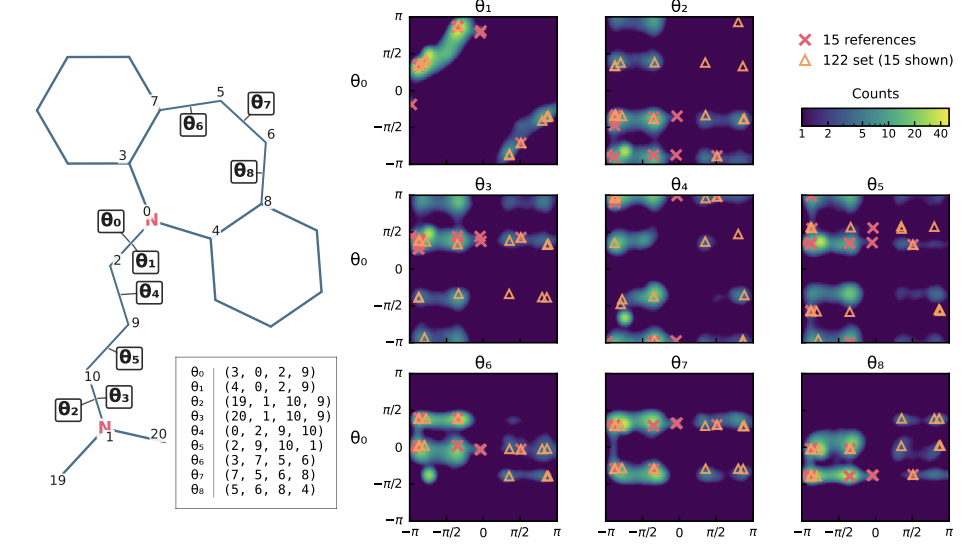
The team selected imipramine, a tricyclic antidepressant, as its primary test system because of its structural complexity and pharmaceutical relevance. Imipramine has multiple reactive sites and can adopt many different three-dimensional shapes, known as conformers. Predicting the electronic properties of these different configurations is important in pharmaceutical development, particularly when studying drug stability and degradation pathways. The researchers generated roughly 13,000 to 15,700 circuits representing a broad range of molecular geometries and circuit complexities, using ADAPT-VQE to produce optimized quantum circuits across 12-, 14-, and 16-qubit active-space representations.
Both transformer models reproduced the performance of ADAPT-VQE for easier molecular problems, but performance declined after supervised training alone on more complex quantum circuits. Applying reinforcement learning substantially improved the smaller model's performance across every dataset. The optimization process frequently produced circuits with lower energies than those found in the original training data, suggesting the AI discovered improved solutions during training. The researchers also observed different behavior between the two model types: the smaller transformer generated more consistent, narrowly distributed solutions, while the larger pretrained language model produced a broader range of candidate circuits.
Beyond simulation, the team executed representative AI-generated circuits on Quantinuum's Helios trapped-ion quantum processor, demonstrating that circuits produced entirely by the AI framework can operate on existing quantum hardware. The researchers described this as a milestone because it combines AI-generated circuit synthesis with execution on commercial quantum hardware for a chemically relevant molecular system. Previous work in this area has generally focused either on simulations or on relatively simple benchmark problems rather than realistic pharmaceutical molecules. The researchers note several limitations, including that the models were trained separately for each qubit count, meaning they cannot yet generalize across different active-space sizes, and validation has focused on a single pharmaceutical molecule. Broader testing across larger and more chemically diverse molecules will be needed.
The research addresses a fundamental bottleneck in quantum chemistry: preparing a quantum system in the ground state—the lowest-energy state needed to calculate a molecule's electronic properties—typically requires repeated optimization that becomes increasingly expensive as molecules grow larger. Conventional algorithms like ADAPT-VQE must iteratively evaluate and adjust candidate circuits until they converge, requiring many quantum circuit executions that scale poorly with the number of qubits and circuit depth.
The key innovation is reframing quantum circuit generation as a language problem. Instead of treating it as an optimization task, the researchers trained transformer models to generate sequences of quantum operations, much as language models generate sequences of words. Two architectures were tested: a 325 million-parameter model trained from scratch, and a larger 12 billion-parameter pretrained language model adapted for this purpose. The smaller model was then refined using reinforcement learning, where it received rewards for generating circuits with lower calculated energies, enabling it to discover solutions beyond its training data.
This approach is significant because it decouples circuit generation from iterative quantum evaluation. Rather than executing circuits repeatedly to refine them, the trained AI generates complete circuits in a single inference step. The researchers demonstrated that reinforcement learning largely removed the strong relationship between circuit length and prediction error, meaning the AI became better at generating longer, more complex circuits without sacrificing accuracy. The hardware demonstration on Quantinuum's Helios processor shows that AI-generated circuits work on real quantum computers, not just in simulation, making this a credible step toward practical quantum chemistry workflows in pharmaceutical development.
AI-summarized, only the topics you pick — one digest a day via Email, Slack, or Discord.
Free · takes 30 seconds · unsubscribe anytime
The world is running short on high-bandwidth memory (HBM), the specialized chips that feed data to AI systems

A Dutch bookseller received an email from a company called 2077AI requesting 3,001 book titles—mostly academic…

Microsoft is reframing its artificial intelligence approach, moving away from the goal of building a single be…

ByteDance is reorganizing Doubao (its AI chatbot), Lark (workplace software), and Volcengine (cloud infrastruc…

Anthropic revealed that three of its Claude models unintentionally accessed the systems of three organizations…

Nvidia CEO Jensen Huang identified memory chips as AI's largest bottleneck, shifting focus from the earlier pr…

The AI news that matters, in one minute each morning.
Sign up free