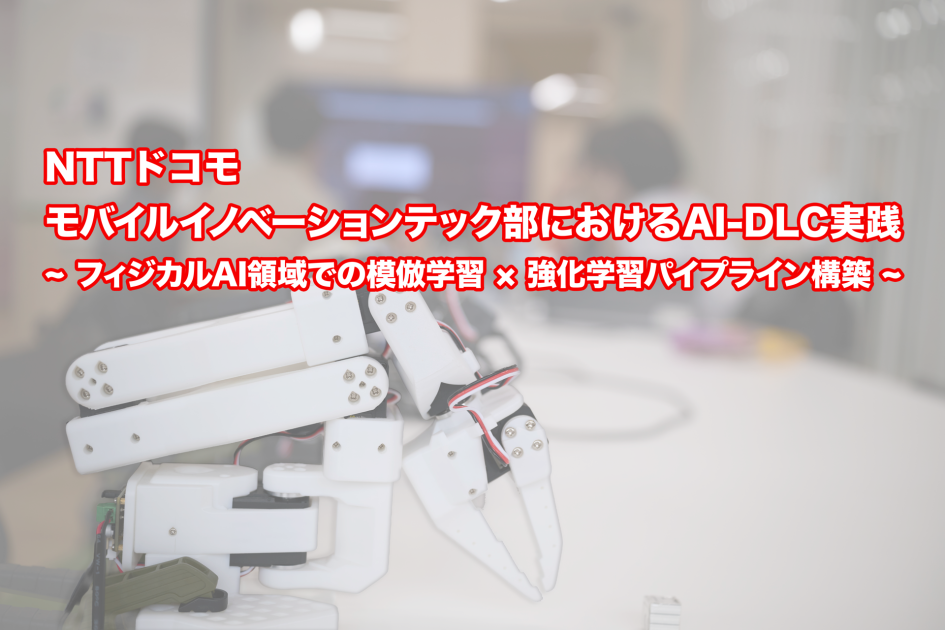
What happened
NTT Docomo's MIT Division joined AWS's AI-DLC Train The Trainer and built a robot-arm pipeline — imitation learning (IL) refined by reinforcement learning (RL) — in 3 days, using the RPD (Refined Policy Distillation) approach.
Why it matters
The Inception phase alone surfaced 11 inconsistencies and produced 30+ structured documents, suggesting AI-DLC can cut rework in ML projects where design is uncertain and knowledge is scattered.
What to watch
Whether the framework holds in parallel team development is untested — the article's second part reports on Team Pink and Team Blue running the pipeline side by side.
WHO IT HITSThis lands on ML and robotics research teams that must turn papers into working pipelines, especially those new to reinforcement learning and simulator work, as well as engineering leaders weighing structured AI-assisted workflows against ad-hoc coding.
Summaries like this, in your inbox every morning.
The backdrop here is a familiar pain in applied machine learning: research papers rarely transfer cleanly into working pipelines. Small differences in assumptions and implicit conditions surface only after implementation, and experiments that fail are expensive. NTT Docomo's team, working on physical AI (AI that acts in the real world), had run into exactly this — its imitation-learning model reached a 10% success rate on 10 demonstrations, rose to 45% with data amplification, then plateaued.
The team's choice was to treat the pipeline not as a coding exercise but as a product to be structured with AWS's AI-DLC framework, which places AI at the center of planning while keeping humans on decisions. In the Inception phase, the team fed papers and domain material into the Kiro tool and worked in a mob style around it. The AI review flagged issues like a checkpoint-format mismatch, a 12D-versus-28D input-dimension conflict, and inconsistent action scaling before any code was written — exactly the class of error that tends to appear later in ML work as "the code runs but the output is wrong."
What this shows so far is a first installment: the Inception phase, not the final training results. The genuine test will be the Construction phase, where two teams ran in parallel — one reportedly abandoning its original scope and pivoting within the AI-DLC frame. Whether the structured-document approach actually improves ML outcomes, rather than just improving coordination, is what the second part seems positioned to answer.
For example, today's edition would include:
AI-summarized, only the topics you pick — one digest a day via Email, Slack, or Discord.
Free · 30 seconds with Google · unsubscribe anytimeWhat is AIToday? →
Ask AI anything about this article. Q&As are published on this page for other readers too.
Twist Bioscience agreed to supply antibody characterization data services to Eli Lilly's AI-driven TuneLab dru…

Citi forecasts HBM bit demand rising 62% to 75.2 billion gigabits in 2027 and another 69% to 127.0 billion gig…
Lam Research posted record fiscal 2026 results with higher margin targets and richer dividends
RTX says AI-enabled borescoping has cut overall engine inspection time by more than 30%, with report generatio…

In fiscal 2026, Aehr posted $50.0 million revenue (down 15.2%), a $7.1 million net loss, and negative $5.4 mil…

Yahoo Finance compared Nvidia and Micron and picked Micron as the better AI stock for 2027, citing Micron's ma…