What happened
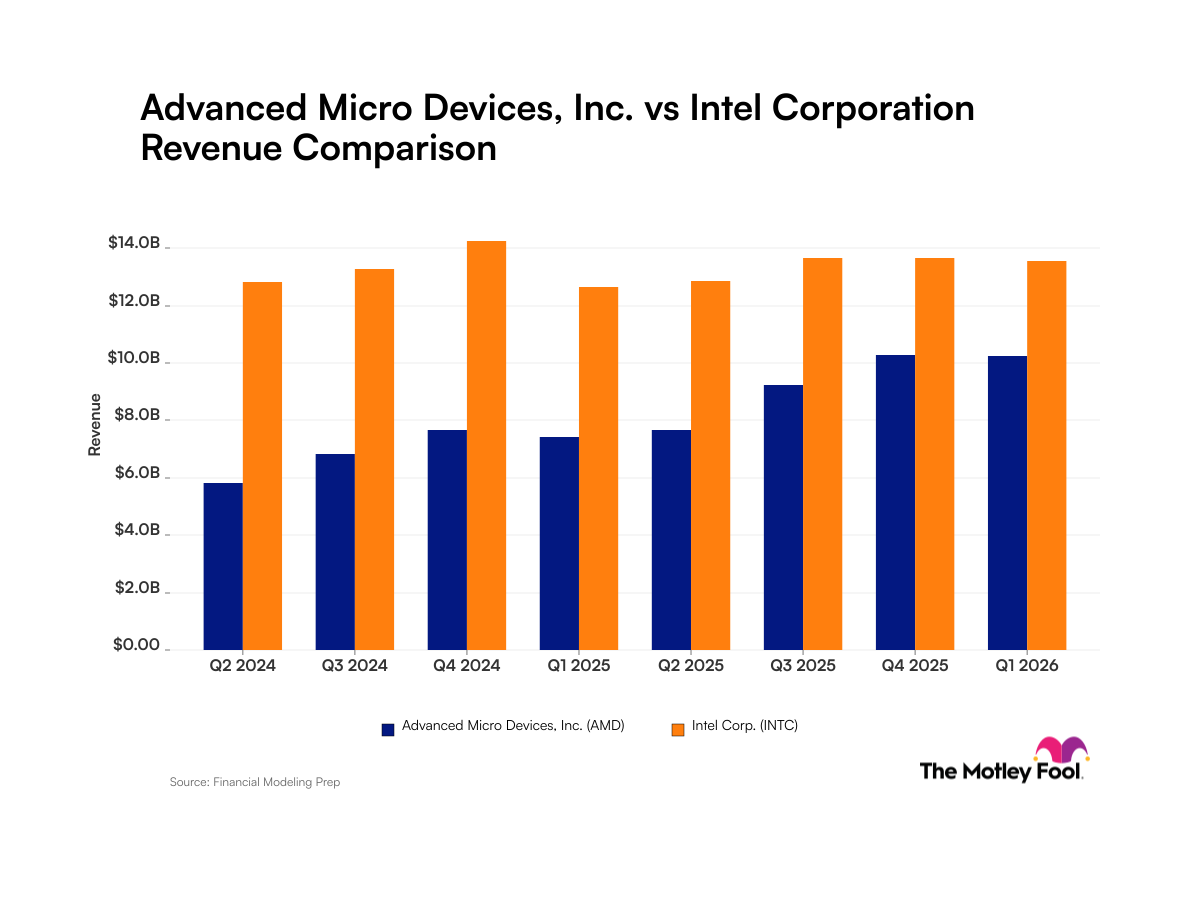
AMD reported $10.3 billion(約1.6兆円) in revenue for Q1 2026 (quarter ended March 28, 2026), matching Intel's $13.6 billion(約2.2兆円) in the same quarter. AMD has grown steadily from $5.8 billion(約9300億円) in Q2 2024 to $10.3 billion(約1.6兆円) by Q1 2026, while Intel's revenue has remained relatively flat over the same period. Intel, under new CEO Lip-Bu Tan, reported a 7% year-over-year revenue increase for Q1 2026 and expects Q2 2026 sales between $13.8 billion(約2.2兆円) and $14.8 billion(約2.4兆円).
Why it matters
AMD has reversed its historical position as a graphics specialist to become a serious competitor in AI semiconductors, a shift that began when GPUs became essential to artificial intelligence. Intel missed early GPU opportunities, which the body suggests explains AMD's ascent. AMD reported a 14% net income margin for Q1 2026, while Intel reported a -28% margin for the same period, indicating AMD is far more profitable despite lower absolute revenue. Wall Street reflects this shift: AMD's stock trades above $500 per share while Intel has dropped below $100 as of July 20.
What to watch
Intel's turnaround strategy under CEO Lip-Bu Tan includes a $5.7 billion(約9100億円) capital investment to expand its Ireland manufacturing campus and new foundry partnerships, including a multi-year collaboration with Alphabet. AMD announced an expanded partnership with Microsoft on July 20. Intel's guidance for Q2 2026 (between $13.8 billion(約2.2兆円) and $14.8 billion(約2.4兆円)) and its execution on foundry deals will signal whether the company can stabilize its position against AMD's momentum.
Summaries like this, in your inbox every morning.
AMD and Intel's diverging fortunes reflect a fundamental shift in semiconductor demand driven by artificial intelligence adoption. AMD's steady revenue growth from $5.8 billion(約9300億円) to $10.3 billion(約1.6兆円) over roughly two years mirrors the market's shift toward GPUs, which became essential infrastructure for AI systems. The body notes that AMD, historically known for consumer graphics processors, capitalized on this transition, while Intel's focus on traditional central processing units and its late entry into the GPU market cost it dearly. The profitability gap is stark: AMD's 14% net income margin versus Intel's -28% margin for Q1 2026 shows that AMD is not just catching up on volume but also converting that volume into shareholder value far more efficiently. Intel's new CEO Lip-Bu Tan is attempting to engineer a comeback through manufacturing expansion and foundry partnerships—notably a multi-year collaboration with Alphabet—and the company is signaling confidence through a 7% year-over-year revenue increase and guidance for Q2 2026 between $13.8 billion(約2.2兆円) and $14.8 billion(約2.4兆円). However, the stock market's verdict is unambiguous: AMD trades above $500 per share as of July 20 while Intel has fallen below $100, reflecting Wall Street's assessment that AMD's AI momentum is more durable than Intel's turnaround promise.
For example, today's edition would include:
AI-summarized, only the topics you pick — one digest a day via Email, LINE, or Slack.
Free · 30 seconds with Google · unsubscribe anytimeWhat is AIToday? →
Ask AI anything about this article. Q&As are published on this page for other readers too.
Identity Digital spun out Known Systems AI Inc., based on its Innovation Labs unit and DNSid, a 'birth certifi…

Qualcomm and MediaTek announced on the same day that they are entering the Googlebook supply chain, as preorde…
Brahma AI raised $150 million through preferred shares, with $100 million from Multiples Alternate Asset Manag…

Singapore's electronics exports rose 132% from a year ago in August, with personal computer shipments up 238%…

A Bloomberg gauge of 30 Chinese technology stocks with the biggest overseas revenue exposure returned 36% this…
Anthropic released Claude Opus 5.5 today and cut its price 20%, with input at $4 per million tokens and output…