An essay on artificial intelligence argues that while AI agents can produce output at stunning speed—one developer reportedly achieves 50 to 100 code changes weekly using parallel AI sessions—this velocity exposes a deeper problem: human brains cannot absorb and truly understand information at that pace. The author contends that meaningful knowledge requires deliberate cognitive friction—time for reflection, repetition, and mental struggle—and proposes three methods to reclaim that slowness: the Zettelkasten note system, Sanskrit linguistic training, and ancient contemplative practices of hearing, reflection, and meditation.
Summaries like this, in your inbox every morning.
Sign up free →What happened
An essay argues that while AI agents can generate code and output at extreme speed—one Claude Code creator reportedly produces 50 to 100 code changes a week by running parallel sessions—this velocity creates a mismatch with human cognition. The brain cannot keep pace with the latest hardware, raising a fundamental question about whether humans can meaningfully understand what AI systems are actually doing.
Why it matters
The piece contends that automating routine work (like writing unit tests) is valuable, but automating deep thinking poses a risk. Using AI to bypass hard mental effort prevents the kind of concentrated struggle needed to create something meaningful. Knowledge only transforms into lasting value when given time to absorb and process—skipping that gap means ideas slip away into what the essay calls "the purgatory of forgotten neurons."
What to watch
The essay proposes three concrete methods to rebuild cognitive friction: the Zettelkasten note-taking system (which requires rephrasing ideas in your own words and connecting them to previous notes), linguistic training through Sanskrit and classical poetry (where rigid meter forces readers to decode meaning across multiple lines), and the three-step contemplative process from the Brihadaranyaka Upanishad—hearing (Sravanam), reflection (Mananam), and meditation (Nididhyasanam).
A recent essay titled "The Architecture of Deep Thought: Fight AI Speed with Cognitive Friction" examines the tension between the explosive productivity of modern AI agents and the limited capacity of human cognition to process their output. The author opens with a striking example: the creator of Claude Code—a tool that allows AI to write and modify code autonomously—runs multiple AI sessions in parallel and only steps in when human approval is required. This workflow produces 50 to 100 code changes a week, an extraordinary volume. Rather than laboriously prompting the AI, the developer writes high-level master plans, lets the agents handle the execution, and asks them to notify him only when human input becomes necessary.
However, the author contends that raw velocity masks a more fundamental problem: cognitive overload. AI chips can operate at speeds human brains have not evolved to match. The central claim is that we face a "mismatch" between machine speed and human cognition. The essay distinguishes between two uses of AI: automating tedious work (like generating hundreds of unit tests) and automating deep thinking. The former is legitimate; the latter is dangerous because it allows people to avoid the concentrated mental struggle necessary to produce something genuinely meaningful.
To illustrate why this matters, the author references Hamlet's Blackberry, a book that contains an anecdote about a man driving to his mother's house. Realizing he will be late, he calls her. After the call ends, he drives the rest of the way in silence, absorbed in memories of their relationship. The key insight: a practical task (the phone call) was followed by a gap—an empty space. Because that gap existed, deeper reflection was able to occur. If he had immediately switched to another app or task, the reflection would have vanished. The author argues that every form of knowledge behaves the same way: information only transforms into deeper, long-lasting value when given time to settle.
The essay then turns to a personal problem: retention. The author reads books one at a time, and the ideas stay with him for a few weeks, but once he moves to the next book and the next, the concepts of the first fade into what he calls "the purgatory of forgotten neurons." Even taking notes does not solve this, because most people never return to their notes. To counter this tendency, he proposes three interconnected approaches to build deliberate cognitive friction.
The first is the Zettelkasten method, a note-taking system designed for long-term knowledge retention. It works by forcing repetition and frequent access to memory. The process has several steps: read the text, take initial notes, then—crucially—rewrite those notes entirely in your own words. Simply highlighting on Kindle and copying material over is a purely mechanical process that does not engage the mind. Rephrasing forces active thought. Finally, connect the new note with previous notes. By forcing these associations, the neural network becomes stronger, and the likelihood of forgetting diminishes. The entire progression slows you down, creating the exact gap needed to truly experience and integrate knowledge.
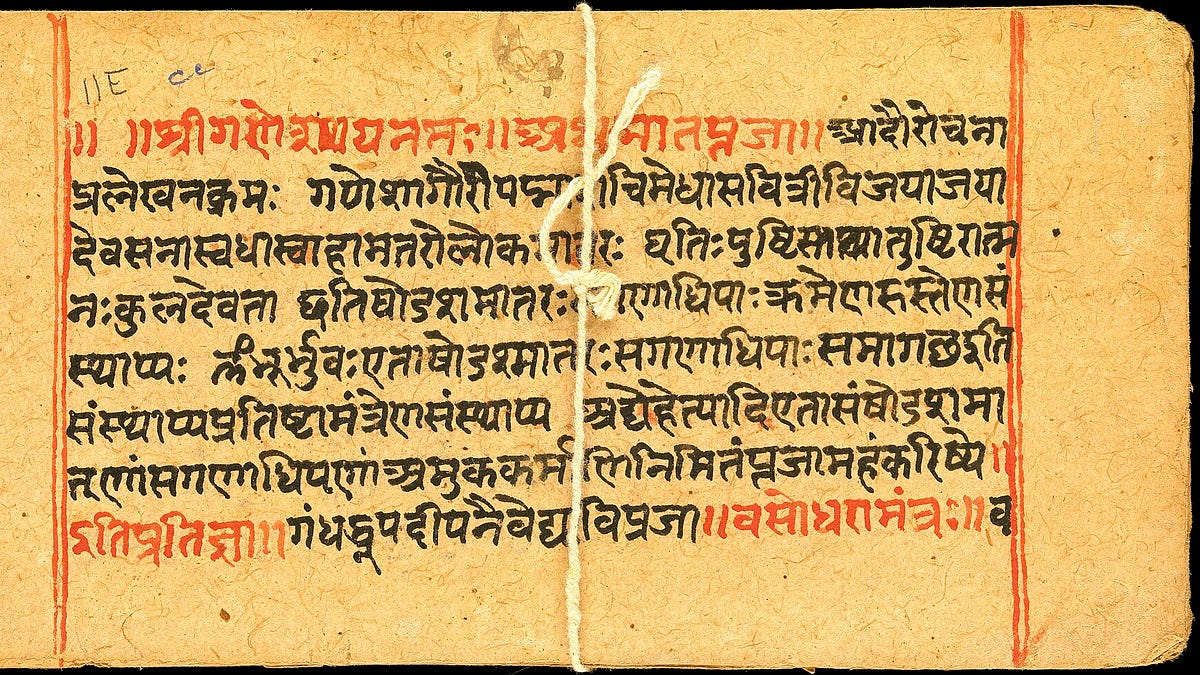
The second approach draws on linguistics and cognitive training through Sanskrit and classical poetry. The essay references a recent video by Swami Chidananda Puri, who discussed how to improve children's concentration in an age of constant cell-phone connectivity. According to Swamiji, learning Sanskrit builds the power to break concepts down and understand their true meaning, moving beyond blind acceptance of surface-level claims. Technical Sanskrit concepts like Dhatu (verbal roots), Upasarga (prefixes), and Sandhi (word compounding) require learners to split language apart to find truth. Classical poetry introduces an even more rigorous exercise. Prose follows predictable word order and conveys meaning immediately. In Sanskrit poetry, however, the verb might appear in the first line and the noun in the fourth, because the poet arranged them to fit rigid meter. A reader often must process the entire verse just to understand the opening line. This decoding process—called finding the Anvaya, or natural word order—requires investment of time. That specific speed bump is what enables deep understanding of the verse.
The final approach rests on ancient spiritual philosophy, specifically the Brihadaranyaka Upanishad. In this text, Yajnavalkya instructs Maitreyi on the exact steps to realize Brahman, the Self: it must be heard of (Sravanam), reflected on (Mananam), and meditated upon (Nididhyasanam). To truly comprehend anything of substance, the essay argues, you cannot outsource your thinking to hyper-speed external agents. You must intentionally slow down, resist the urge for instant output, and give your brain space to absorb, process, and relate information to existing knowledge. Both reflection (mananam) and meditation (nididhyasanam) are essential to deep understanding. The essay concludes that true intellect is not measured by how fast we generate answers, but by our willingness to sit with the slow friction of thought.
The essay identifies a contemporary paradox: artificial intelligence can execute tasks at speeds that far exceed human cognitive capacity, yet this capability creates a gap between what machines can do and what humans can meaningfully comprehend. The creator of Claude Code exemplifies this mismatch—by orchestrating parallel AI sessions and asking them to request human intervention only when necessary, he achieves productivity (50 to 100 code changes weekly) that would be impossible to oversee directly. The author argues this is not a problem of tools being too fast, but of humans losing the cognitive space required to transform information into knowledge.
The essay draws a distinction between automating drudgery (repetitive unit tests, boilerplate code) and automating thinking itself. The former frees humans for deeper work; the latter risks allowing people to outsource the mental struggle that produces genuine understanding. A key insight comes from Hamlet's Blackberry: a man calls his mother to say he'll be late, and during the silence that follows—the gap between task completion and the next activity—he enters a reflective state about their relationship. Remove that gap, and the reflection vanishes. The author contends that all knowledge behaves this way: ideas require time to settle, be questioned, and integrate with existing mental models. Without that breathing room, learning remains shallow.
To recover cognitive depth, the essay proposes three interconnected practices grounded in different traditions. The Zettelkasten method, which requires rephrasing notes in one's own words and cross-linking them, introduces friction through the act of rewriting—a process slow enough to force genuine engagement. Sanskrit and classical poetry introduce a linguistic friction: Sanskrit's grammatical complexity (verbal roots, prefixes, word compounding) requires decomposition of meaning, while classical poetry's rigid meter can place the verb in line one and the noun in line four, forcing readers to reconstruct the sentence's natural word order (Anvaya) across the entire verse. Finally, the Brihadaranyaka Upanishad's threefold path—hearing (Sravanam), reflection (Mananam), and meditation (Nididhyasanam)—codifies the idea that comprehension requires multiple passes: first exposure, then active contemplation, then sustained internal absorption. Collectively, these methods argue for intentional slowness as a path to depth.
AI-summarized, only the topics you pick — one digest a day via Email, Slack, or Discord.
Free · takes 30 seconds · unsubscribe anytime
No comments yet. Be the first to share your thoughts!
Log in to join the discussion



Get curated AI news from 200+ sources delivered daily to your inbox. Free to use.
Get Started FreeFree · takes 30 seconds · unsubscribe anytime
