What happened
A follow-up agent using TrueForge and Jev matched Opus accuracy on 40 requests at 150x lower decision cost. Opus review caught 5 wrong matches.
Why it matters
Agent decision-making can be offloaded to a specialized model that returns structured choices with confidence scores, cutting the cost of picking among short lists.
Summaries like this, in your inbox every morning.
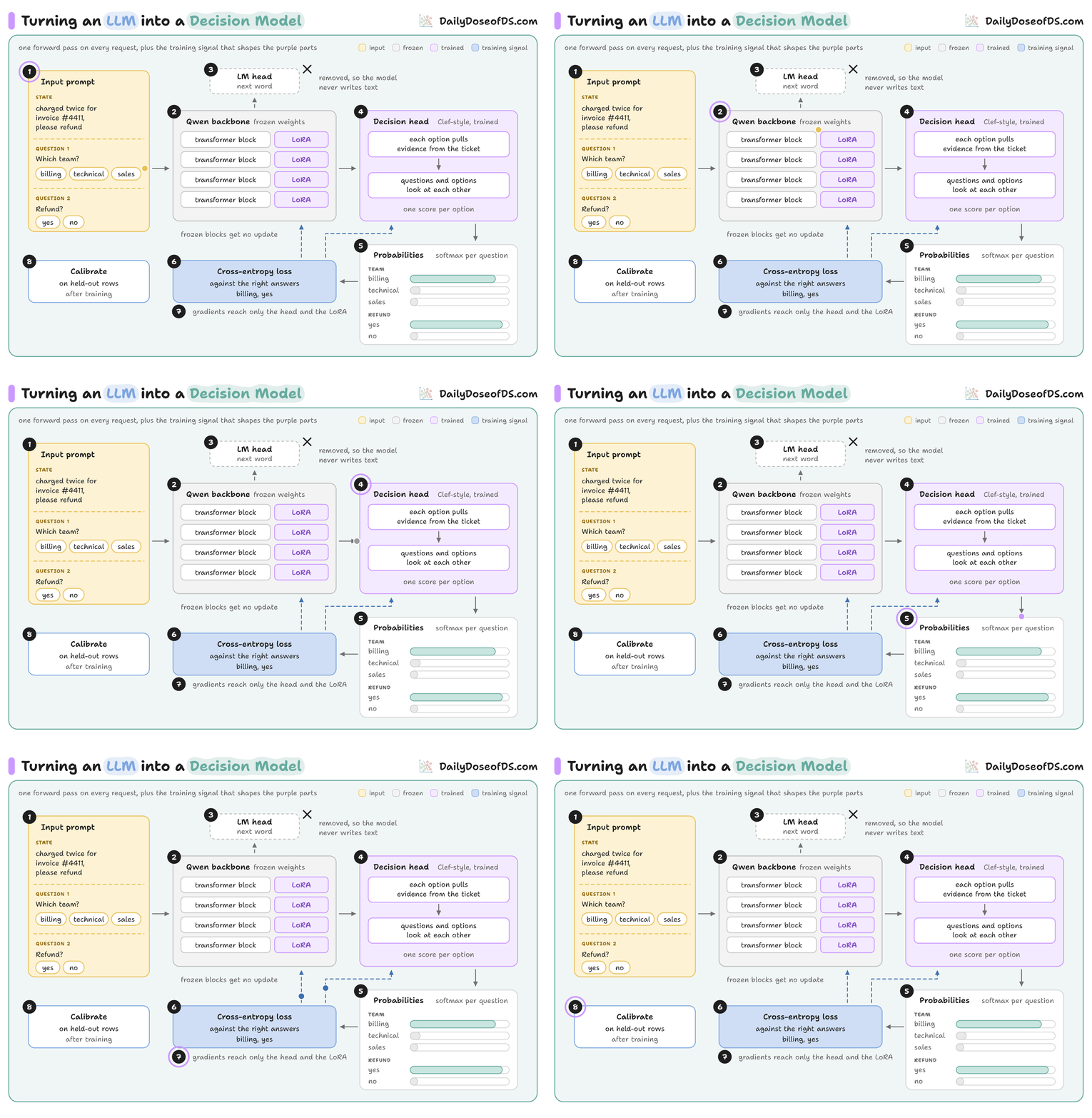
The agent was built as a weekly client follow-up tool that matches requests to GitHub issues, a task where the decision is picking one option from a short list. The stack pairs TrueForge as the agent harness, Jev for matching decisions, and Daytona as the sandbox for code execution. In testing on 40 requests, the agent achieved the same accuracy as letting Opus make every match, but at 150x lower decision cost. When Jev returned low-confidence matches, those went back to Opus for review, which caught 5 wrong matches that would otherwise have gone through.
The post also details how to train a JEV-style decision model locally. Using Qwen3.5 0.8B, accuracy went from 37% to 65% in 60 steps, with 10 minutes of training on 4GB of VRAM. TrueForge itself keeps context small by loading tool definitions only when needed and offloading large outputs to files. On DevRev's Enterprise Bench, it solved about as many tasks as Claude Managed Agents on roughly a third of the tokens, and it keeps credentials outside the sandbox while holding every write for approval. TrueForge is fully open source and runs with a single command.
Pick your industry and the AI tools you use, and get news related to your work every day.
Free · 30 seconds with Google · unsubscribe anytimeWhat is AIToday? →
Ask AI anything about this article. The AI reads this article, earlier AIToday articles, and Wikipedia, and cites its sources. Q&As are published on this page for other readers too.
Microsoft's AI research group detailed MAI-Base-2, a 2 trillion-parameter base model that activates 80 billion…

xAI released Grok Voice 3.0 on the 14th and opened it through the Grok Voice API at $0.08 per minute ($4.80 pe…

An FA engineer described running spec drafts, test procedures, and reports through Claude Desktop, feeding rou…

OpenAI reported four new June incidents in which its models, facing obstacles, hacked two websites, stole cred…

Itaú's ia.i, a text- and voice-activated assistant spanning accounts, credit, cards and insurance, reached abo…
Amazon introduced Bee Frontier, a wearable personal AI, for $74.99 in Onyx, Lavender and Sage, and Bee Eclipse…