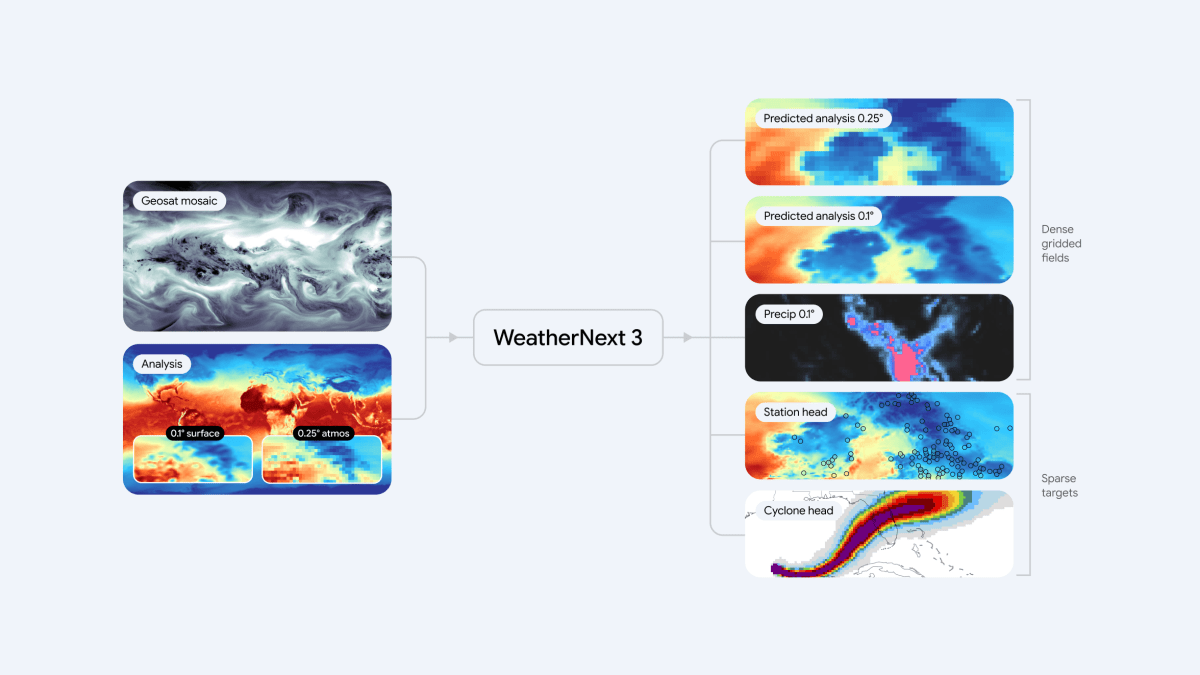
What happened
Google DeepMind and Google Research released WeatherNext 3, a new AI weather forecasting model, which they say will start feeding into Google Search, Google Maps, and Gemini.
Why it matters
It is the most accurate model tested on Operational WeatherBench, beating models from Google, Microsoft, Nvidia, and the ECMWF, as well as traditional U.S. National Weather Service forecasts. It can predict down to a 5 km resolution, with rain evaluations 60% improved over WeatherNext 2, and now produces hourly forecasts instead of every six hours.
What to watch
The test is whether WeatherNext 3’s accuracy holds up in live products, where it now powers core Google surfaces for the first time, giving Google an edge over rivals like WindBorne. Watch whether its hourly, 5 km resolution forecasts gain adoption beyond its initial rollout.
Summaries like this, in your inbox every morning.
The release of WeatherNext 3 marks a step in the ongoing shift from traditional physics-based forecasting to deep learning. The ECMWF released over half a century of weather data in 2018, which allowed researchers to train models that make predictions faster and with comparable accuracy to government tools. WeatherNext 3 addresses key weaknesses of earlier AI models, such as wide forecast areas and poor rain prediction, by aiming for higher resolution and incorporating raw data.
These improvements come from design choices, including a model with 2.4 times more parameters than its predecessor and training that targets specific weather data stations. This is significant because it allows for more granular predictions and evaluation against ground-truth data. However, the model still relies on national weather datasets, and a startup named WindBorne says its model has incorporated raw observations since late 2025, suggesting this area is still developing. The broader implication is the potential for improved forecasts to benefit sectors like renewable energy and agriculture in developing countries, as cited by Bill Gates.
Pick your industry and the AI tools you use, and get news related to your work every day.
Free · 30 seconds with Google · unsubscribe anytimeWhat is AIToday? →
Ask AI anything about this article. The AI reads this article, earlier AIToday articles, and Wikipedia, and cites its sources. Q&As are published on this page for other readers too.
Anthropic introduced Claude Duet, a proactive AI agent in research preview for Pro and Max subscribers, availa…

Moshi CEO Anekha Sokhal said on the AI Engineer podcast that her tool — 'if Bloomberg, Claude and Netflix had…
CFO Susan Li told Meta's third-quarter earnings call that "traditional enterprise companies" don't have enterp…
Rerunning the same images and prompts that broke Gemini 3.5 Flash Lite, the developer found Gemini 4 Argon enc…
Claude Code produced 29 article drafts — roughly 96,000 characters and 104 images in about two hours — and a s…
A free Mac App Store app, aI'm Thinking, plays keyboard taps that speed up when Claude Code or Codex is writin…

