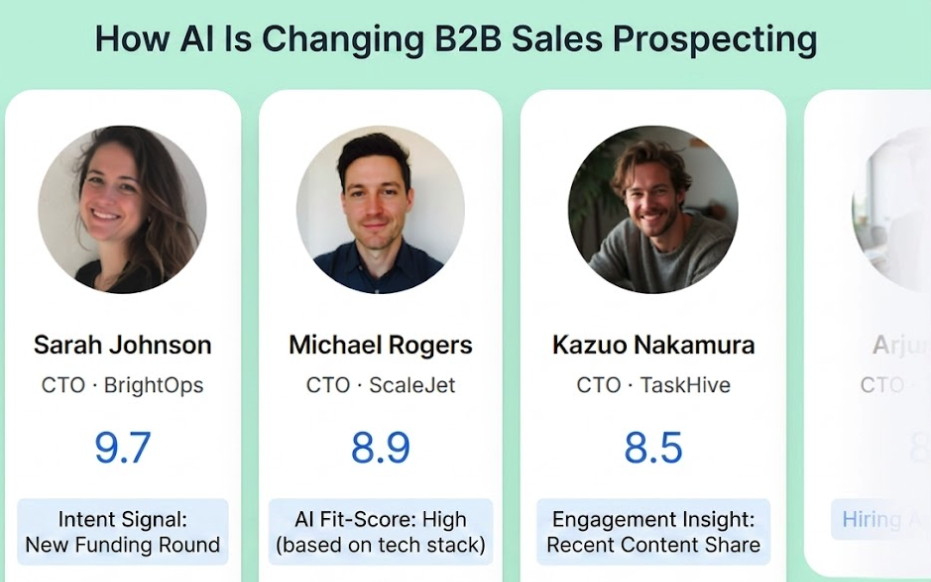
AI-powered B2B lead generators are replacing static contact databases with real-time intelligence that continuously monitors buyer signals and updates prospect information automatically.
Instead of relying on outdated lists and manual research, sales teams can now define an ideal customer profile and let AI systems identify matching prospects, enrich their data with business context, and support personalized outreach—freeing teams to focus on relationship building rather than administrative work.
What happened
AI-powered B2B lead generators are replacing traditional contact lists by providing real-time business signals, automatic data updates, and deeper buyer context. Platforms like Lev8 transform raw web data into actionable sales intelligence that continuously monitors buyer intent and keeps contact information current across target markets.
Why it matters
Sales teams historically wasted time on outdated contact information and low-quality prospects, hampering relationship building. AI tools now automate prospect research, enrich lead profiles with business context (company growth, new hires, market movements), and help teams focus on qualified decision-makers—reducing manual labor and improving response rates. This applies across sales, marketing, recruiting, and startup teams seeking efficient customer discovery.
What to watch
Modern AI workflows integrate prospect discovery, lead qualification, enrichment, and outreach automation into one process. Sales teams define an ideal buyer profile (industry, job role, company size, location), the AI system analyzes and enriches leads based on requirements, then teams launch personalized outreach campaigns rather than generic bulk messages.
B2B sales prospecting has historically relied on static contact lists and manual research to identify new customers. Salespeople would purchase or maintain large databases of contacts and spend considerable time searching across platforms to compile prospect information. However, as business conditions change faster than ever—companies hire new employees, market conditions shift, buying needs evolve—these databases quickly become outdated and less valuable for sales teams.
The article identifies specific problems with traditional approaches: outdated contact information, low response rates, and excessive time spent searching for potential buyers rather than building relationships. Traditional lead lists provide basic information but lack real-time updates and deeper business context. This disconnect between static data and dynamic business reality creates an opening for AI-powered solutions.
AI-powered B2B lead generators work differently. Instead of relying on purchased lists, they function as "dynamic intelligence engines" that transform raw web data into actionable sales signals. These platforms continuously monitor buyer intent and automatically update contact lists across a company's target market. They analyze multiple business signals—industry, company size, roles, and market activity—to help sales teams focus on prospects that closely match their ideal customer profile. Importantly, they monitor ongoing changes such as company growth, new hires, or market movements, allowing teams to adjust targeting strategies and discover new opportunities faster. The automation extends to lead research itself: instead of hours spent collecting information across platforms, AI tools gather and organize useful information automatically.
A typical workflow using a platform like Lev8 unfolds in three stages. First, a business defines its ideal buyer profile by specifying details such as industry, job role, company size, or location. The AI system then identifies matching prospects from current business data. Second, the AI analyzes and enriches each potential lead based on those requirements, organizing profiles, improving data accuracy, and providing additional business details to help sales teams determine which prospects are worth contacting. Third, once the best prospects are selected, sales teams launch personalized outreach campaigns—not generic messages to large lists, but targeted campaigns based on real prospect information, improving chances of generating genuine conversations. The article emphasizes that modern AI solutions support the entire workflow: not only prospect discovery but also lead qualification, enrichment, and outreach automation, creating a smoother end-to-end process.
The benefits extend across multiple teams. Sales teams use these tools to identify qualified prospects and relevant decision-makers, reducing time spent searching through outdated lists. Marketing teams leverage them to better understand target audiences, build accurate customer lists, and create personalized campaigns based on real business information and market signals. Recruiting teams use the same search capabilities to discover potential candidates and identify professionals with specific skills. Startups and business owners find particular value, as they can discover new customers, research markets, and build sales pipelines without needing large dedicated sales or research teams. The underlying premise is that competition is intensifying, and businesses need better ways to identify the right decision-makers and opportunities—AI-powered solutions help teams streamline prospect discovery, improve outreach effectiveness, and build stronger sales pipelines.
The shift from static lead lists to AI-powered intelligence reflects a fundamental change in how B2B sales operate. Traditionally, salespeople relied on purchased contact databases and manual research—time-consuming work that yielded outdated information as soon as it was compiled. The body identifies a core problem: company needs, employees, and buying signals change rapidly, making old data stale before teams can act on it. This gap between static data and dynamic business reality is what AI-powered platforms address.
The article positions AI lead generators as solving three interconnected challenges. First, they automate the tedious research work that once consumed hours per prospect, freeing sales teams to focus on actual engagement and relationship building. Second, they provide continuous real-time monitoring of buyer signals—monitoring changes like new hires, company growth, and market movements—so prospects remain relevant and current. Third, they enrich raw contact data with business context (industry classification, company size, role mapping), helping sales teams qualify leads before outreach rather than after. The workflow described—define buyer profile, analyze and enrich leads, then launch personalized campaigns—suggests that AI doesn't replace salespeople but amplifies their effectiveness by handling discovery and qualification at scale. This model applies across sales, marketing, recruiting, and startup teams, making it relevant to multiple buyer personas within a company.
AI-summarized, only the topics you pick — one digest a day via Email, Slack, or Discord.
Free · takes 30 seconds · unsubscribe anytime
Ask AI anything about this article. Q&As are published on this page for other readers too.
QumulusAI announced a GPU-as-a-Service agreement with DRW, a global trading firm, to supply a dedicated NVIDIA…

OpenAI introduced Premium Seats for ChatGPT Business, priced at $125 per user per month ($100 with annual bill…

Anthropic pledged to embed machine-readable watermarks in Claude-generated text and digitally signed provenanc…

OpenAI announced that its unreleased model Astra had produced solutions to 10 long-standing mathematics proble…

Anthropic confirmed it will add watermarks to text generated by Claude and other models to comply with the EU…

Tech companies are raising unprecedented sums for AI infrastructure—$194 billion so far in 2026 by just four f…

The AI news that matters, in one minute each morning.
Sign up free