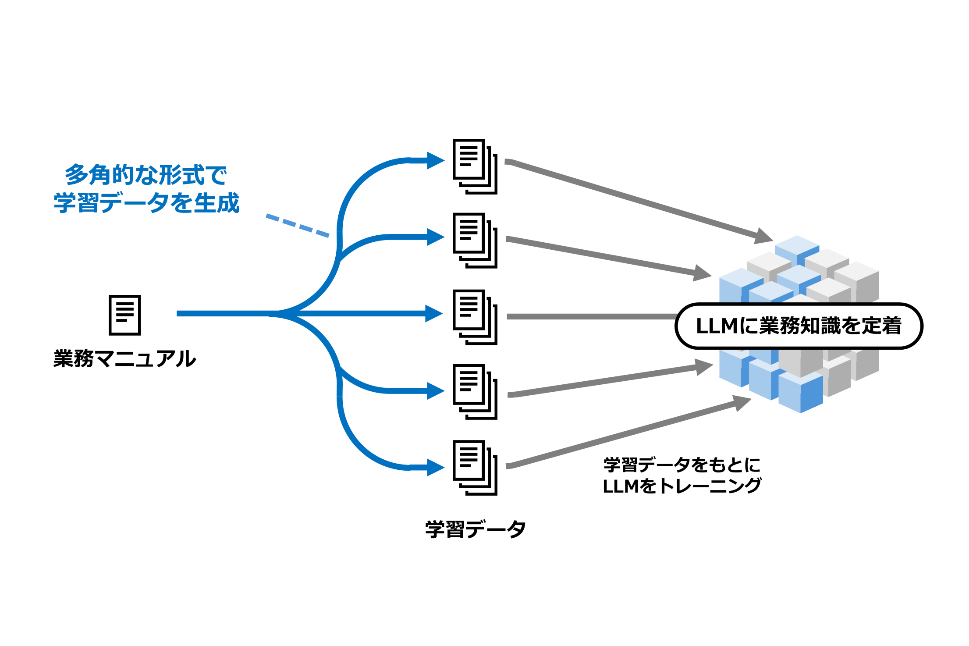
What happened
NTT said its technique has the LLM generate FAQ, table and dialogue-format training material from a few internal manuals; on tsuzumi 2 it scored 83.1%, about 10 points above prior methods.
Why it matters
Because the model builds varied study material from the same small source, NTT says deep knowledge can be fixed without the vast datasets prior tuning needed — an approach it also confirmed on Llama 3.
What to watch
The results will be shown at NTT R&D FORUM 2026, running Nov 18–25.
WHO IT HITSEnterprise teams that hold only a modest set of internal manuals — in medical, financial and manufacturing settings with strict local rules and jargon — may be able to specialize a model without assembling tens of gigabytes of training data.
Summaries like this, every morning.
NTT frames the problem as one of scale: conventional tuning to instill company-specific knowledge is said to demand tens of gigabytes of data, while an individual firm's working documents amount to about 1,000 PDFs of up to roughly 100 pages — far too little for standard training. Simply repeating that material, NTT says, overfits the model to specific wording and article numbers, so it cannot answer questions phrased differently, and pulling in similar material from the open web tends to introduce noise.
The technique borrows from how people study: instead of rereading one text, the model acts as a material writer, producing FAQ, table and dialogue-format data that anticipate how the knowledge would be used on the job. NTT says tsuzumi itself drives this generation engine, expanding a small seed set into billions to tens of billions of tokens of training data. In its benchmark, prior paraphrase-based methods such as FinePhrase reached at most 73.3%, against 83.1% for the new technique, and NTT reports no loss of general-domain capability from injecting the specialized knowledge.
NTT positions the method alongside retrieval-augmented generation rather than as a replacement: RAG is recommended where absolute accuracy comes first, while fixing knowledge in the model suits high-speed processing such as real-time analysis of call-center audio, where external retrieval adds latency and GPU cost. NTT says it plans to fold the technique into group solutions and is considering a managed service that runs tuning in its data centers and returns a customized model. At NTT R&D FORUM 2026 it will also present a "self-evolving tsuzumi" concept in which the model autonomously builds and updates a knowledge graph from daily documents and retrains itself — a step toward recursive self-improvement adapted to Japanese corporate data environments, in NTT's framing.
Pick your industry and the AI tools you use, and get news related to your work every day.
Free · 30 seconds with Google · unsubscribe anytimeWhat is AIToday? →
Ask AI anything about this article. The AI reads this article, earlier AIToday articles, and Wikipedia, and cites its sources. Q&As are published on this page for other readers too.
Notion Labs said on November 9 that unauthorized access to contractor Fireworks.ai may have exposed chat recor…
Google introduced the Gemini Decisions API backed by Gemini Decision 1, which handles closed-set decisions suc…
A test paired the self-hosted RustXNG meta-search engine with Gemini Decision 1, a judgment-only model Google…

A Zenn writer who opted out of model training on claude.ai found Claude Code drafting a "Bug report drafted" r…
A developer running FLYSTAR pointed the code's base_url at one OpenAI-compatible endpoint and could call GPT-5…
A writer who can't read code had Claude Code run hourly check-ins at :17 and :47 and :08 and :38, but the rese…