What happened
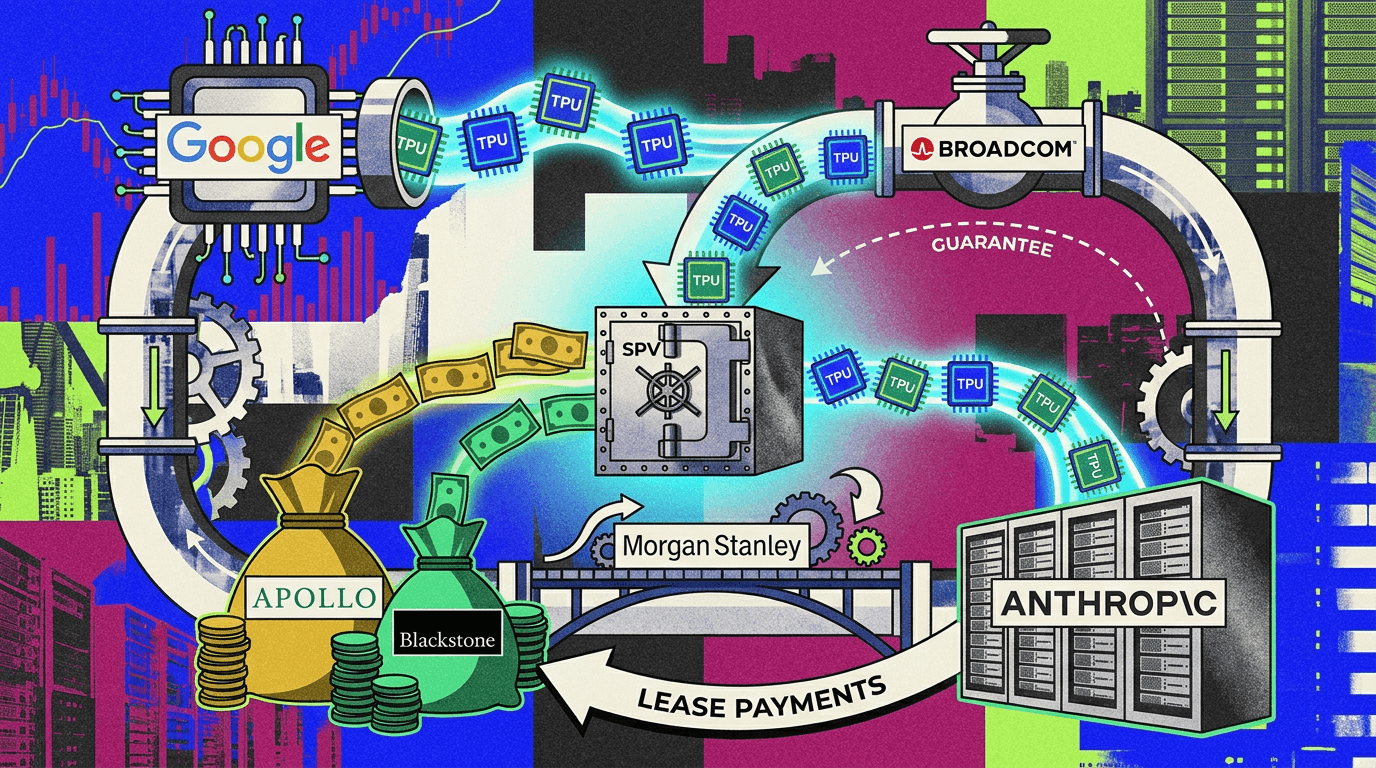
Google has partnered with Broadcom, Apollo, Blackstone, Morgan Stanley, and crypto mining companies to finance AI chip sales to Anthropic through complex financial structures. A special purpose vehicle called Compute SPV bought about one gigawatt of TPU hardware for $35 billion in June, and Broadcom has committed to $128 billion in Google TPU purchases through 2028. Google is also backing ten crypto mining projects with 2.4 gigawatts of combined capacity to provide power and data centers for the chips.
Why it matters
Anthropic cannot buy chips itself due to lack of a credit rating, and all parties involved want to keep the hardware off their own balance sheets. By using financing vehicles and investor capital, Google records only $815 million in liability while potentially facing up to $44 billion in obligations if leases default. The arrangement is already creating a cost advantage—data center projects backed by Google borrow at a median rate of 7.1 percent versus 9.3 percent for competitors using Nvidia chips, according to Jefferies analysts.
What to watch
The entire structure depends on $200 billion in contracts and Anthropic continuing to make lease payments. Anthropic has committed to spending about $200 billion on Google Cloud over five years, which accounts for more than 40 percent of Google's committed future cloud revenue. Both Anthropic and OpenAI together account for roughly half of the $2 trillion in cloud backlogs at Amazon, Microsoft, Google, and Oracle, and both are counting on revenue growing 20 to 30 times by 2029.
Summaries like this, in your inbox every morning.
Google's move addresses a fundamental problem: Anthropic needs enormous quantities of AI hardware but lacks the financial standing to purchase or finance it alone, and neither Google nor its supply-chain partners want to tie up capital or balance-sheet space on long-term commitments. By creating special financing vehicles funded by private equity firms Apollo and Blackstone, and by partnering with crypto miners already positioned to access large power supplies, Google has engineered a structure that keeps the hardware off everyone's books while maintaining control of the relationship. The arrangement also unlocks a financial advantage—borrowing costs for Google-backed infrastructure are materially lower than for competitors using Nvidia chips, creating what Jefferies analysts describe as a structural cost disadvantage for Nvidia's ecosystem. However, the system carries substantial hidden risk: $200 billion in contracts hinge on Anthropic's ability to sustain extraordinary growth (20 to 30 times revenue by 2029), and Google sits simultaneously as investor, supplier, and cloud provider to the same customer, concentrating exposure across multiple dimensions.
Pick your industry and the AI tools you use, and get news related to your work every day.
Free · 30 seconds with Google · unsubscribe anytimeWhat is AIToday? →
Ask AI anything about this article. The AI reads this article, earlier AIToday articles, and Wikipedia, and cites its sources. Q&As are published on this page for other readers too.
The Motley Fool argues Amazon is the AI company of the two, since AWS was just 21% of first-half 2026 revenue…

Hewlett Packard Enterprise stock is down 5% at $55.87
Vercel data published Thursday shows TypeSafe AI's Jev, a lightweight decision model for choosing among predet…
Chunghwa Telecom president Rong-shy Lin said the shift from conversational AI to autonomous AI agents is resha…
CoreWeave fell 5% in premarket trading Friday and was on track to finish the week down 15%, after rebounding f…
Apple and Meta said they would jointly release a new open-weight AI model designed to run on high-end Macs, ai…